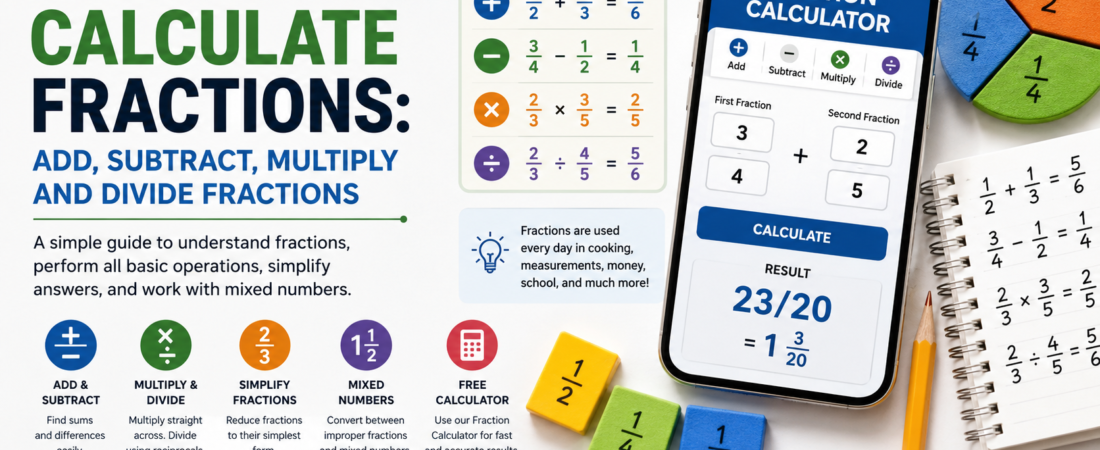
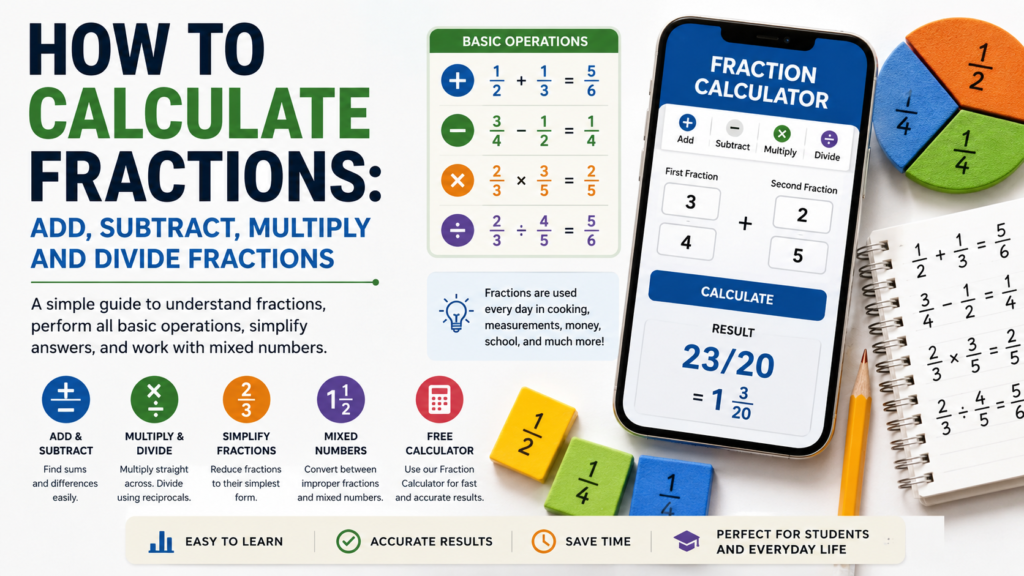
The Fraction Calculator helps you quickly add, subtract, multiply, and divide fractions while providing accurate results for everyday math problems.
Fractions are used in everyday life for measurements, cooking, money, construction, schoolwork, and many other calculations.
Although simple fractions can be calculated mentally, operations involving different denominators can quickly become confusing.
In this guide, you’ll learn what fractions are, how to add, subtract, multiply, and divide them, and how to simplify your final answer.
What Is a Fraction?
A fraction represents part of a whole.
A fraction normally contains two numbers:
Numerator — the number above the fraction line.
Denominator — the number below the fraction line.
For example:
3/4
In this fraction, 3 is the numerator and 4 is the denominator.
The fraction 3/4 means three out of four equal parts.
Types of Fractions
Fractions can appear in several forms.
Proper Fractions
A proper fraction has a numerator smaller than its denominator.
Example:
3/5
Its value is less than 1.
Improper Fractions
An improper fraction has a numerator equal to or greater than its denominator.
Example:
7/4
Its value is equal to or greater than 1.
Mixed Numbers
A mixed number contains a whole number and a fraction.
Example:
1 3/4
Mixed numbers can be converted into improper fractions before performing calculations.
How to Add Fractions
When fractions have the same denominator, simply add the numerators.
For example:
2/7 + 3/7 = 5/7
The denominator remains 7.
If the denominators are different, first find a common denominator.
For example:
1/2 + 1/3
The least common denominator of 2 and 3 is 6.
Convert the fractions:
1/2 = 3/6
1/3 = 2/6
Now add:
3/6 + 2/6 = 5/6
Therefore:
1/2 + 1/3 = 5/6
How to Subtract Fractions
Subtracting fractions follows a similar process.
If the denominators are the same, subtract the numerators.
For example:
5/8 − 2/8 = 3/8
If the denominators are different, find a common denominator first.
For example:
3/4 − 1/2
Convert 1/2 to fourths:
1/2 = 2/4
Then:
3/4 − 2/4 = 1/4
How to Multiply Fractions
Multiplying fractions is usually simpler because you do not need a common denominator.
Multiply the numerators together and then multiply the denominators together.
For example:
2/3 × 4/5
Multiply the numerators:
2 × 4 = 8
Multiply the denominators:
3 × 5 = 15
Therefore:
2/3 × 4/5 = 8/15
How to Divide Fractions
To divide fractions, multiply the first fraction by the reciprocal of the second fraction.
For example:
2/3 ÷ 4/5
The reciprocal of 4/5 is 5/4.
Therefore:
2/3 × 5/4 = 10/12
Simplify the result:
10/12 = 5/6
So:
2/3 ÷ 4/5 = 5/6
How to Simplify Fractions
A fraction is simplified when the numerator and denominator have no common factor greater than 1.
For example:
8/12
Both 8 and 12 can be divided by 4.
8 ÷ 4 = 2
12 ÷ 4 = 3
Therefore:
8/12 = 2/3
The fraction 2/3 is the simplified result.
How to Convert an Improper Fraction to a Mixed Number
An improper fraction can be converted into a mixed number by dividing the numerator by the denominator.
For example:
7/4
Divide 7 by 4.
The result is 1 with a remainder of 3.
Therefore:
7/4 = 1 3/4
Example Fraction Calculation
Suppose you want to calculate:
3/4 + 2/5
First find a common denominator.
The least common denominator of 4 and 5 is 20.
Convert both fractions:
3/4 = 15/20
2/5 = 8/20
Now add them:
15/20 + 8/20 = 23/20
The result can also be written as:
1 3/20
Therefore:
3/4 + 2/5 = 23/20 = 1 3/20
Use Our Free Fraction Calculator
Doing fraction calculations manually can take several steps, especially when the fractions have different denominators.
You can use the free Fraction Calculator on LivingToolsGuide to perform fraction calculations quickly.
Enter the fractions, select the mathematical operation, and let the calculator determine the result.
It can help you check manual calculations and save time when working with fractions.
Where Are Fractions Used in Everyday Life?
For more information about fractions and their mathematical properties, see the Fraction reference from Wolfram MathWorld.
Fractions appear in many everyday situations.
Common examples include cooking recipes, measuring ingredients, construction measurements, dividing quantities, calculating portions, and school mathematics.
Understanding fractions can therefore be useful well beyond the classroom.
Frequently Asked Questions
What is the numerator of a fraction?
The numerator is the top number in a fraction. It represents how many parts are being considered.
What is the denominator of a fraction?
The denominator is the bottom number. It represents the total number of equal parts in the whole.
Do fractions need the same denominator when adding them?
Yes. Fractions must have a common denominator before their numerators can be added or subtracted.
Do fractions need the same denominator when multiplying?
No. Multiply the numerators together and multiply the denominators together.
How do you divide two fractions?
Keep the first fraction, change division to multiplication, and multiply by the reciprocal of the second fraction.
Should fractions always be simplified?
When possible, fractions are usually presented in their simplest form because this makes them easier to understand and compare.
Final Thoughts
Fractions become much easier to work with once you understand the basic rules.
Addition and subtraction usually require a common denominator, while multiplication involves multiplying straight across. Division can be handled by multiplying by the reciprocal of the second fraction.
For more complicated calculations, a Fraction Calculator can perform the arithmetic quickly and help you verify your answer.
The Fraction Calculator makes it easy to check fraction calculations quickly and accurately when adding, subtracting, multiplying, or dividing fractions.