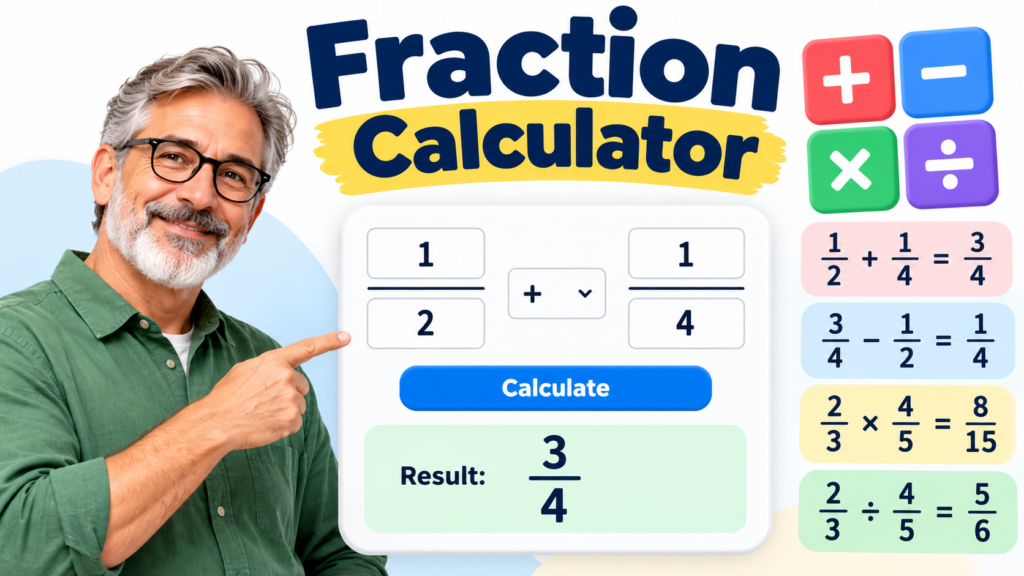
Add, subtract, multiply, or divide two fractions and get the simplified result, decimal value, and mixed number.
/
/
Simplified result
—
First fraction—
Second fraction—
Operation—
Decimal result—
Mixed number—
Unsimplified result—
How this calculator works
Enter the numerator and denominator for each fraction, choose an operation, and click Calculate Fraction.
The result is automatically simplified.
Example: 1/2 + 1/3 = 5/6.
➗
Fraction Calculator
Add, subtract, multiply or divide two fractions and see the simplified fraction and decimal result.
Fraction 1
Fraction 2
Simplified Result
--
Original result--
Simplified fraction--
Decimal result--
Operation--
How this calculator works
Enter two fractions, choose an operation, and the calculator will calculate
the result and reduce it to its simplest form.
Fraction Calculator helps you add, subtract, multiply, and divide fractions quickly and accurately. Enter the numerator and denominator for each fraction, choose the operation, and calculate the result instantly.
For example, if you want to add 1/2 + 1/4, the result is 3/4. You can also use the calculator for subtraction, multiplication, and division, making everyday fraction calculations much easier.
How to Calculate Fractions
Fractions represent parts of a whole. A fraction contains two numbers: the numerator at the top and the denominator at the bottom.
For example:
3/4
Here, 3 is the numerator and 4 is the denominator. This means three out of four equal parts.
Different mathematical operations require different methods when working with fractions.
How to Add Fractions
When two fractions have the same denominator, simply add the numerators and keep the denominator unchanged.
For example:
2/7 + 3/7 = 5/7
When the denominators are different, first find a common denominator.
For example:
1/2 + 1/4
Convert 1/2 to 2/4:
2/4 + 1/4 = 3/4
Therefore, the answer is 3/4.
How to Subtract Fractions
Fraction subtraction follows a similar process.
If the denominators are the same:
5/8 − 2/8 = 3/8
For different denominators, convert the fractions so they have a common denominator before subtracting the numerators.
For example:
3/4 − 1/2
Convert 1/2 to 2/4:
3/4 − 2/4 = 1/4
How to Multiply Fractions
Multiplication is usually simpler because you do not need to find a common denominator.
Multiply the numerators together and then multiply the denominators.
For example:
2/3 × 4/5 = 8/15
The result can then be simplified if the numerator and denominator have a common factor.
How to Divide Fractions
To divide fractions, multiply the first fraction by the reciprocal of the second fraction.
For example:
2/3 ÷ 4/5
Turn 4/5 upside down to get 5/4:
2/3 × 5/4 = 10/12
Simplify the result:
10/12 = 5/6
Therefore, the answer is 5/6.
Simplifying Fractions
A fraction is usually simplified by dividing both the numerator and denominator by their greatest common factor.
For example:
12/18
Both numbers can be divided by 6:
12 ÷ 6 = 2 18 ÷ 6 = 3
Therefore:
12/18 = 2/3
Simplifying makes the final result easier to understand and compare.
Why Fraction Calculations Are Useful
Fractions appear frequently in everyday life. They are commonly used when working with recipes, measurements, construction projects, school mathematics, distances, quantities, and proportions.
For example, a recipe might require 3/4 cup of an ingredient, while a home improvement project might require measurements such as 1/2 inch or 5/8 inch.
Understanding how fractions work can make these calculations easier.
Our Fraction Calculator makes it easier to check fraction operations and get quick results for everyday calculations.
Tips for Working With Fractions
Before calculating, check that the numerator and denominator have been entered correctly.
Remember that a denominator cannot be zero because division by zero is undefined.
When adding or subtracting fractions, use a common denominator. When multiplying, multiply the numerators and denominators directly. When dividing, use the reciprocal of the second fraction.
Always simplify the final result when possible.
Use the Fraction Calculator whenever you need a quick way to solve and verify fraction problems.
Frequently Asked Questions
What is a numerator?
The numerator is the number above the fraction line. It represents how many parts are being considered.
What is a denominator?
The denominator is the number below the fraction line. It represents the total number of equal parts.
Can fractions have different denominators?
Yes. Fractions can have different denominators. For addition or subtraction, however, they must first be converted to equivalent fractions with a common denominator.
Can a fraction be greater than one?
Yes. When the numerator is greater than the denominator, the value of the fraction is greater than one. For example, 5/4 = 1.25.
Why should fractions be simplified?
Simplification expresses a fraction in its lowest terms without changing its value. For example, 6/8 can be simplified to 3/4.
Need to simplify fractions? Try our GCD Calculator to quickly find the greatest common divisor of two numbers.
Final Thoughts
Working with fractions becomes much easier once you understand the basic rules for addition, subtraction, multiplication, and division. Enter the required values carefully, select the correct operation, and check the result.
A Fraction Calculator can save time and reduce mistakes when solving fraction problems for school, work, measurements, recipes, and everyday calculations.
To learn more about adding, subtracting, multiplying, and dividing fractions, visit the Khan Academy Fractions Guide.