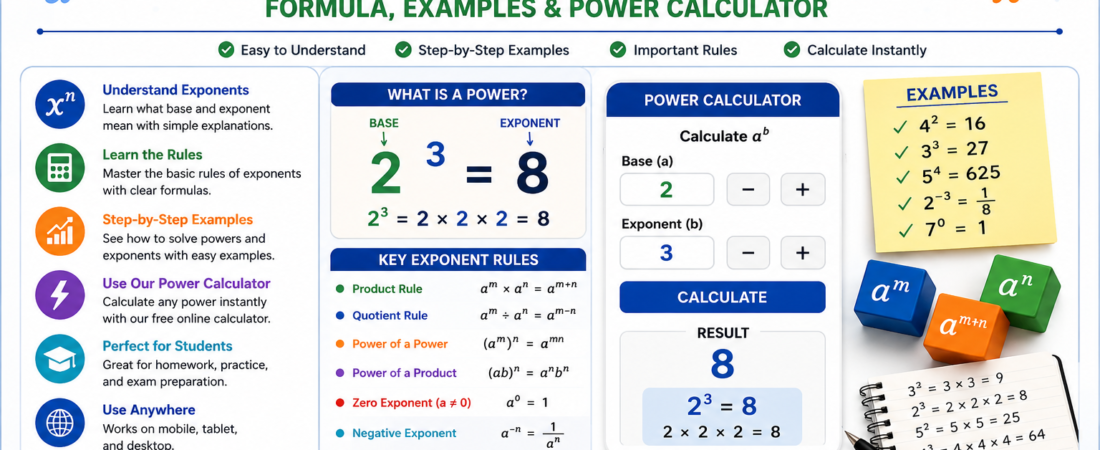
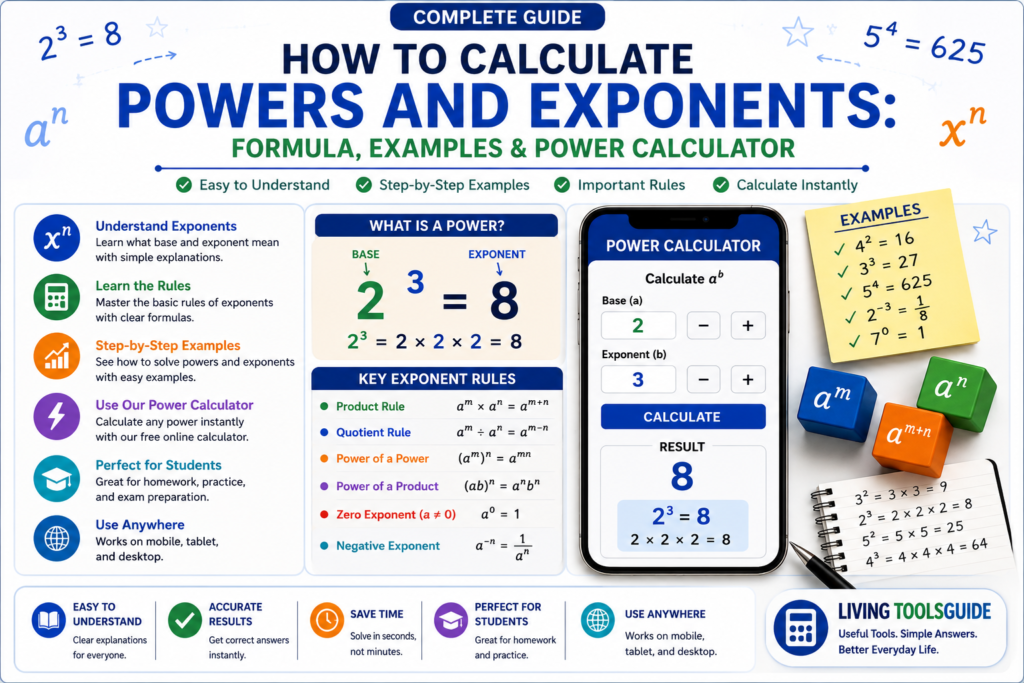
The Power Calculator helps you quickly calculate powers and exponents by entering a base number and an exponent.
Powers and exponents provide a simple way to represent repeated multiplication. They are widely used in mathematics, science, engineering, finance, computing, and everyday calculations.
Instead of writing the same number multiplied by itself several times, an exponent lets you express the calculation in a much shorter form.
In this guide, you’ll learn what powers and exponents mean, how to calculate them, the basic exponent rules, and how to use a Power Calculator for quick results.
What Are Powers and Exponents?
A power consists of two main parts: a base and an exponent.
For more information about exponent rules and powers, see the Exponent Laws reference from Wolfram MathWorld.
For example:
2³ = 8
Here:
2 is the base.
3 is the exponent.
The exponent tells you how many times the base is used as a factor.
Therefore:
2³ = 2 × 2 × 2 = 8
The entire expression 2³ can be described as a power.
What Is the Base?
The base is the number being multiplied repeatedly.
For example:
5³
The base is 5.
This means:
5 × 5 × 5 = 125
Therefore:
5³ = 125
What Is an Exponent?
The exponent is the small number written above and to the right of the base.
It tells you how many times the base appears as a factor.
For example:
4²
The exponent is 2, so:
4² = 4 × 4 = 16
An exponent of 2 is commonly called squared.
Therefore, 4² can be read as “four squared.”
How to Calculate a Power
To calculate a power manually, multiply the base by itself the number of times indicated by the exponent.
For example:
3⁴
The base is 3 and the exponent is 4.
Therefore:
3⁴ = 3 × 3 × 3 × 3
Calculate step by step:
3 × 3 = 9
9 × 3 = 27
27 × 3 = 81
Therefore:
3⁴ = 81
What Does Squared Mean?
When a number has an exponent of 2, it is said to be squared.
For example:
6² = 6 × 6 = 36
Squared numbers are commonly used when calculating areas.
For example, the area of a square with sides measuring 6 units is:
6² = 36 square units
What Does Cubed Mean?
When a number has an exponent of 3, it is said to be cubed.
For example:
4³ = 4 × 4 × 4 = 64
Cubed numbers frequently appear in volume calculations.
For example, a cube with sides measuring 4 units has a volume of:
4³ = 64 cubic units
What Is a Zero Exponent?
For any nonzero number, raising it to the power of zero gives:
a⁰ = 1
For example:
5⁰ = 1
100⁰ = 1
This is one of the basic rules of exponents.
The expression 0⁰ is a special case and should not simply be treated as an ordinary application of this rule.
What Is a Negative Exponent?
A negative exponent represents the reciprocal of the corresponding positive power.
The general rule is:
a⁻ⁿ = 1 / aⁿ
For example:
2⁻³ = 1 / 2³
Since:
2³ = 8
Then:
2⁻³ = 1/8 = 0.125
Basic Rules of Exponents
Exponent rules make it easier to simplify calculations involving powers.
Multiplying Powers With the Same Base
When multiplying powers with the same base, add the exponents.
aᵐ × aⁿ = aᵐ⁺ⁿ
Example:
2³ × 2² = 2⁵ = 32
Dividing Powers With the Same Base
When dividing powers with the same nonzero base, subtract the exponents.
aᵐ ÷ aⁿ = aᵐ⁻ⁿ
Example:
5⁴ ÷ 5² = 5² = 25
Power of a Power
When raising one power to another power, multiply the exponents.
(aᵐ)ⁿ = aᵐⁿ
Example:
(2³)² = 2⁶ = 64
Power of a Product
When a product is raised to a power, the exponent can be applied to each factor.
(ab)ⁿ = aⁿbⁿ
Example:
(2 × 3)² = 2² × 3²
= 4 × 9
= 36
Example Power Calculation
Suppose you want to calculate:
5⁴
This means:
5 × 5 × 5 × 5
Calculate step by step:
5 × 5 = 25
25 × 5 = 125
125 × 5 = 625
Therefore:
5⁴ = 625
Use Our Free Power Calculator
Calculating small powers manually is straightforward, but calculations involving large exponents can become time-consuming.
You can use the free Power Calculator on LivingToolsGuide to calculate powers quickly.
Enter the base and exponent, and the calculator will determine the result automatically.
It can be useful for checking homework, mathematical calculations, scientific problems, and everyday calculations involving exponents.
Where Are Powers and Exponents Used?
Powers and exponents appear in many areas of mathematics and everyday calculations.
Common examples include:
Area and volume calculations.
Scientific notation.
Compound growth calculations.
Computer science.
Engineering calculations.
Physics and chemistry.
Large and very small numbers.
Understanding exponents therefore provides a useful foundation for many other mathematical concepts.
Frequently Asked Questions
What is the difference between a base and an exponent?
The base is the number being repeatedly multiplied. The exponent indicates how many times the base is used as a factor.
What does 2³ mean?
It means:
2 × 2 × 2 = 8
Therefore, 2³ = 8.
What is any nonzero number raised to the power of zero?
Any nonzero number raised to the power of zero equals 1.
For example:
7⁰ = 1
What does a negative exponent mean?
A negative exponent represents the reciprocal of the corresponding positive power.
For example:
2⁻² = 1/2² = 1/4
Is squared the same as power 2?
Yes. A number raised to the second power is commonly described as being squared.
Is cubed the same as power 3?
Yes. A number raised to the third power is commonly described as being cubed.
Final Thoughts
Powers and exponents make repeated multiplication much easier to represent and calculate.
The base is the number being multiplied, while the exponent tells you how many times that number is used as a factor.
Understanding rules for zero exponents, negative exponents, multiplication, division, and powers of powers can make more advanced calculations much easier.
For quick calculations, a Power Calculator can determine the result automatically and help you verify your manual calculations.