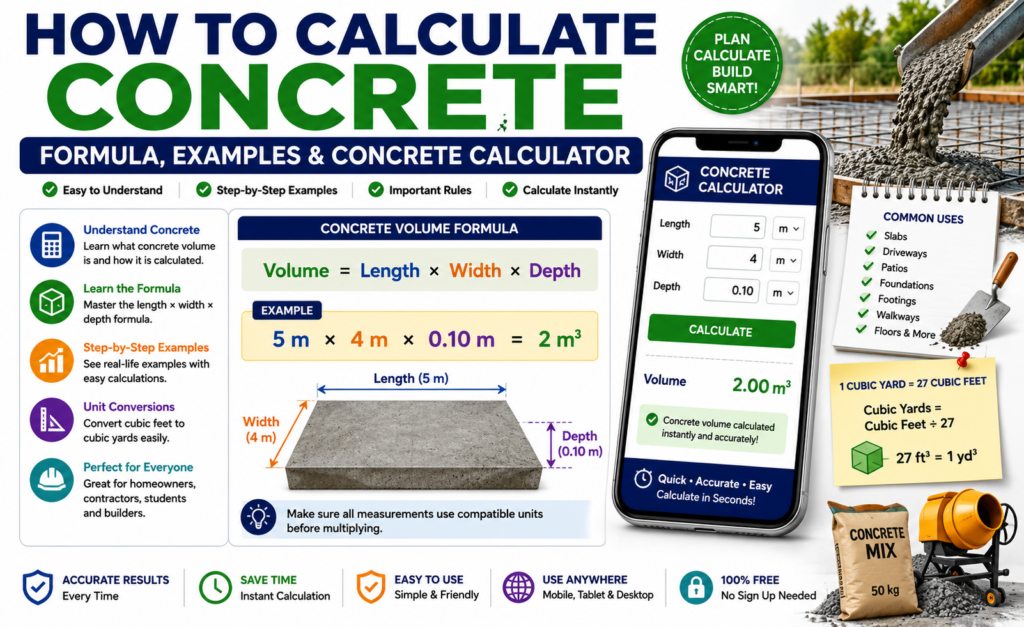
The Concrete Calculator helps you quickly estimate how much concrete you need for slabs, footings, columns, and other construction projects.
Concrete is commonly used for slabs, driveways, patios, foundations, footings, paths, and many other construction projects. Before ordering or mixing concrete, it is important to estimate how much material your project requires.
Calculating concrete volume is straightforward when you know the length, width, and depth of the area. A good estimate can help you plan your project, reduce unnecessary waste, and avoid running short of concrete during the job.
What Is Concrete Volume?
Concrete volume is the amount of three-dimensional space that concrete will occupy.
For a rectangular slab, you normally need three measurements:
Length × Width × Depth
The result represents the volume of concrete required.
Depending on your measurements, concrete volume may be expressed in cubic meters, cubic feet, or cubic yards.
Concrete Volume Formula
For a rectangular area, use:
Concrete Volume = Length × Width × Depth
For example, suppose a slab measures:
Length = 5 m
Width = 4 m
Depth = 0.10 m
The calculation is:
5 × 4 × 0.10 = 2 m³
Therefore, the slab requires approximately:
2 cubic meters of concrete
For more information about concrete construction and recommended practices, see the Concrete Resources from the Portland Cement Association.
How to Calculate Concrete Step by Step
Follow these basic steps when estimating concrete for a rectangular slab.
Step 1: Measure the Length
Measure the total length of the area that will contain the concrete.
For example:
Length = 6 meters
Step 2: Measure the Width
Measure the width of the area.
For example:
Width = 3 meters
Step 3: Measure the Depth
Determine the required concrete thickness or depth.
Suppose the slab will be:
100 mm thick
Convert millimeters to meters:
100 mm = 0.10 m
Step 4: Multiply the Measurements
Now multiply:
6 × 3 × 0.10 = 1.8
Therefore:
Concrete Volume = 1.8 m³
Why All Measurements Must Use Compatible Units
Before multiplying your measurements, make sure they use compatible units.
For example, you should not directly multiply:
5 meters × 4 meters × 100 millimeters
Instead, convert 100 mm to meters:
100 mm = 0.10 m
Then calculate:
5 m × 4 m × 0.10 m = 2 m³
Using consistent units helps prevent major calculation errors.
How to Calculate Concrete in Cubic Feet
If your measurements are in feet, use the same basic formula:
Cubic Feet = Length (ft) × Width (ft) × Depth (ft)
For example:
10 ft × 8 ft × 0.5 ft = 40 ft³
Therefore, the required volume is:
40 cubic feet
How to Convert Cubic Feet to Cubic Yards
Concrete is often sold by the cubic yard in the United States.
There are:
27 cubic feet in 1 cubic yard
Therefore:
Cubic Yards = Cubic Feet ÷ 27
For example:
81 ft³ ÷ 27 = 3 yd³
So 81 cubic feet equals:
3 cubic yards
Example Concrete Calculation
Suppose you want to build a rectangular patio measuring:
Length = 8 m
Width = 4 m
Depth = 0.12 m
Use the formula:
Volume = Length × Width × Depth
Calculate:
8 × 4 × 0.12 = 3.84 m³
The estimated concrete volume is:
3.84 cubic meters
Should You Order Extra Concrete?
The calculated volume represents the theoretical amount required based on your measurements.
Real construction projects may require some additional concrete because of factors such as uneven excavation, variations in dimensions, spillage, and other site conditions.
If you plan to add an allowance for waste or unexpected requirements, base it on the needs of your particular project rather than assuming the calculated volume will always be exact.
Use Our Free Concrete Calculator
You can use the free Concrete Calculator on LivingToolsGuide to estimate concrete volume quickly.
Enter the required measurements into the calculator and calculate the estimated amount of concrete for your project.
A calculator is especially helpful when you need to work with different measurements or unit conversions.
Where Is a Concrete Calculator Useful?
A Concrete Calculator can help when planning:
- Concrete slabs
- Driveways
- Patios
- Walkways
- Foundations
- Footings
- Floors
- Garden structures
- Small construction projects
It can also help you compare different dimensions before purchasing or ordering materials.
Frequently Asked Questions
What is the basic formula for concrete volume?
For a rectangular area:
Volume = Length × Width × Depth
Make sure the measurements use compatible units before multiplying them.
How do I calculate concrete for a slab?
Measure the slab’s length, width, and thickness. Convert the measurements to compatible units and multiply them together.
How many cubic feet are in a cubic yard?
There are:
27 cubic feet in one cubic yard
Therefore, divide cubic feet by 27 to calculate cubic yards.
Why do I need to convert concrete thickness?
Thickness may be measured in millimeters or inches while the length and width are measured in meters or feet. Converting them to compatible units before multiplication ensures the volume calculation is correct.
Is a concrete calculator an exact ordering tool?
It provides an estimate based on the dimensions you enter. Actual requirements can vary because of site conditions, measurement differences, waste, and other practical factors.
Final Thoughts
Calculating concrete begins with a simple volume formula:
Concrete Volume = Length × Width × Depth
The most important part is making sure your measurements use compatible units.
Once the measurements are ready, you can calculate the volume manually or use the Concrete Calculator on LivingToolsGuide for a faster estimate.