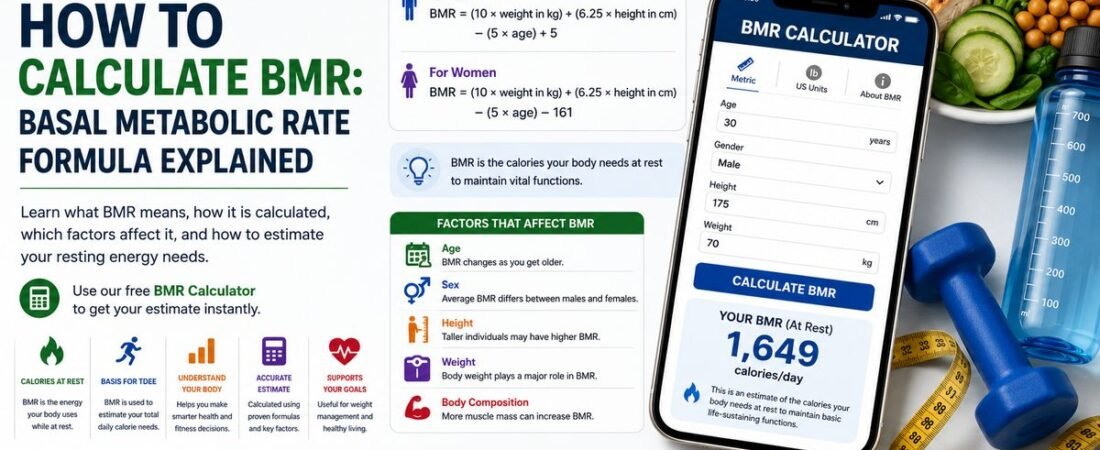
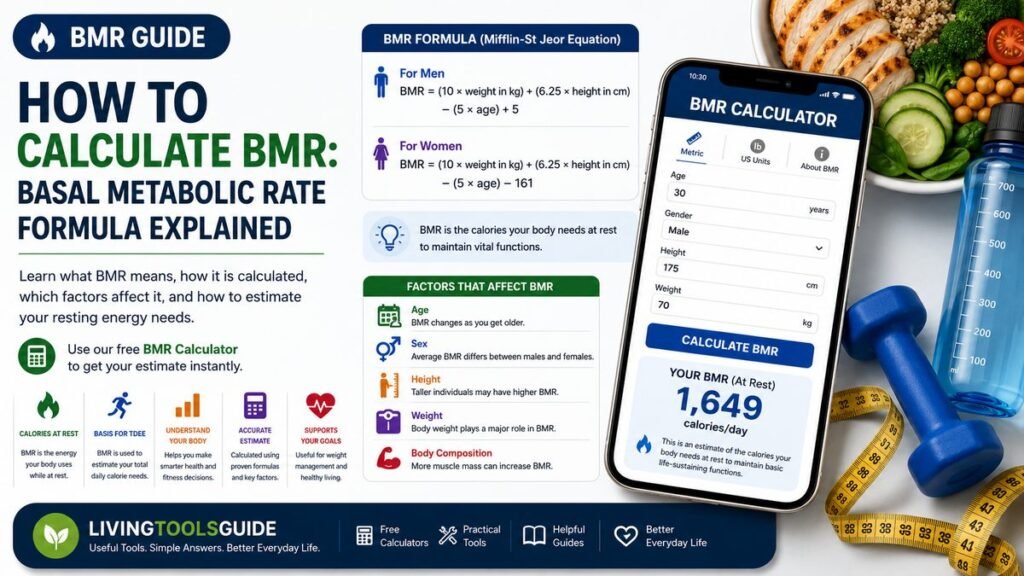
BMR Calculator helps you estimate how many calories your body needs each day at rest to support basic functions such as breathing, circulation, and maintaining body temperature.
Your body uses energy every day, even when you are resting. Energy is needed for essential functions such as breathing, circulating blood, maintaining body temperature, and supporting your organs.
The amount of energy your body requires for these basic functions is commonly called your Basal Metabolic Rate (BMR).
Understanding BMR can help you better understand your daily energy requirements and how calorie estimates are calculated.
In this guide, we’ll explain what BMR means, how it is estimated, which factors influence it, and how you can quickly calculate your estimated BMR.
What Is BMR?
BMR stands for Basal Metabolic Rate.
It represents an estimate of the amount of energy your body uses while at rest to maintain essential life functions.
These functions include breathing, blood circulation, maintaining body temperature, cell production, and normal organ function.
Your body continues using energy for these processes even when you are sleeping or resting.
Why Is BMR Important?
BMR provides a useful starting point for understanding your body’s energy requirements.
It can also be used when estimating how many calories you may use during an entire day.
Your total daily energy expenditure is generally higher than your BMR because normal daily activities and exercise require additional energy.
Understanding your estimated BMR can therefore help explain how daily calorie estimates are produced.
What Factors Affect Your BMR?
Several factors can influence your estimated BMR.
Age
BMR can change with age as body composition and activity patterns change over time.
Sex
Common BMR formulas use different calculations for males and females because average body composition differs between the two groups.
Height
Taller individuals generally have more body tissue to maintain, which can influence energy requirements.
Weight
Body weight is another major factor used in most BMR formulas.
Body Composition
Muscle and other lean tissues generally require more energy to maintain than body fat.
For this reason, two people with the same body weight may have different actual energy requirements.
How Is BMR Calculated?
Several formulas have been developed to estimate BMR.
One commonly used approach is the Mifflin-St Jeor equation.
For men:
BMR = (10 × weight in kg) + (6.25 × height in cm) − (5 × age) + 5
For women:
BMR = (10 × weight in kg) + (6.25 × height in cm) − (5 × age) − 161
These equations provide an estimate rather than a direct measurement of metabolism.
Example BMR Calculation
Suppose a 30-year-old man weighs 70 kg and is 175 cm tall.
Using the formula:
BMR = (10 × 70) + (6.25 × 175) − (5 × 30) + 5
This becomes:
BMR = 700 + 1,093.75 − 150 + 5
Estimated BMR:
1,648.75 calories per day
Rounded to the nearest whole number, the estimated BMR would be approximately 1,649 calories per day.
This represents an estimate of the energy required for basic bodily functions at rest.
BMR vs. Daily Calorie Needs
BMR and daily calorie needs are related, but they are not the same thing.
Your BMR represents estimated energy use at rest.
Your total daily energy expenditure includes BMR plus energy used through movement, exercise, digestion, and other daily activities.
A simplified estimate is:
Daily Calorie Needs = BMR × Activity Factor
Someone who is highly active will generally have greater total daily energy expenditure than someone with the same estimated BMR who is sedentary.
BMR vs. RMR
You may also see the term Resting Metabolic Rate (RMR).
BMR and RMR both describe energy used while the body is at rest, but the measurement conditions can differ.
BMR is traditionally measured under stricter laboratory conditions, while RMR may be measured under less restrictive resting conditions.
Online calculators generally provide formula-based estimates rather than laboratory measurements.
Use Our Free BMR Calculator
Instead of calculating the formula manually, you can use the free BMR Calculator on LivingToolsGuide.
Enter the requested information, such as your age, sex, height, and weight.
The calculator will estimate your BMR automatically, saving you from performing the formula yourself.
Are BMR Calculators Exact?
BMR calculators provide estimates based on mathematical formulas.
They cannot directly measure an individual’s metabolism.
Actual energy expenditure can vary because of body composition, genetics, hormones, environment, activity, and other individual factors.
For this reason, a calculated BMR should generally be treated as a useful estimate rather than an exact measurement.
Frequently Asked Questions
What does BMR stand for?
BMR stands for Basal Metabolic Rate.
How many calories does my body burn at rest?
The amount varies between individuals. Factors such as age, sex, height, weight, and body composition can influence resting energy requirements.
Is BMR the same as daily calorie needs?
No. BMR estimates energy requirements at rest, while total daily calorie needs also include energy used for physical activity and other daily processes.
Does exercise increase BMR?
Regular exercise can influence body composition and overall energy expenditure. However, calories used during exercise are generally considered separately when estimating total daily energy expenditure.
Can my BMR change over time?
Yes. Changes in age, body weight, body composition, and other factors can affect estimated BMR.
Final Thoughts
BMR provides a useful way to understand approximately how much energy your body requires for essential functions while at rest.
Formulas such as the Mifflin-St Jeor equation make it possible to estimate BMR using basic information including age, sex, height, and weight.
Your BMR is only one part of your total daily energy expenditure, but understanding it can make daily calorie calculations much easier to understand.
For more information about energy metabolism and how the body uses calories at rest, see the NIDDK Metabolic Testing guide.