BMI Calculator helps you quickly estimate your Body Mass Index using your height and weight. BMI is commonly used as a screening measure to categorize weight relative to height, although it does not directly measure body fat or overall health.
Body Mass Index (BMI) is a simple measurement commonly used to compare a person’s weight with their height. It can provide a quick general indication of whether an adult’s weight falls within a standard BMI category.
BMI is easy to calculate, but understanding the formula and what the result means is important. In this guide, we’ll explain how BMI is calculated, show an example, explain the standard adult BMI ranges, and show you how to calculate your BMI instantly.
What Is BMI?
BMI stands for Body Mass Index. It is calculated using your weight and height to produce a single number.
BMI does not directly measure body fat. Instead, it is a screening measure that can be useful for looking at weight relative to height.
How Is BMI Calculated?
BMI can be calculated using either metric or imperial measurements.
Using kilograms and meters:
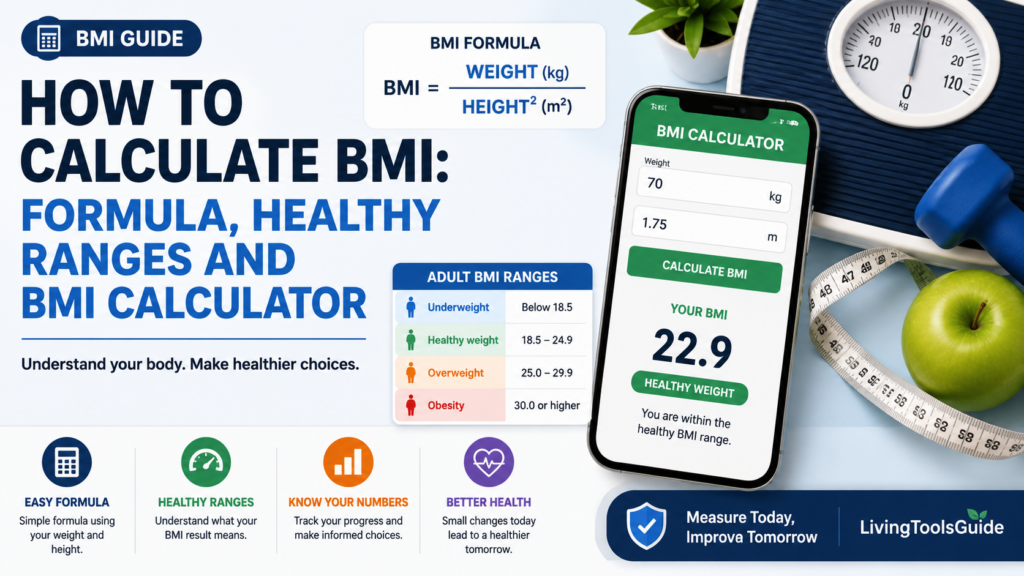
BMI = weight (kg) ÷ height² (m²)
For example, if a person weighs 70 kg and is 1.75 meters tall:
BMI = 70 ÷ (1.75 × 1.75)
BMI ≈ 22.9
Using Pounds and Inches
If you use pounds and inches, the formula is:
BMI = [weight (lb) ÷ height² (in²)] × 703
A BMI calculator can perform these calculations automatically, which is especially convenient when converting between different measurement systems.
Adult BMI Ranges
For most adults, commonly used BMI categories are:
Underweight: Below 18.5
Healthy weight: 18.5 to 24.9
Overweight: 25.0 to 29.9
Obesity: 30.0 or higher
These categories provide general reference ranges rather than a complete assessment of an individual’s health.
What Does Your BMI Result Mean?
Your BMI result shows how your weight compares with your height according to standard BMI ranges.
For example, a BMI of 22.9 falls within the commonly used healthy-weight range for adults.
However, BMI should be interpreted carefully because people with the same BMI can have different amounts of muscle, body fat, and overall body composition.
Limitations of BMI
BMI is useful because it is quick and simple, but it has limitations.
It does not distinguish between muscle and body fat.
It does not show where body fat is distributed.
Athletes or people with high muscle mass may have a higher BMI even when they have relatively low body fat.
BMI categories may also require different interpretation for some individuals and populations.
For these reasons, BMI is best treated as a general screening measurement rather than a diagnosis.
Use Our Free BMI Calculator
Instead of calculating the formula manually, you can use the free BMI Calculator on LivingToolsGuide.
Enter your height and weight, and the calculator will calculate your BMI automatically.
This makes it easy to check your result without manually squaring your height or converting measurements.
Frequently Asked Questions
What does BMI stand for?
BMI stands for Body Mass Index.
Is a BMI calculator accurate?
A BMI calculator can accurately calculate the BMI formula when the height and weight entered are correct. However, BMI itself has limitations and does not directly measure body fat or overall health.
Is BMI the same for everyone?
The mathematical formula is the same for adults, but interpretation can vary depending on factors such as age, pregnancy, muscle mass, and individual circumstances.
Can BMI tell me if I am healthy?
BMI alone cannot determine whether someone is healthy. It is one screening measure and should be considered alongside other relevant health information.
For more information about BMI, how it is calculated, and how it should be interpreted, see the CDC’s About Body Mass Index (BMI) guide.
Final Thoughts
BMI provides a quick way to compare weight with height and understand where a result falls within commonly used adult BMI ranges.
Knowing the formula can help you understand how BMI works, while a BMI calculator makes the calculation faster and easier.
Remember that BMI is only a general screening measure and should not be treated as a complete assessment of your health.