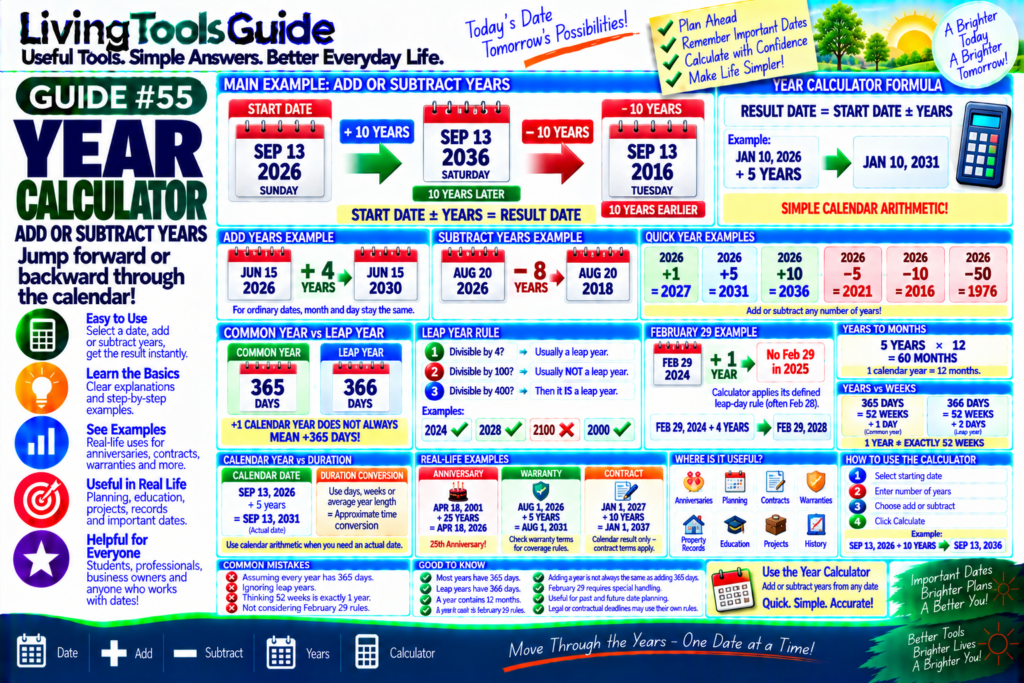
A Year Calculator makes it easy to find a future or past date by adding or subtracting a specific number of years from a starting date.
For example, if your starting date is:
September 13, 2026
and you add:
5 Years
the result is:
September 13, 2031
Or, if you subtract 10 years:
September 13, 2026 − 10 Years
=
September 13, 2016
This type of calculator is useful for planning, anniversaries, contracts, historical dates, warranties, age-related dates, project timelines, and long-term schedules.
Important: Adding calendar years is different from simply adding a fixed number of days. Leap years and special dates such as February 29 can affect the result.
What Does a Year Calculator Do?
A Year Calculator performs a simple calendar operation:
Starting Date ± Number of Years = Result Date
You provide:
📅 Starting Date
🔢 Number of Years
➕ Add or ➖ Subtract
and the calculator returns the resulting calendar date.
How to Add Years to a Date
Suppose the starting date is:
June 15, 2026
Add:
4 Years
Keep the month and day the same and increase the year:
2026 + 4 = 2030
Therefore:
June 15, 2030
Example 1 — Add 5 Years
Start:
January 10, 2026
Add:
5 years
Calculation:
2026 + 5 = 2031
Result:
January 10, 2031
Example 2 — Add 20 Years
Start:
March 25, 2026
Add:
20 years
Result:
March 25, 2046
How to Subtract Years From a Date
Subtraction works in the opposite direction.
Suppose:
August 20, 2026
Subtract:
8 years
Calculation:
2026 − 8 = 2018
Result:
August 20, 2018
Example 3 — Subtract 15 Years
Start:
November 5, 2026
Subtract:
15 years
Calculation:
2026 − 15 = 2011
Result:
November 5, 2011
Example 4 — Subtract 50 Years
Start:
July 1, 2026
Subtract:
50 years
Calculation:
2026 − 50 = 1976
Result:
July 1, 1976
Quick Year Calculation Examples
| Starting Date | Operation | Result |
|---|---|---|
| Jan 10, 2026 | +5 years | Jan 10, 2031 |
| Mar 25, 2026 | +20 years | Mar 25, 2046 |
| Sep 13, 2026 | +10 years | Sep 13, 2036 |
| Aug 20, 2026 | −8 years | Aug 20, 2018 |
| Nov 5, 2026 | −15 years | Nov 5, 2011 |
| Jul 1, 2026 | −50 years | Jul 1, 1976 |
For most ordinary dates, the month and day remain unchanged.
Why Adding a Year Is Not Always 365 Days
A common mistake is assuming:
1 Year = Exactly 365 Days
Most common calendar years contain:
365 Days
but leap years contain:
366 Days
Therefore, adding one calendar year and adding 365 days can produce different dates.
Example — Calendar Year vs 365 Days
Suppose you start on:
March 1, 2023
Add one calendar year:
March 1, 2024
But the interval crosses February 29, 2024.
The elapsed time between these dates is:
366 Days
Therefore:
+1 Calendar Year ≠ Always +365 Days
This distinction is important in date calculations.
What Is a Leap Year?
A leap year normally contains:
366 Days
instead of 365.
February contains:
29 Days
instead of 28.
Under the Gregorian calendar, a year is a leap year if:
It is divisible by 4,
except years divisible by 100 are not leap years,
unless they are also divisible by 400.
For more information about leap years and the Gregorian calendar, see the U.S. Naval Observatory’s calendar reference.
Leap Year Examples
2024
Divisible by 4.
✓ Leap Year
2028
Divisible by 4.
✓ Leap Year
2100
Divisible by 100 but not 400.
✕ Not a Leap Year
2000
Divisible by 400.
✓ Leap Year
The February 29 Problem
February 29 requires special treatment.
Suppose the starting date is:
February 29, 2024
and you add:
1 Year
The year 2025 does not contain February 29.
So what should the result be?
Depending on the calculator’s chosen rule, it may return:
February 28, 2025
or another defined calendar adjustment.
This behavior should be clearly stated by the calculator.
Example — Add 4 Years From Leap Day
Start:
February 29, 2024
Add:
4 Years
Result:
February 29, 2028
because 2028 is also a leap year.
Adding Multiple Years
Suppose:
Start Date = October 12, 2026
Add:
25 Years
Calculation:
2026 + 25
=
2051
Result:
October 12, 2051
For an ordinary date, the month and day remain the same.
Subtracting Multiple Years
Suppose:
Start Date = December 31, 2026
Subtract:
100 Years
Calculation:
2026 − 100
=
1926
Result:
December 31, 1926
Years vs Months
A year contains:
12 Calendar Months
Therefore, in many ordinary calendar situations:
5 Years = 60 Months
because:
5 × 12 = 60
However, date arithmetic should still be performed using calendar rules rather than assuming every month contains the same number of days.
Years vs Weeks
Years and weeks do not have an exact whole-number relationship.
A common year contains:
365 days
which equals:
52 Weeks + 1 Day
A leap year contains:
366 days
which equals:
52 Weeks + 2 Days
Therefore:
1 Calendar Year ≠ Exactly 52 Weeks
Years vs Days
For calendar calculations:
Common Year
365 Days
Leap Year
366 Days
An average Gregorian calendar year is:
365.2425 Days
This average is useful for approximate duration conversions, but adding calendar years should follow actual calendar dates.
Calendar Years vs Duration Years
This distinction is important.
📅 Calendar-Year Calculation
Start:
September 13, 2026
Add:
5 calendar years
Result:
September 13, 2031
⏱️ Duration Calculation
A duration calculation might instead use an average number of days per year.
These methods serve different purposes.
For date planning:
Use Calendar Years
For approximate duration conversions:
Use an Average-Year Conversion
Year Calculator vs Age Calculator
A Year Calculator changes a date by a chosen number of years.
An Age Calculator determines the elapsed age between a birth date and another date.
For example:
Birth Date
January 27, 1990
and:
Reference Date
January 27, 2030
would represent:
40 Years
The two calculators are related, but they answer different questions.
Year Calculator vs Month Calculator
Your Month Calculator — GUIDE #30 adds or subtracts calendar months.
Your Year Calculator — GUIDE #55 adds or subtracts calendar years.
Example:
September 13, 2026 + 12 months
=
September 13, 2027
and:
September 13, 2026 + 1 year
=
September 13, 2027
For ordinary dates, these results often match.
Special end-of-month and leap-day situations can require calendar adjustment rules.
Future Date Example
Suppose a long-term plan begins:
May 20, 2026
and lasts:
10 Years
Calculate:
2026 + 10
=
2036
Result:
May 20, 2036
Past Date Example
Suppose you want to know the date exactly 30 calendar years before:
September 13, 2026
Calculation:
2026 − 30
=
1996
Result:
September 13, 1996
Anniversary Example
Suppose an event occurred on:
April 18, 2001
Its 25-year anniversary is:
2001 + 25
=
2026
Therefore:
April 18, 2026
A Year Calculator makes anniversary calculations very easy.
Warranty Example
Suppose a product warranty begins:
August 1, 2026
and the stated term is:
5 Calendar Years
A simple date addition gives:
August 1, 2031
However, actual warranty coverage can depend on the manufacturer’s terms, including whether the final date is inclusive.
Contract Example
Suppose an agreement begins:
January 1, 2027
with a stated term of:
10 Years
Adding 10 calendar years gives:
January 1, 2037
Legal contracts may define commencement, expiration, renewal, and inclusive dates differently, so the calculator result should be treated as a calendar calculation rather than legal interpretation.
Where Is a Year Calculator Useful?
A Year Calculator is useful for:
🎂 Anniversaries
📅 Long-Term Planning
📑 Contracts
🛡️ Warranties
🏠 Property Records
🎓 Education
🏗️ Projects
📚 Historical Research
💼 Business Planning
⏳ Past & Future Dates
Common Mistakes
❌ Assuming Every Year Has 365 Days
Leap years have 366 days.
❌ Ignoring February 29
Leap-day calculations require a defined adjustment rule.
❌ Confusing Years With Weeks
52 weeks is only 364 days.
❌ Using Average Years for Calendar Dates
Use calendar arithmetic when you need an actual date.
❌ Ignoring Contract Rules
A calculated date does not determine legal commencement or expiration rules.
How to Use the Year Calculator
Using your LivingToolsGuide calculator is simple:
1 — Select Starting Date
Example:
September 13, 2026
2 — Enter Number of Years
Example:
10
3 — Choose Operation
ADD +
or:
SUBTRACT −
4 — Click Calculate
For Add:
September 13, 2036
For Subtract:
September 13, 2016
Add or Subtract Years Now
Need to find a date several years in the future or past?
Use our Year Calculator to quickly add or subtract calendar years from any starting date.
📅 Date | ➕ Add | ➖ Subtract | 🗓️ Years | 🧮 Calculator
Move Through the Years — One Date at a Time!