Year Calculator
Add or subtract a number of years from any date and find the resulting date.
How this year calculator works
Select a starting date, enter the number of years, and choose whether to add or subtract them. The calculator shows the resulting date, weekday, and whether the resulting year is a leap year.
Table of Contents
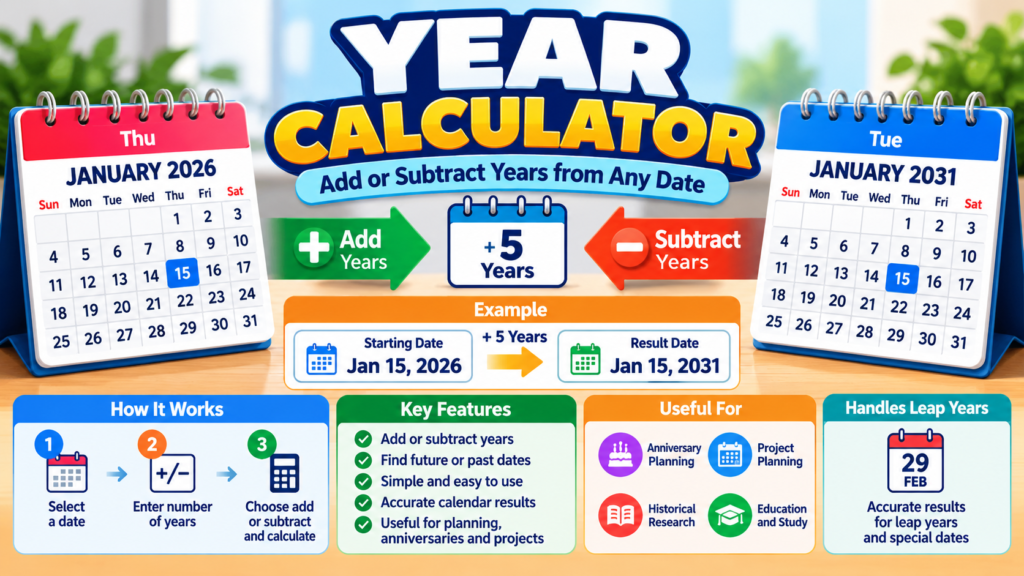
Year Calculator – Add or Subtract Years from Any Date
Our free Year Calculator helps you add or subtract a specific number of years from a selected date. Whether you want to calculate a future anniversary, find a past date, plan a long-term project, or determine when a certain number of years will have passed, this tool makes date calculations simple.
Instead of manually checking calendars, you can enter a starting date, select the number of years, and choose whether to add or subtract them.
The calculator then displays the resulting date according to its date-handling rules.
What Is a Year Calculator?
A Year Calculator is an online date calculation tool designed to move a selected date forward or backward by a specified number of calendar years.
For example, if you start with January 15, 2026, and add five years, the resulting date is January 15, 2031.
Similarly, subtracting five years from January 15, 2026, produces January 15, 2021.
This type of calculation is useful for personal planning, historical research, contract schedules, and everyday date calculations.
How to Use the Year Calculator
Follow these three simple steps:
Step 1: Select your starting date using the date field.
Step 2: Enter the number of years you want to add or subtract.
Step 3: Choose the operation and click Calculate Date.
The calculator will display the resulting date.
For example:
Starting date: June 10, 2026
Number of years: 4
Operation: Add years
Result: June 10, 2030
You can also select the subtraction option to calculate an earlier date.
How to Add Years to a Date
Adding calendar years generally means increasing the year while keeping the month and day unchanged, provided that the resulting date is valid.
For example:
Starting Date: March 20, 2025
Years to Add: 6
Calculation: 2025 + 6 = 2031
Result: March 20, 2031
This method is commonly used for anniversaries, future milestones, and long-term planning.
Example 1: Add 3 Years
Starting date: January 1, 2026
Add: 3 years
Answer: January 1, 2029
Example 2: Add 10 Years
Starting date: September 15, 2024
Add: 10 years
Answer: September 15, 2034
Example 3: Add 25 Years
Starting date: December 5, 2020
Add: 25 years
Answer: December 5, 2045
These examples demonstrate how the calendar year changes while the month and day remain the same.
How to Subtract Years from a Date
Subtracting years means moving backward through the calendar.
For ordinary dates, subtract the requested number of years from the starting year while keeping the month and day unchanged.
For example:
Starting Date: July 18, 2030
Years to Subtract: 5
Calculation: 2030 − 5 = 2025
Result: July 18, 2025
This is useful when checking historical dates, finding previous anniversaries, or reviewing past events.
Example 4: Subtract 2 Years
Starting date: August 12, 2026
Subtract: 2 years
Answer: August 12, 2024
Example 5: Subtract 15 Years
Starting date: November 30, 2025
Subtract: 15 years
Answer: November 30, 2010
Example 6: Subtract 30 Years
Starting date: April 8, 2026
Subtract: 30 years
Answer: April 8, 1996
Year Addition and Subtraction Examples
The following table shows common date calculations.
| Starting Date | Operation | Years | Result |
|---|---|---|---|
| January 10, 2026 | Add | 1 | January 10, 2027 |
| March 15, 2025 | Add | 5 | March 15, 2030 |
| July 20, 2024 | Add | 10 | July 20, 2034 |
| December 1, 2026 | Add | 20 | December 1, 2046 |
| May 12, 2026 | Subtract | 2 | May 12, 2024 |
| August 25, 2025 | Subtract | 5 | August 25, 2020 |
| October 30, 2030 | Subtract | 10 | October 30, 2020 |
| June 18, 2026 | Subtract | 25 | June 18, 2001 |
These examples use dates that remain valid in the resulting year.
Understanding Calendar Years
A calendar year normally contains 365 days.
However, a leap year contains 366 days because February has an additional day.
This means adding one calendar year is not always the same as adding exactly 365 days.
For example, the period from January 1, 2024, to January 1, 2025, contains 366 days because 2024 is a leap year.
Calendar-year calculations are therefore different from fixed-day calculations.
How Do Leap Years Affect Date Calculations?
Leap years occur in the Gregorian calendar when a year is divisible by four, except that century years must also be divisible by 400.
Examples include:
- 2024: Leap year
- 2025: Common year
- 2028: Leap year
- 2100: Common year
- 2400: Leap year
Leap years matter when calculating dates involving February 29.
For example, February 29, 2024, does not have an equivalent date in 2025.
Different date-calculation systems may handle this situation differently. Some use February 28, while others move to March 1.
Important: Check how your calculator handles February 29 before relying on its results for official or legal purposes.
Why Add or Subtract Years?
Anniversary Planning
You can calculate future anniversaries by adding a selected number of years to the original date.
For example, adding 20 years to a wedding date helps identify the twentieth anniversary.
Project Planning
Long-term projects may require milestone dates several years into the future.
Calendar-year calculations can help organize planning schedules.
Historical Research
Researchers can subtract years from known dates to identify earlier calendar dates.
Financial Planning
Date calculations can help estimate future milestones for savings goals and financial planning.
However, the actual rules for financial products and contract maturities may differ.
Education
Students can use calendar-year calculations to understand dates, leap years, and time measurement.
Calendar Years vs. Exact Days
A calendar year is not always equal to a fixed number of days.
For example:
One common year = 365 days
One leap year = 366 days
Therefore, adding five calendar years may cover a different number of days depending on the starting date and leap years involved.
If your goal is to move to the same month and day in another year, calendar-year addition is generally appropriate.
If your goal is to count an exact number of days, a day-based date calculator is more suitable.
Common Mistakes in Year Calculations
Ignoring Leap Years
February 29 requires special attention when the target year is not a leap year.
Confusing Years with Days
Adding one year is not necessarily the same as adding 365 days.
Selecting the Wrong Operation
Make sure you choose addition for future dates and subtraction for earlier dates.
Entering an Incorrect Starting Date
Always verify the month, day, and year before calculating.
Assuming Every Calendar Rule Is Universal
Legal deadlines, anniversaries, contracts, and administrative procedures may have specific date-counting rules.
Use the calculator as a planning aid and verify official requirements separately.
Adding or subtracting years is useful for planning anniversaries, long-term projects, and future dates. If you need to adjust a date by a smaller calendar unit, try our free Month Calculator to add or subtract months from any selected date quickly and easily.
Frequently Asked Questions
How do I add years to a date?
Select the starting date, enter the number of years, and choose the addition option.
How do I subtract years from a date?
Enter your starting date, select the number of years, and choose subtraction.
What is the date five years after January 1, 2026?
The date is January 1, 2031.
What is the date ten years before June 15, 2026?
The date is June 15, 2016.
Can I calculate dates several decades into the future?
Yes, provided the date range is supported by the calculator.
Does adding one year always mean adding 365 days?
No. Leap years can affect the number of days between calendar dates.
What happens when I add a year to February 29?
The result depends on the calculator's leap-day handling rules.
Can I use this tool for anniversaries?
Yes. It can help identify calendar anniversaries and future milestones.
Can I calculate dates in the past?
Yes. Select the subtraction option to move backward by a specified number of years.
Is this tool useful for project planning?
Yes. It can help estimate calendar milestones for long-term projects.
When adding or subtracting years from a date, it is important to understand how leap years affect the calendar. A leap year contains 366 days instead of 365, which can influence date calculations involving February. To learn more about leap years and how they work, visit timeanddate.com.
Final Thoughts
Adding or subtracting calendar years is useful for anniversaries, planning, education, historical research, and everyday date calculations.
For most dates, the process simply changes the year while keeping the month and day unchanged.
Remember that leap years and special dates may require additional attention.
Use our free Year Calculator to calculate future or past dates quickly and conveniently.