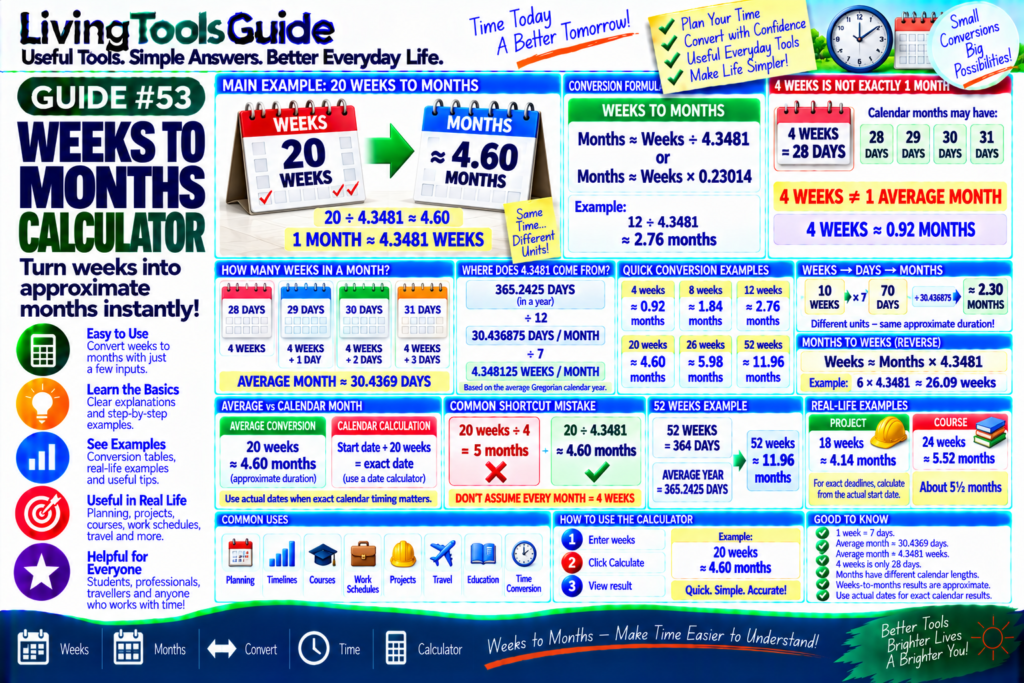
The Weeks to Months Calculator makes it easy to convert weeks into approximate months for planning, schedules, projects, pregnancy timelines, travel, education, and everyday date calculations.
A week always contains:
7 Days
But calendar months vary in length:
- 28 days
- 29 days
- 30 days
- 31 days
Because of this, a weeks-to-months conversion is usually an approximation unless you are working with actual calendar dates.
Using the average Gregorian calendar year:
1 Year = 365.2425 Days
Average month length:
365.2425 ÷ 12
=
30.436875 Days
Since a week contains 7 days:
30.436875 ÷ 7
≈
4.3481 Weeks per Month
Therefore:
1 Week ≈ 0.23014 Months
A Weeks to Months Calculator can perform this conversion instantly.
Weeks to Months Formula
Using the average Gregorian calendar month:
Months ≈ Weeks ÷ 4.3481
Another equivalent formula is:
Months ≈ Weeks × 0.23014
For example:
20 Weeks
Calculation:
20 ÷ 4.3481
≈
4.60 Months
So:
20 Weeks ≈ 4.6 Months
Why Isn’t 4 Weeks Exactly 1 Month?
This is one of the most important things to understand.
Four weeks equals:
28 Days
But most calendar months contain:
30 or 31 days
Therefore:
4 Weeks ≠ 1 Average Calendar Month
Using the average-month conversion:
4 ÷ 4.3481
≈
0.92 Months
So four weeks is approximately 0.92 average months, not exactly one month.
How Many Weeks Are in a Month?
There isn’t one fixed answer for calendar months.
28-Day Month
4 Weeks
29-Day Month
4 Weeks + 1 Day
30-Day Month
4 Weeks + 2 Days
31-Day Month
4 Weeks + 3 Days
Using the average Gregorian month:
1 Month ≈ 4.3481 Weeks
Example 1 — 8 Weeks to Months
Formula:
8 ÷ 4.3481
≈
1.84 Months
Therefore:
8 weeks ≈ 1.84 months
Example 2 — 12 Weeks
Calculation:
12 ÷ 4.3481
≈
2.76 Months
Therefore:
12 Weeks ≈ 2.76 Months
Example 3 — 16 Weeks
Calculation:
16 ÷ 4.3481
≈
3.68 Months
Example 4 — 26 Weeks
Calculation:
26 ÷ 4.3481
≈
5.98 Months
So:
26 Weeks ≈ 6 Months
This makes sense because 26 weeks is approximately half of a year.
Example 5 — 52 Weeks
Calculation:
52 ÷ 4.3481
≈
11.96 Months
Why isn’t it exactly 12 months?
Because:
52 weeks = 364 days
while an average Gregorian year is approximately:
365.2425 days
So 52 weeks is slightly shorter than an average calendar year.
Quick Weeks to Months Table
| Weeks | Approx. Months |
|---|---|
| 1 | 0.23 |
| 2 | 0.46 |
| 4 | 0.92 |
| 6 | 1.38 |
| 8 | 1.84 |
| 10 | 2.30 |
| 12 | 2.76 |
| 16 | 3.68 |
| 20 | 4.60 |
| 26 | 5.98 |
| 40 | 9.20 |
| 52 | 11.96 |
Values are rounded and based on an average Gregorian month.
Weeks → Days → Months
You can also understand the conversion in two stages.
Suppose:
10 Weeks
First convert weeks to days:
10 × 7
=
70 Days
Then divide by the average month length:
70 ÷ 30.436875
≈
2.30 Months
Therefore:
10 Weeks ≈ 2.30 Months
Convert Months Back to Weeks
To reverse the approximate conversion:
Weeks ≈ Months × 4.3481
Example:
3 Months
Calculation:
3 × 4.3481
≈
13.04 Weeks
So three average calendar months correspond to approximately 13 weeks.
Example — 6 Months to Weeks
Calculation:
6 × 4.3481
≈
26.09 Weeks
Therefore:
6 Months ≈ 26.09 Weeks
Calendar Months vs Average Months
This distinction matters.
A mathematical converter generally uses an average month length.
A calendar-date calculation uses actual months.
For example, adding one calendar month to:
January 1
takes you to:
February 1
The elapsed number of days is:
31 Days
But adding one calendar month to:
April 1
takes you to:
May 1
which is:
30 Days
So if you need an exact calendar answer, use actual start and end dates rather than an average weeks-to-months conversion.
Approximate Conversion vs Calendar Calculation
Weeks to Months Converter
Best when you want:
An approximate equivalent duration
Example:
20 weeks ≈ 4.60 months
Calendar Calculator
Best when you want:
An exact date
Example:
What date is 20 weeks from today?
These are different calculations.
Why Use 30.436875 Days?
The average Gregorian year contains:
365.2425 Days
Divide by 12:
365.2425 ÷ 12
=
30.436875 Days per Average Month
Then:
30.436875 ÷ 7
=
4.348125 Weeks
This gives us the average conversion factor.
Alternative Simple Conversion
Sometimes people use:
1 Month ≈ 4.33 Weeks
This is a convenient rounded approximation.
For quick mental estimates, it may be sufficient.
However, your calculator can use the more precise average:
4.348125 Weeks per Month
For example:
20 weeks
Using 4.33:
20 ÷ 4.33 ≈ 4.62 months
Using 4.348125:
20 ÷ 4.348125 ≈ 4.60 months
Both are approximations.
Common Mistake — Dividing by 4
A very common shortcut is:
Weeks ÷ 4 = Months
For example:
20 ÷ 4 = 5 months
But this treats every month as exactly 28 days.
Using the average calendar month:
20 ÷ 4.3481
≈
4.60 Months
So dividing by four can noticeably overestimate the number of months.
Common Mistake — Assuming 52 Weeks = Exactly 12 Months
Remember:
52 weeks = 364 days
An average Gregorian year is:
365.2425 days
Therefore:
52 Weeks ≈ 11.96 Average Months
For everyday conversation, people may describe 52 weeks as approximately one year, but the durations are not mathematically identical.
Weeks, Months and Years
Useful approximate relationships include:
1 Week = 7 Days
1 Average Month ≈ 30.4369 Days
1 Average Month ≈ 4.3481 Weeks
12 Average Months = 1 Average Gregorian Year
This creates the conversion chain:
Weeks → Days → Average Months → Years
Where Is Weeks-to-Months Conversion Useful?
Because calendar months have different lengths, weeks-to-months conversions are often approximate. For more information about calendar systems and how months are defined, see the U.S. Naval Observatory’s calendar reference.
This conversion can be helpful for:
The Weeks to Months Calculator is especially useful when you need a quick estimate without manually working through the conversion formula.
📅 Planning
📊 Project Timelines
🎓 Courses
💼 Work Schedules
🏗️ Projects
✈️ Travel Planning
📚 Education
⏱️ General Time Conversion
For situations involving medical timelines or pregnancy, weeks and calendar months are not interchangeable; use the convention recommended by the relevant healthcare professional.
Project Example
Suppose a project is expected to take:
18 Weeks
Convert:
18 ÷ 4.3481
≈
4.14 Months
So you could describe the duration as approximately:
4.1 Months
For exact scheduling, however, use the project’s actual start date and add 18 weeks.
Course Example
Suppose a training course lasts:
24 Weeks
Calculation:
24 ÷ 4.3481
≈
5.52 Months
So the course lasts approximately:
5½ Months
Again, the exact calendar dates depend on when the course begins.
How to Use the Weeks to Months Calculator
Using your LivingToolsGuide calculator is simple:
1 — Enter Weeks
Example:
20
2 — Click Calculate
3 — View Approximate Months
Result:
≈ 4.60 MONTHS
The calculator automatically applies the selected average-month conversion factor.
Convert Weeks to Months Now
Need to express a number of weeks in months?
Use our Weeks to Months Calculator to instantly convert weeks into approximate months.