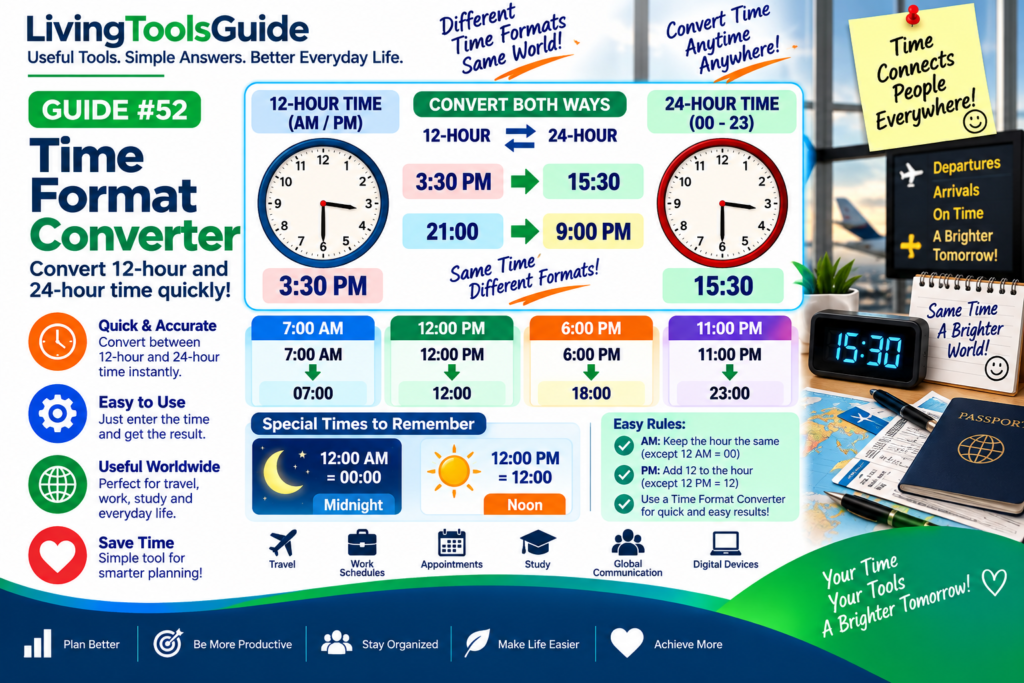
The Time Format Converter makes it easy to convert between 12-hour (AM/PM) and 24-hour time formats quickly and accurately.
Time can be displayed in two common formats: the 12-hour clock and the 24-hour clock.
The 12-hour format uses AM and PM, while the 24-hour format represents the hours of the day from 00 to 23. Understanding how to convert between these formats is useful for travel, work schedules, transportation timetables, appointments, digital devices, and everyday planning.
A Time Format Converter makes switching between 12-hour and 24-hour time quick and easy.
What Is 12-Hour Time?
The 12-hour clock divides the day into two 12-hour periods.
AM represents times from midnight to before noon.
PM represents times from noon to before midnight.
Examples:
7:30 AM — morning
11:45 AM — before noon
2:15 PM — afternoon
9:30 PM — evening
What Is 24-Hour Time?
The 24-hour clock numbers the hours from 00 through 23.
It does not require AM or PM.
For example:
07:30 = 7:30 AM
14:15 = 2:15 PM
21:30 = 9:30 PM
The 24-hour format is commonly used for transportation schedules, computers, international time displays, and many workplaces.
For official information about time and timekeeping standards, see the NIST Time and Frequency Division.
How to Convert AM Time to 24-Hour Time
For most AM times, the hour remains the same.
For example:
7:30 AM → 07:30
9:45 AM → 09:45
11:20 AM → 11:20
There is one important exception:
Midnight
12:00 AM = 00:00
Therefore:
12:30 AM → 00:30
How to Convert PM Time to 24-Hour Time
For PM times from 1:00 PM through 11:59 PM, add 12 to the hour.
Formula:
24-Hour Hour = PM Hour + 12
Example:
3:30 PM
3 + 12 = 15
Therefore:
3:30 PM → 15:30
Another example:
8:45 PM
8 + 12 = 20
Therefore:
8:45 PM → 20:45
Remember Noon
12:00 PM = 12:00
You do not add 12 to 12 PM.
How to Convert 24-Hour Time to 12-Hour Time
For times from 01:00 to 11:59, keep the hour and add AM.
08:15 → 8:15 AM
For 12:00 to 12:59, keep 12 and use PM.
12:30 → 12:30 PM
For times from 13:00 to 23:59, subtract 12 from the hour and add PM.
Formula:
12-Hour Hour = 24-Hour Hour − 12
Example:
18:45
18 − 12 = 6
Therefore:
18:45 → 6:45 PM
For hour 00, use 12 AM:
00:30 → 12:30 AM
Quick 12-Hour and 24-Hour Conversion Table
| 12-Hour Time | 24-Hour Time |
|---|---|
| 12:00 AM | 00:00 |
| 1:00 AM | 01:00 |
| 6:00 AM | 06:00 |
| 9:30 AM | 09:30 |
| 12:00 PM | 12:00 |
| 1:00 PM | 13:00 |
| 3:30 PM | 15:30 |
| 6:00 PM | 18:00 |
| 9:00 PM | 21:00 |
| 11:59 PM | 23:59 |
Easy Rule to Remember
For AM:
Keep the hour the same, except:
12 AM → 00
For PM:
Add 12 to the hour, except:
12 PM stays 12
For example:
2 PM → 14:00
5 PM → 17:00
10 PM → 22:00
Midnight and Noon
Midnight and noon are the two times that often cause confusion.
🌙 Midnight
12:00 AM = 00:00
☀️ Noon
12:00 PM = 12:00
Remember:
AM midnight → 00
PM noon → 12
Where Is 24-Hour Time Useful?
✈️ Travel — flight, train, and transportation schedules may use 24-hour time.
🏥 Healthcare — 24-hour time can help make scheduled times unambiguous.
💼 Work schedules — some workplaces use 24-hour time.
🌍 International communication — many countries commonly use 24-hour notation.
💻 Computers and devices — operating systems and applications often allow either format.
📅 Appointments and planning — converting formats can make unfamiliar schedules easier to understand.
Why Use a Time Format Converter?
Although the conversion rules are simple, times around noon and midnight can be easy to misread.
A Time Format Converter can instantly convert:
12-Hour Time ⇄ 24-Hour Time
This is especially convenient when converting several times or reading schedules in an unfamiliar format.
Convert Your Time
Enter your time into our Time Format Converter to quickly switch between 12-hour and 24-hour formats.