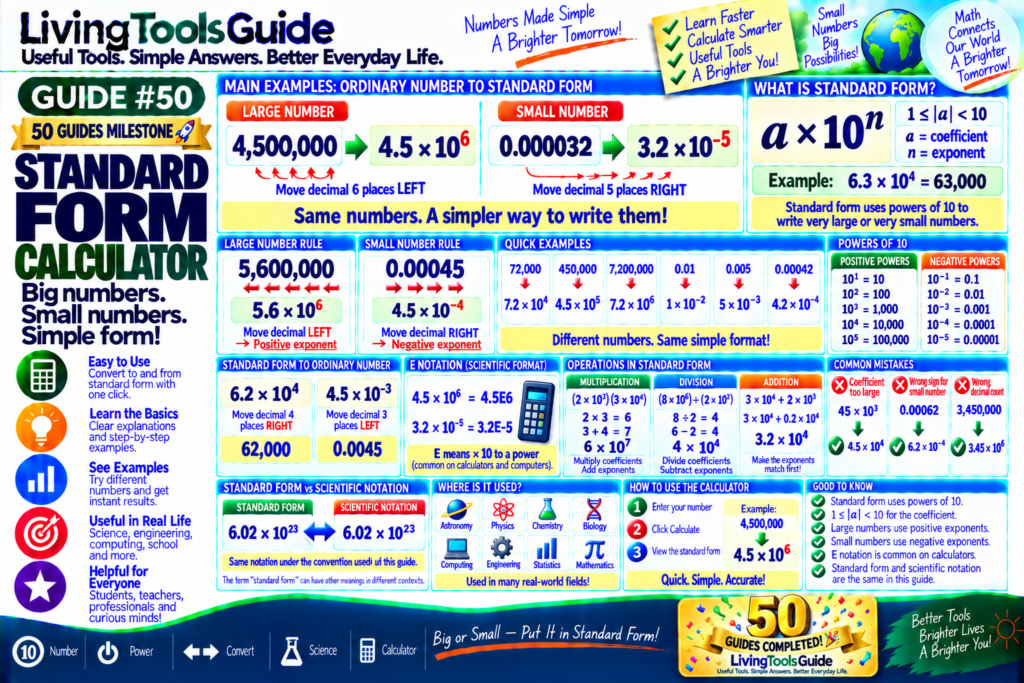
Standard form is a convenient way to write very large or very small numbers using powers of 10.
For example, instead of writing:
4,500,000
you can write:
4.5 × 10⁶
And instead of:
0.000032
you can write:
3.2 × 10⁻⁵
A Standard Form Calculator quickly converts ordinary numbers into standard form and can also help convert standard form back into ordinary decimal notation.
Terminology note: In this guide, “standard form” means the scientific-notation format a × 10ⁿ, commonly called standard form in some school systems. In other countries or contexts, “standard form” can mean ordinary decimal notation.
What Is Standard Form?
A Standard Form Calculator makes it easy to convert very large or very small numbers into standard form using powers of 10. It can also help you check your calculations and understand how the decimal point moves when the exponent changes.
A nonzero number in normalized standard form is written as:
a × 10ⁿ
where:
a = a number whose absolute value is at least 1 but less than 10
n = an integer exponent
In mathematical notation:
1 ≤ |a| < 10
For example:
6.3 × 10⁴
Here:
6.3 is the coefficient.
4 is the exponent.
Since:
10⁴ = 10,000
we get:
6.3 × 10,000 = 63,000
Therefore:
6.3 × 10⁴ = 63,000
Converting a Large Number to Standard Form
Consider:
5,600,000
Move the decimal point until only one nonzero digit remains to its left:
5.600000
The decimal point moved:
6 places to the left
Therefore:
5,600,000 = 5.6 × 10⁶
For numbers with magnitude greater than or equal to 10:
Move Decimal LEFT → Positive Exponent
Example 1 — 72,000
Start with:
72,000
Move the decimal:
72,000 → 7.2
The decimal moved:
4 places left
Therefore:
72,000 = 7.2 × 10⁴
Example 2 — 8,250,000
Move the decimal point six places left:
8,250,000 → 8.25
Therefore:
8,250,000 = 8.25 × 10⁶
Converting a Small Number to Standard Form
Now consider:
0.00045
Move the decimal point until the coefficient is:
4.5
The decimal moved:
4 places to the right
Therefore:
0.00045 = 4.5 × 10⁻⁴
For nonzero numbers with magnitude below 1:
Move Decimal RIGHT → Negative Exponent
Example 3 — 0.0062
Move the decimal:
0.0062 → 6.2
The decimal moves:
3 places right
Therefore:
0.0062 = 6.2 × 10⁻³
Example 4 — 0.0000078
Move the decimal:
6 places right
Therefore:
0.0000078 = 7.8 × 10⁻⁶
Standard Form Formula
The basic structure is:
N = a × 10ⁿ
where:
1 ≤ |a| < 10
for any nonzero number in normalized standard form.
Example:
450,000
becomes:
4.5 × 10⁵
because:
4.5 × 100,000 = 450,000
Positive Exponents
A positive exponent represents multiplication by a positive power of 10.
Example:
3.4 × 10⁵
Since:
10⁵ = 100,000
we get:
3.4 × 100,000
=
340,000
Negative Exponents
A negative exponent represents a reciprocal power of 10.
Example:
3.4 × 10⁻⁵
Since:
10⁻⁵ = 0.00001
we get:
3.4 × 0.00001
=
0.000034
Quick Standard Form Examples
| Ordinary Number | Standard Form |
|---|---|
| 10 | 1 × 10¹ |
| 100 | 1 × 10² |
| 1,000 | 1 × 10³ |
| 25,000 | 2.5 × 10⁴ |
| 450,000 | 4.5 × 10⁵ |
| 7,200,000 | 7.2 × 10⁶ |
| 0.1 | 1 × 10⁻¹ |
| 0.01 | 1 × 10⁻² |
| 0.005 | 5 × 10⁻³ |
| 0.00042 | 4.2 × 10⁻⁴ |
Convert Standard Form Back to an Ordinary Number
The process also works in reverse.
Suppose:
6.2 × 10⁴
A positive exponent of 4 means the decimal point moves four places to the right.
Therefore:
6.2 × 10⁴ = 62,000
Negative Exponent Example
Convert:
4.5 × 10⁻³
Move the decimal three places to the left:
4.5 → 0.0045
Therefore:
4.5 × 10⁻³ = 0.0045
Powers of 10
Understanding powers of 10 makes standard form much easier.
Positive Powers
10⁰ = 1
10¹ = 10
10² = 100
10³ = 1,000
10⁴ = 10,000
10⁵ = 100,000
Negative Powers
10⁻¹ = 0.1
10⁻² = 0.01
10⁻³ = 0.001
10⁻⁴ = 0.0001
10⁻⁵ = 0.00001
Standard Form and Scientific Notation
You can also learn more about scientific notation from Khan Academy.
In the meaning used by this guide:
Standard Form = Scientific Notation
For example:
6.02 × 10²³
is both standard form and scientific notation under this convention.
This makes GUIDE #50 an excellent companion to:
GUIDE #43 — Scientific Notation Calculator
Standard Form vs E Notation
Computers and calculators frequently display powers of ten using E notation.
For example:
4.5 × 10⁶
can be displayed as:
4.5E6
Similarly:
3.2 × 10⁻⁵
can be displayed as:
3.2E-5
So:
E6 means × 10⁶
and:
E-5 means × 10⁻⁵
Standard Form With Negative Numbers
Negative numbers can also be written in standard form.
Example:
−45,000
becomes:
−4.5 × 10⁴
Another example:
−0.00032
becomes:
−3.2 × 10⁻⁴
The negative sign remains with the coefficient.
What About Zero?
Zero is a special case.
Normalized standard form requires:
1 ≤ |a| < 10
so zero cannot satisfy the usual nonzero coefficient rule.
For practical calculator purposes, simply display:
0
Multiplying Numbers in Standard Form
Standard form can simplify multiplication.
Example:
(2 × 10³) × (3 × 10⁴)
Multiply the coefficients:
2 × 3 = 6
Add the exponents:
3 + 4 = 7
Therefore:
6 × 10⁷
Dividing Numbers in Standard Form
Example:
(8 × 10⁶) ÷ (2 × 10²)
Divide the coefficients:
8 ÷ 2 = 4
Subtract the exponents:
6 − 2 = 4
Therefore:
4 × 10⁴
Adding Numbers in Standard Form
For addition, first express the numbers using the same power of 10.
Example:
3 × 10⁴ + 2 × 10³
Rewrite:
2 × 10³ = 0.2 × 10⁴
Then:
3 × 10⁴ + 0.2 × 10⁴
=
3.2 × 10⁴
Subtracting Numbers in Standard Form
Again, make the powers of 10 the same.
Example:
5 × 10⁵ − 2 × 10⁴
Rewrite:
2 × 10⁴ = 0.2 × 10⁵
Then:
5 × 10⁵ − 0.2 × 10⁵
=
4.8 × 10⁵
Common Mistake — Wrong Coefficient
Consider:
45 × 10³
Although mathematically meaningful, it is not normalized standard form because:
45 ≥ 10
Move the decimal one place left and increase the exponent:
4.5 × 10⁴
Now:
1 ≤ 4.5 < 10
Correct. ✓
Common Mistake — Wrong Exponent Sign
For:
0.00062
the correct answer is:
6.2 × 10⁻⁴
not:
❌ 6.2 × 10⁴
Small nonzero numbers with magnitude below 1 use a negative exponent in normalized standard form.
Common Mistake — Counting Decimal Places
Consider:
3,450,000
Move the decimal:
3,450,000 → 3.45
Count the moves:
6
Therefore:
3.45 × 10⁶
Counting each decimal movement carefully helps avoid exponent errors.
Why Use Standard Form?
Standard form makes very large and very small numbers easier to:
🔢 Read
✍️ Write
🧮 Calculate
📊 Compare
💻 Enter into computers
🔬 Use in science
📐 Use in engineering
📚 Study in mathematics
Real-World Uses
Standard form appears frequently in:
🌌 Astronomy
⚛️ Physics
🧪 Chemistry
🦠 Biology
💻 Computing
📐 Engineering
📊 Statistics
🧮 Mathematics
For example, scientists often work with values that would otherwise contain extremely long strings of zeros.
How to Use the Standard Form Calculator
Using a Standard Form Calculator is especially helpful when working with long numbers, small decimals, scientific measurements, engineering calculations, and mathematics homework.
Using your LivingToolsGuide calculator is simple:
Our Standard Form Calculator makes it easy to convert large or small numbers into standard form. Enter your number into the Standard Form Calculator to get the result instantly and check your calculations quickly.
1 — Enter Your Number
Example:
4,500,000
2 — Click Calculate
3 — View Standard Form
Result:
4.5 × 10⁶
If your calculator supports reverse conversion, users can also convert standard form back into an ordinary number.
Convert a Number Now
Need to simplify a very large or very small number?
Use our Standard Form Calculator to quickly convert numbers between ordinary notation and standard form.
👉 Use the Standard Form Calculator
🔢 Number | 🔟 Power | ↔️ Convert | 🔬 Science | 🧮 Calculator
The Standard Form Calculator makes it easy to convert large or small numbers into standard form quickly and accurately.
Big or Small — Put It in Standard Form!