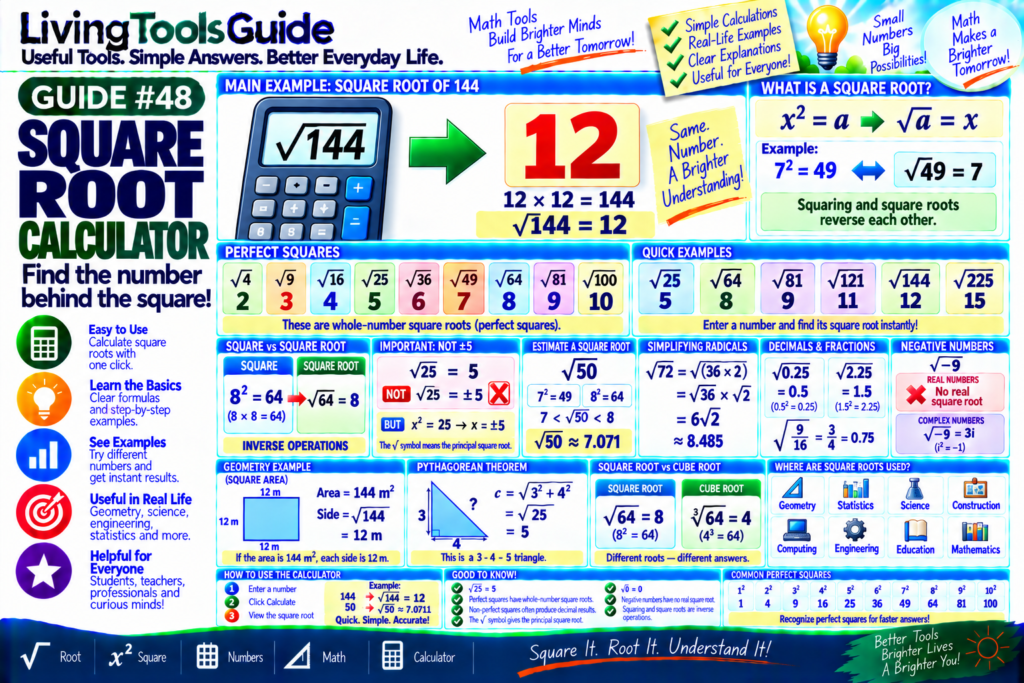
A square root is a number that, when multiplied by itself, produces another number.
For example:
5 × 5 = 25
Therefore:
√25 = 5
The symbol √ is called the radical symbol, and the number inside it is called the radicand.
Square roots are used throughout mathematics, geometry, science, engineering, statistics, construction, and many everyday calculations.
A Square Root Calculator lets you enter a number and instantly find its principal square root.
What Is a Square Root?
For more information about square roots and radicals, see the Square Root reference from Wolfram MathWorld.
For more information about square roots and radicals, see the Square Root reference from Wolfram MathWorld.
If:
x² = a
then:
x = √a
when referring to the principal square root for a nonnegative real number.
For example:
7² = 49
because:
7 × 7 = 49
Therefore:
√49 = 7
Understanding the √ Symbol
Consider:
√64 = 8
Here:
√ = radical symbol
64 = radicand
8 = principal square root
We can check the answer:
8 × 8 = 64
Therefore:
√64 = 8 ✓
Perfect Squares
Some whole numbers have whole-number square roots. These are called perfect squares.
Examples:
| Number | Square Root |
|---|---|
| 1 | 1 |
| 4 | 2 |
| 9 | 3 |
| 16 | 4 |
| 25 | 5 |
| 36 | 6 |
| 49 | 7 |
| 64 | 8 |
| 81 | 9 |
| 100 | 10 |
These come from:
1² = 1
2² = 4
3² = 9
4² = 16
and so on.
Example 1 — Square Root of 25
We need a number that multiplied by itself equals 25.
5 × 5 = 25
Therefore:
√25 = 5
Example 2 — Square Root of 81
Because:
9 × 9 = 81
we know:
√81 = 9
Example 3 — Square Root of 144
Because:
12 × 12 = 144
therefore:
√144 = 12
Example 4 — Square Root of 225
Because:
15 × 15 = 225
therefore:
√225 = 15
What If the Number Is Not a Perfect Square?
Not every square root is a whole number.
For example:
√2 ≈ 1.4142
because:
1.4142 × 1.4142 ≈ 2
Another example:
√10 ≈ 3.1623
These decimal values can continue indefinitely.
A Square Root Calculator makes it easy to obtain an approximation to the desired number of decimal places.
Quick Square Root Examples
| Number | Square Root |
|---|---|
| 4 | 2 |
| 9 | 3 |
| 16 | 4 |
| 25 | 5 |
| 36 | 6 |
| 49 | 7 |
| 64 | 8 |
| 81 | 9 |
| 100 | 10 |
| 121 | 11 |
| 144 | 12 |
| 225 | 15 |
Squaring and Square Roots Are Related
Squaring a number and finding its square root are inverse operations in the appropriate nonnegative setting.
For example:
Square
8² = 64
Then reverse it:
Square Root
√64 = 8
So:
8 → Square → 64
and:
64 → Square Root → 8
Important: √25 Is Not ±5
This is a common source of confusion.
The symbol:
√25
means the principal square root, which is:
5
It does not mean ±5.
However, if you solve the equation:
x² = 25
there are two real solutions:
x = 5 or x = −5
because:
5² = 25
and:
(−5)² = 25
So remember:
√25 = 5
but:
x² = 25 → x = ±5
Estimating a Square Root
Suppose you want to estimate:
√50
We know:
7² = 49
and:
8² = 64
Therefore:
7 < √50 < 8
Since 50 is very close to 49:
√50 ≈ 7.071
A calculator gives a much more precise approximation.
Simplifying Square Roots
Some square roots can be simplified even when they are not whole numbers.
Example:
√72
Factor 72:
72 = 36 × 2
Therefore:
√72 = √(36 × 2)
Using the product rule for nonnegative values:
√72 = √36 × √2
Since:
√36 = 6
we get:
√72 = 6√2
Approximately:
8.4853
Another Simplification Example
Consider:
√48
Factor:
48 = 16 × 3
Therefore:
√48 = √16 × √3
=
4√3
Approximately:
6.9282
Square Root of a Decimal
Square roots can also be calculated for decimals.
For example:
√0.25 = 0.5
because:
0.5 × 0.5 = 0.25
Another example:
√2.25 = 1.5
because:
1.5 × 1.5 = 2.25
Square Root of a Fraction
Fractions can also have square roots.
For nonnegative values:
√(a/b) = √a / √b
when b > 0.
Example:
√(9/16)
=
√9 ÷ √16
=
3 ÷ 4
=
3/4
or:
0.75
What About √0?
Zero has a square root.
Because:
0 × 0 = 0
therefore:
√0 = 0
What About Negative Numbers?
In the real number system, a negative number does not have a real square root.
For example:
√−9
is not a real number.
In the complex number system:
√−9 = 3i
where:
i² = −1
Whether your calculator supports complex numbers depends on how it was designed.
For a standard real-number Square Root Calculator, negative inputs may return an error or indicate that there is no real square root.
Square Root vs Cube Root
These operations are similar but different.
Square Root
√64 = 8
because:
8² = 64
Cube Root
∛64 = 4
because:
4³ = 64
This makes GUIDE #48 a perfect companion to your existing:
GUIDE #9 — Cube Root Calculator
Where Are Square Roots Used?
Square roots appear in many areas:
📐 Geometry — distances and dimensions.
📊 Statistics — standard deviation and related calculations.
🔬 Science — formulas and measurements.
🏗️ Construction — dimensions and diagonal measurements.
💻 Computing — algorithms and graphics.
⚙️ Engineering — technical calculations.
📚 Education — algebra and arithmetic.
🧮 Everyday Mathematics — solving numerical problems.
Geometry Example — Square Area
Suppose a square has an area of:
144 m²
For a square:
Area = Side²
Therefore:
Side = √Area
Calculation:
√144
=
12
So each side is:
12 m
because:
12 × 12 = 144 m²
Geometry Example — Pythagorean Theorem
Square roots also appear in the Pythagorean theorem:
c = √(a² + b²)
Suppose:
a = 3
b = 4
Then:
c = √(3² + 4²)
=
√(9 + 16)
=
√25
=
5
This is the classic 3–4–5 triangle.
How to Use the Square Root Calculator
Using your LivingToolsGuide calculator is simple:
1 — Enter a Number
Example:
144
2 — Click Calculate
3 — View the Square Root
Result:
√144 = 12
You can also enter non-perfect squares such as:
50
and receive an approximate result:
√50 ≈ 7.0711
depending on the calculator’s displayed precision.
Calculate a Square Root Now
Need to find the square root of a number?
Use our Square Root Calculator to quickly calculate perfect squares, decimals, and approximate square roots.
👉 Use the Square Root Calculator
√ Root | x² Square | 🔢 Numbers | 📐 Math | 🧮 Calculator
The Square Root Calculator makes it easy to check square roots quickly and accurately for everyday math problems.
Square It. Root It. Understand It!