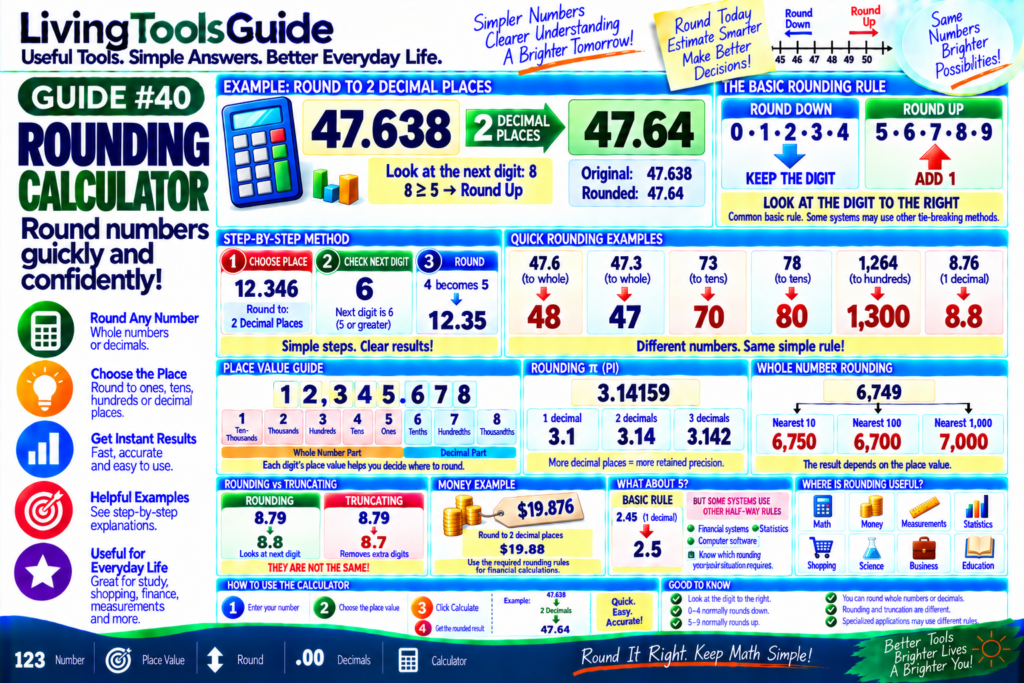
Rounding makes numbers simpler and easier to read, compare, estimate, and use in everyday calculations.
For example, the number:
47.638
can be rounded to:
48 — nearest whole number
47.6 — nearest tenth
47.64 — nearest hundredth
A Rounding Calculator lets you enter a number, choose the place value you want, and instantly get the rounded result.
Rounding is useful in mathematics, money, measurements, statistics, science, shopping, budgeting, and many other everyday situations.
What Does Rounding Mean?
Rounding replaces a number with a nearby value that is easier to work with while keeping it reasonably close to the original.
For example:
73 → 70
when rounding to the nearest ten.
And:
78 → 80
when rounding to the nearest ten.
The original number changes slightly, but the rounded number is often more convenient for estimates and comparisons.
The Basic Rounding Rule
The familiar elementary rounding rule is:
0, 1, 2, 3, 4 → Round Down
5, 6, 7, 8, 9 → Round Up
To round a number:
1 — Find the digit at the place you want to round.
2 — Look at the digit immediately to its right.
3 — If that digit is 0–4, keep the rounding digit unchanged.
4 — If it is 5–9, increase the rounding digit by 1.
5 — Remove or replace the remaining digits as appropriate.
This is commonly called the round-half-up style rule for positive numbers. Some software, financial, scientific, or statistical systems may use other tie-breaking rules, so your calculator’s stated method should be followed when exact behavior matters.
Example 1 — Round to the Nearest Whole Number
Round:
47.6
Look at the tenths digit:
6
Because 6 is 5 or greater, round upward.
Result:
48
Another example:
47.3
The tenths digit is 3.
Therefore:
47
Example 2 — Round to the Nearest Ten
Round:
347
The tens digit is:
4
Look at the ones digit:
7
Because 7 is 5 or greater, increase the tens digit from 4 to 5.
Result:
350
Example 3 — Round to the Nearest Hundred
Round:
1,264
The hundreds digit is:
2
Look at the tens digit:
6
Since 6 is 5 or greater, round the hundreds digit upward.
Result:
1,300
Example 4 — Round to One Decimal Place
Round:
8.76
to one decimal place.
The tenths digit is:
7
Look at the hundredths digit:
6
Because 6 is 5 or greater:
8.76 → 8.8
Example 5 — Round to Two Decimal Places
Round:
12.346
to two decimal places.
The hundredths digit is:
4
Look at the next digit:
6
Round 4 upward to 5.
Result:
12.35
Place Value Guide
Understanding place value makes rounding much easier.
For the number:
12,345.678
the positions are:
| Digit | Place |
|---|---|
| 1 | Ten-thousands |
| 2 | Thousands |
| 3 | Hundreds |
| 4 | Tens |
| 5 | Ones |
| 6 | Tenths |
| 7 | Hundredths |
| 8 | Thousandths |
The digit immediately to the right determines whether the selected place rounds up or stays the same.
Quick Rounding Examples
| Number | Round To | Result |
|---|---|---|
| 47.6 | Whole number | 48 |
| 47.3 | Whole number | 47 |
| 73 | Nearest ten | 70 |
| 78 | Nearest ten | 80 |
| 347 | Nearest ten | 350 |
| 1,264 | Nearest hundred | 1,300 |
| 8.76 | 1 decimal place | 8.8 |
| 12.346 | 2 decimal places | 12.35 |
Rounding to Decimal Places
Decimal-place rounding is common when working with measurements and calculations.
Consider:
3.14159
Rounded to:
1 decimal place → 3.1
2 decimal places → 3.14
3 decimal places → 3.142
Notice the third example.
To round to three decimal places, look at the fourth decimal digit:
3.14159
The fourth decimal digit is 5, so the third decimal digit increases from 1 to 2.
Therefore:
3.142
Rounding Whole Numbers
Rounding is not limited to decimals.
Suppose:
6,749
Nearest ten:
6,750
Nearest hundred:
6,700
Nearest thousand:
7,000
The result changes depending on the selected place value.
Rounding vs Truncating
These operations are not the same.
Suppose the number is:
8.79
To one decimal place:
Rounding
Look at the next digit, which is 9.
Therefore:
8.8
Truncating
Simply remove digits beyond the selected place:
8.7
So:
Rounding considers the next digit.
Truncation simply removes extra digits.
Rounding and Money
Money is commonly displayed to two decimal places in currencies divided into 100 minor units.
For example:
$19.876
Rounded to two decimal places using the usual positive-number rule:
$19.88
However, financial systems may have specific rounding requirements, especially for taxes, interest, accounting, or transactions. Use the required method for the particular situation.
What Happens When the Next Digit Is Exactly 5?
In basic arithmetic lessons, a common rule is:
5 → Round Up
For example:
2.45 → 2.5
when rounding to one decimal place under that convention.
But not every system uses the same rule for halfway cases.
Some applications use methods such as round half to even, sometimes called banker’s rounding.
Therefore, when precise rounding rules matter, especially in financial or technical work, check which method is required.
Why Use a Rounding Calculator?
A Rounding Calculator is useful for:
🧮 Mathematics — simplify numerical answers.
💰 Money — display currency amounts appropriately.
📏 Measurements — report practical precision.
📊 Statistics — present results clearly.
🛒 Shopping — make quick estimates.
🔬 Science — work with numerical precision.
💼 Business — simplify figures in reports.
📚 Education — practice place values and rounding.
How to Use the Rounding Calculator
Using your LivingToolsGuide calculator is simple:
1 — Enter Your Number
Example:
47.638
2 — Choose the Rounding Place
For example:
2 Decimal Places
3 — Click Calculate
4 — View the Rounded Number
Result:
47.64
You can repeat the calculation using another place value whenever needed.
Round a Number Now
Need to round a whole number or decimal?
For more information about rounding numbers and rounding methods, see the Rounding reference from Wolfram MathWorld.
Use our Rounding Calculator to quickly round numbers to your selected place value.
The Rounding Calculator makes it easy to round whole numbers and decimals quickly and accurately.
🔢 Number | 🎯 Place Value | ↕️ Round | .00 Decimals | 🧮 Calculator
Round It Right. Keep Math Simple!