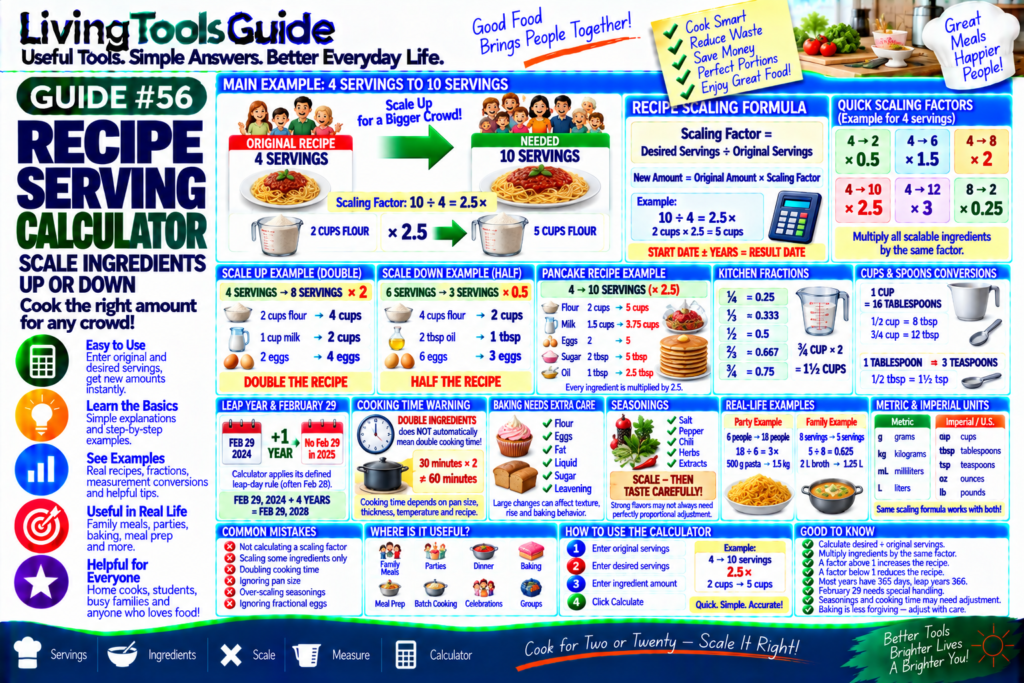
Have you ever found the perfect recipe only to discover that it serves 4 people when you’re cooking for 6, 8, or 12?
Or perhaps a recipe makes too much food and you only need half as much.
A Recipe Serving Calculator helps you adjust ingredient quantities when changing the number of servings.
For example, suppose a recipe serves:
4 People
but you need:
10 Servings
First calculate the scaling factor:
10 ÷ 4 = 2.5
Then multiply every scalable ingredient by:
2.5
If the original recipe requires:
2 cups flour
the adjusted amount is:
2 × 2.5
=
5 Cups Flour
This simple calculation lets you scale recipes up or down without manually recalculating every ingredient.
Important: Mathematical scaling works well for many ingredients, but cooking does not always scale perfectly. Seasonings, leavening agents, thickening agents, cooking time, pan size, and some baking recipes may require additional adjustment.
What Is a Recipe Serving Calculator?
A Recipe Serving Calculator changes ingredient quantities based on the number of servings you want to prepare.
You enter:
🍽️ Original Servings
👨👩👧👦 Desired Servings
🥣 Original Ingredient Amount
The calculator determines:
NEW INGREDIENT AMOUNT
For reliable measurement and unit information used in cooking, see the NIST Guide to the SI.
The central idea is:
New Amount = Original Amount × Scaling Factor
Recipe Scaling Formula
First calculate:
Scaling Factor = Desired Servings ÷ Original Servings
Then:
New Ingredient Amount = Original Amount × Scaling Factor
For example:
Original recipe = 4 servings
Desired recipe = 10 servings
Scaling factor:
10 ÷ 4
=
2.5
Therefore every directly scalable ingredient is multiplied by:
2.5
Example — Scale 4 Servings to 8
Suppose a recipe serves:
4
You want:
8
Calculate:
8 ÷ 4
=
2
Therefore:
DOUBLE THE RECIPE
Original ingredients:
2 cups flour
1 cup milk
2 eggs
Scaled amounts:
4 cups flour
2 cups milk
4 eggs
Example — Scale 4 Servings to 6
Original servings:
4
Desired servings:
6
Scaling factor:
6 ÷ 4
=
1.5
Therefore:
2 cups flour
becomes:
2 × 1.5
=
3 cups
1 cup milk
becomes:
1 × 1.5
=
1.5 cups
2 tablespoons oil
becomes:
2 × 1.5
=
3 tablespoons
Example — Scale 6 Servings to 3
Recipe serves:
6
You only need:
3
Scaling factor:
3 ÷ 6
=
0.5
Therefore:
MAKE HALF THE RECIPE
For example:
4 cups
becomes:
2 cups
2 tablespoons
becomes:
1 tablespoon
6 eggs
becomes:
3 eggs
Quick Scaling Factors
| Original Servings | Desired Servings | Scaling Factor |
|---|---|---|
| 4 | 2 | 0.5× |
| 4 | 4 | 1× |
| 4 | 6 | 1.5× |
| 4 | 8 | 2× |
| 4 | 10 | 2.5× |
| 4 | 12 | 3× |
| 6 | 3 | 0.5× |
| 6 | 9 | 1.5× |
| 8 | 12 | 1.5× |
Scaling a Complete Recipe
Suppose a pancake recipe serves:
4 People
Ingredients:
2 cups flour
1.5 cups milk
2 eggs
2 tbsp sugar
1 tbsp oil
You need:
10 Servings
Scaling factor:
10 ÷ 4 = 2.5
Now multiply each ingredient.
Flour
2 × 2.5
=
5 cups
Milk
1.5 × 2.5
=
3.75 cups
Eggs
2 × 2.5
=
5 eggs
Sugar
2 × 2.5
=
5 tbsp
Oil
1 × 2.5
=
2.5 tbsp
Scaling a Recipe Down
The calculator isn’t only useful for larger meals.
You can also make a recipe smaller.
Suppose:
Original = 8 servings
Desired = 2 servings
Calculate:
2 ÷ 8
=
0.25
So you need:
ONE-QUARTER OF THE ORIGINAL RECIPE
If the recipe calls for:
4 cups broth
you need:
4 × 0.25
=
1 cup
Half a Recipe
To halve a recipe:
Multiply Ingredients × 0.5
Examples:
2 cups → 1 cup
1 cup → ½ cup
½ cup → ¼ cup
4 tbsp → 2 tbsp
2 tsp → 1 tsp
Double a Recipe
To double:
Multiply × 2
Examples:
1 cup → 2 cups
1½ cups → 3 cups
2 tbsp → 4 tbsp
3 eggs → 6 eggs
Triple a Recipe
To triple:
Multiply × 3
Examples:
1 cup → 3 cups
¾ cup → 2¼ cups
2 tbsp → 6 tbsp
2 eggs → 6 eggs
Fractions in Recipes
Recipes frequently use fractions such as:
¼
⅓
½
⅔
¾
These can sometimes make manual scaling confusing.
For example:
¾ cup × 2
=
1½ cups
Another example:
⅔ cup × 1.5
=
1 cup
A Recipe Serving Calculator can make these calculations much easier.
Useful Kitchen Fractions
| Fraction | Decimal |
|---|---|
| ¼ | 0.25 |
| ⅓ | ≈ 0.333 |
| ½ | 0.5 |
| ⅔ | ≈ 0.667 |
| ¾ | 0.75 |
| 1¼ | 1.25 |
| 1½ | 1.5 |
| 1¾ | 1.75 |
Decimals are useful when calculating scaled ingredient amounts.
Cups and Tablespoons
Useful kitchen relationship:
1 Cup = 16 Tablespoons
Therefore:
½ cup
=
8 tablespoons
¼ cup
=
4 tablespoons
¾ cup
=
12 tablespoons
These conversions can be useful when a scaled recipe produces an awkward cup fraction.
Tablespoons and Teaspoons
A common kitchen conversion is:
1 Tablespoon = 3 Teaspoons
Therefore:
½ tablespoon
=
1½ teaspoons
and:
⅓ tablespoon
=
1 teaspoon
For very small quantities, switching units can make measurement easier.
Example — Awkward Measurement
Suppose the scaled result is:
0.25 Cup
Instead of measuring a decimal cup amount, convert it:
0.25 Cup = ¼ Cup
or:
4 Tablespoons
This makes the ingredient easier to measure in the kitchen.
Scaling Eggs
Eggs can be tricky when scaling produces a fraction.
Suppose:
Original recipe = 4 servings
Eggs = 1
You want:
6 servings
Scaling factor:
6 ÷ 4 = 1.5
Mathematically:
1 × 1.5 = 1.5 Eggs
You cannot simply use half an intact egg.
For some recipes, you can beat an egg and measure approximately half of the beaten mixture.
For other recipes, especially baking, it may be easier to choose a batch size that produces whole eggs.
Do Cooking Times Scale Too?
Usually:
NOT DIRECTLY
If you double the ingredients, you should not automatically double the cooking time.
For example:
Original cooking time = 30 minutes
Doubling the recipe does not automatically mean:
60 minutes
Cooking time depends on factors such as:
🔥 Cooking method
🍳 Pan size
📏 Food thickness
🌡️ Temperature
🥘 Recipe type
Always use the recipe’s doneness indicators and appropriate food-safety guidance.
Pan Size Matters
If you increase a recipe substantially but use the same pan, the food may become:
Deeper
Thicker
and potentially:
Slower to cook
For baked goods, using an appropriately sized pan can help maintain a similar batter depth.
A larger recipe may need:
A Larger Pan
or:
Multiple Pans
Baking Requires Extra Care
Cooking recipes can often tolerate approximate adjustments.
Baking is usually less forgiving.
The balance between:
🌾 Flour
🥚 Eggs
🧈 Fat
💧 Liquid
🍬 Sugar
and:
🧁 Leavening
can affect the final texture and structure.
Scale carefully and follow recipe-specific instructions where available.
Seasonings May Need Adjustment
Salt, spices, chili, herbs, extracts, and other strongly flavored ingredients do not always need to be increased exactly in proportion.
For example, if doubling a recipe:
Original chili = 1 tsp
Mathematical result:
2 tsp
But depending on the recipe and your preference, you may choose to start with less and adjust after tasting when it is safe to do so.
Leavening Ingredients
Ingredients such as:
Baking Powder
Baking Soda
Yeast
may require more care when scaling certain recipes.
While mathematical scaling provides a starting quantity, very large changes to a baking recipe can affect rise, fermentation, texture, and baking behavior.
Follow recipe-specific guidance when possible.
Scaling by Portion Size
Serving counts assume that a “serving” remains the same size.
Suppose a recipe makes:
4 servings
with each serving approximately:
250 g
Total food:
4 × 250
=
1,000 g
If you want:
6 servings
of the same size:
6 × 250
=
1,500 g
Scaling factor:
1,500 ÷ 1,000
=
1.5
Again, the recipe should be multiplied by approximately 1.5.
Party Example
Suppose a pasta recipe serves:
6 People
You’re cooking for:
18 People
Scaling factor:
18 ÷ 6
=
3
Therefore:
TRIPLE THE RECIPE
If the original requires:
500 g pasta
then:
500 × 3
=
1,500 g
or:
1.5 kg
Family Dinner Example
Suppose a soup recipe serves:
8
but only:
5 people
are eating.
Scaling factor:
5 ÷ 8
=
0.625
If the original recipe requires:
2 liters broth
then:
2 × 0.625
=
1.25 Liters
Metric Recipes
The same formula works with:
grams (g)
kilograms (kg)
milliliters (mL)
liters (L)
Example:
600 g flour
Scaling factor:
1.5
Calculation:
600 × 1.5
=
900 g Flour
Imperial / U.S. Recipe Units
The same principle works with:
Cups
Tablespoons
Teaspoons
Ounces
Pounds
Example:
2 cups milk
×
1.5
=
3 cups
Common Recipe Scaling Mistakes
❌ Changing Servings Without Calculating a Factor
Always calculate:
Desired ÷ Original
❌ Scaling Some Ingredients but Not Others
Most main ingredients should follow the same base factor.
❌ Automatically Scaling Cooking Time
Cooking time does not increase proportionally with servings.
❌ Ignoring Pan Size
A larger quantity may require a different pan.
❌ Treating Seasoning as Exact
Taste-sensitive ingredients may require adjustment.
❌ Ignoring Fractional Eggs
Some recipes need special handling when egg quantities are fractional.
Where Is a Recipe Serving Calculator Useful?
It can help with:
👨👩👧👦 Family Meals
🎉 Parties
🍽️ Dinner
🧁 Baking
🥘 Meal Prep
🍲 Batch Cooking
🎂 Celebrations
🏕️ Group Cooking
How to Use the Recipe Serving Calculator
Using your LivingToolsGuide calculator is simple:
1 — Enter Original Servings
Example:
4
2 — Enter Desired Servings
Example:
10
3 — Enter Ingredient Quantity
Example:
2 Cups
4 — Click Calculate
Scaling factor:
2.5×
Adjusted ingredient:
5 CUPS
Repeat the same scaling factor for the other scalable ingredients.
Scale Your Recipe Now
Cooking for more—or fewer—people than your recipe was designed for?
Use our Recipe Serving Calculator to adjust ingredient quantities for the number of servings you need.
👉 Use the Recipe Serving Calculator
🍽️ Servings | 🥣 Ingredients | ✖️ Scale | 🥄 Measure | 🧮 Calculator
Cook for Two or Twenty — Scale It Right!