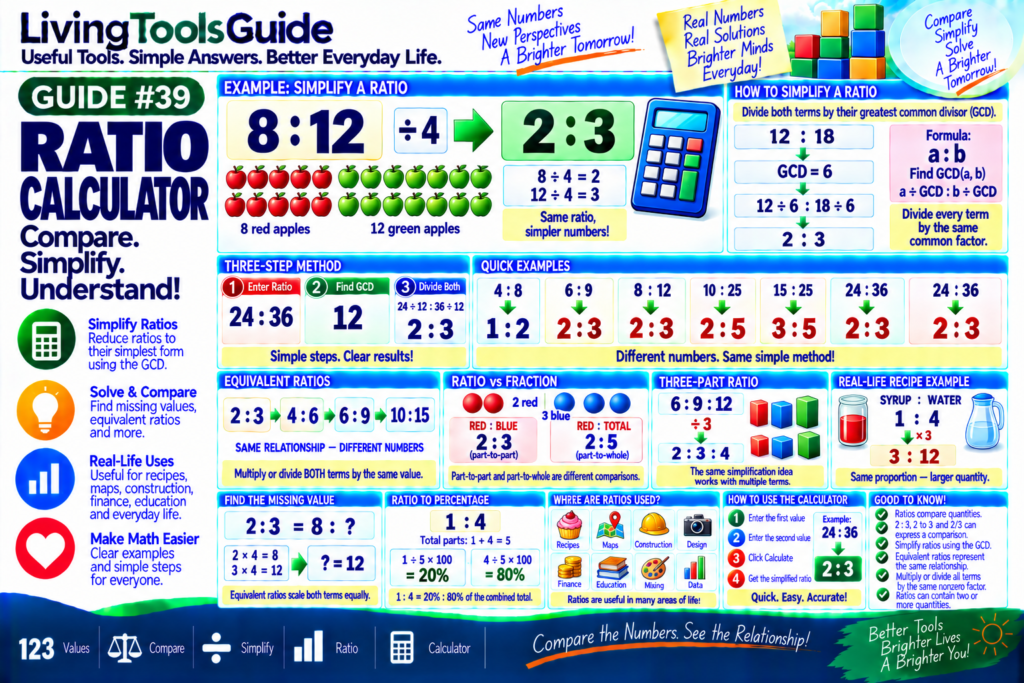
Ratios are used to compare two or more quantities. We see them in recipes, maps, construction, finance, education, photography, design, mixtures, and everyday calculations.
For example, suppose a basket contains:
8 red apples and 12 green apples
The ratio of red apples to green apples is:
8 : 12
Both numbers can be divided by 4:
8 ÷ 4 = 2
12 ÷ 4 = 3
Therefore, the simplified ratio is:
2 : 3
A Ratio Calculator makes this process easy. Enter the values, and the calculator can help simplify or compare the ratio.
What Is a Ratio?
A ratio compares one quantity with another.
For example:
2 : 3
means:
2 parts of one quantity for every 3 parts of another quantity.
Ratios can be written in several ways:
2 : 3
2 to 3
2/3
These can represent the same comparison, although the fraction form may be interpreted differently depending on context.
How to Simplify a Ratio
To simplify a ratio, divide both terms by their greatest common divisor (GCD).
For example:
12 : 18
The greatest common divisor of 12 and 18 is:
6
Divide both values by 6:
12 ÷ 6 = 2
18 ÷ 6 = 3
Therefore:
12 : 18 = 2 : 3
Ratio Simplification Formula
For a two-part ratio:
a : b
Find:
GCD(a,b)
Then calculate:
a ÷ GCD : b ÷ GCD
Example:
20 : 30
GCD:
10
Then:
20 ÷ 10 : 30 ÷ 10
Result:
2 : 3
Example 1 — Simplify 8:12
Original ratio:
8 : 12
GCD:
4
Divide:
8 ÷ 4 = 2
12 ÷ 4 = 3
Result:
2 : 3
Example 2 — Simplify 15:25
Original:
15 : 25
GCD:
5
Calculation:
15 ÷ 5 = 3
25 ÷ 5 = 5
Result:
3 : 5
Example 3 — Simplify 24:36
GCD of 24 and 36:
12
Calculation:
24 ÷ 12 = 2
36 ÷ 12 = 3
Therefore:
24 : 36 = 2 : 3
Example 4 — Ratio Already Simplified
Consider:
7 : 11
The only common positive factor is:
1
Therefore:
7 : 11
is already in simplest whole-number form.
Quick Ratio Examples
| Original Ratio | Divide By | Simplified |
|---|---|---|
| 4 : 8 | 4 | 1 : 2 |
| 6 : 9 | 3 | 2 : 3 |
| 8 : 12 | 4 | 2 : 3 |
| 10 : 25 | 5 | 2 : 5 |
| 15 : 25 | 5 | 3 : 5 |
| 20 : 30 | 10 | 2 : 3 |
| 24 : 36 | 12 | 2 : 3 |
Equivalent Ratios
Different-looking ratios can represent the same relationship.
For example:
2 : 3
Multiply both sides by 2:
4 : 6
Multiply both sides by 3:
6 : 9
Multiply both sides by 5:
10 : 15
Therefore:
2:3 = 4:6 = 6:9 = 10:15
These are called equivalent ratios.
The important rule is:
Multiply or divide both terms by the same nonzero value.
Ratio vs Fraction
Ratios and fractions are closely related, but their meanings can differ.
Suppose there are:
2 red balls
and
3 blue balls
The ratio of red to blue is:
2 : 3
But there are:
5 balls altogether
So the fraction of all balls that are red is:
2/5
Therefore:
Part-to-Part Ratio = 2 : 3
while:
Part-to-Whole Fraction = 2/5
This distinction is very useful for beginners.
Ratios With Three Quantities
Ratios can contain more than two terms.
For example:
6 : 9 : 12
All three numbers can be divided by:
3
So:
6 ÷ 3 = 2
9 ÷ 3 = 3
12 ÷ 3 = 4
Therefore:
6 : 9 : 12 = 2 : 3 : 4
If your calculator supports multi-part ratios, visitors can use the same general simplification principle.
Scaling a Ratio
Suppose a recipe uses:
2 cups flour : 1 cup sugar
If you double the recipe:
2 × 2 = 4 cups flour
1 × 2 = 2 cups sugar
The ratio becomes:
4 : 2
Simplified:
2 : 1
The relationship remains unchanged.
Example — Recipe Ratio
Suppose a drink mixture uses:
1 part syrup : 4 parts water
If you use:
3 cups syrup
multiply both parts by 3:
1 × 3 = 3
4 × 3 = 12
So you need:
3 cups syrup : 12 cups water
The ratio remains:
1 : 4
Finding a Missing Value in an Equivalent Ratio
Suppose:
2 : 3 = 8 : x
Because:
2 × 4 = 8
we multiply the other term by the same value:
3 × 4 = 12
Therefore:
x = 12
You can also solve it using a proportion:
2/3 = 8/x
Cross multiply:
2x = 24
Then:
x = 12
Ratios and Percentages
Ratios can sometimes be converted into percentages.
For example:
1 : 4
If this means 1 part out of a total of:
1 + 4 = 5 parts
then the first part represents:
1 ÷ 5 × 100
=
20% of the total
The second part represents:
4 ÷ 5 × 100
=
80% of the total
So:
1 : 4
can represent a 20% : 80% split of the combined total.
Where Are Ratios Used?
Ratios appear in many everyday situations:
🍰 Recipes — ingredient proportions.
🗺️ Maps — scale and distance.
🏗️ Construction — dimensions and mixtures.
📸 Photography & Design — aspect ratios.
💰 Finance — comparing financial quantities.
📚 Education — mathematics and science.
🎨 Mixing — paint, liquids and materials.
📊 Data — comparing groups and values.
How to Use the Ratio Calculator
Using your LivingToolsGuide calculator is simple:
1 — Enter the First Value
Example:
24
2 — Enter the Second Value
Example:
36
3 — Click Calculate
4 — View the Simplified Ratio
Result:
24 : 36
↓
2 : 3
The calculator handles the simplification automatically.
Calculate and Simplify Your Ratio
Need to simplify or compare a ratio?
Use our Ratio Calculator to quickly reduce ratios and understand the relationship between values.
For more information about ratios and mathematical proportions, see the Ratio reference from Wolfram MathWorld.
The Ratio Calculator makes it easy to simplify ratios and compare quantities quickly and accurately.