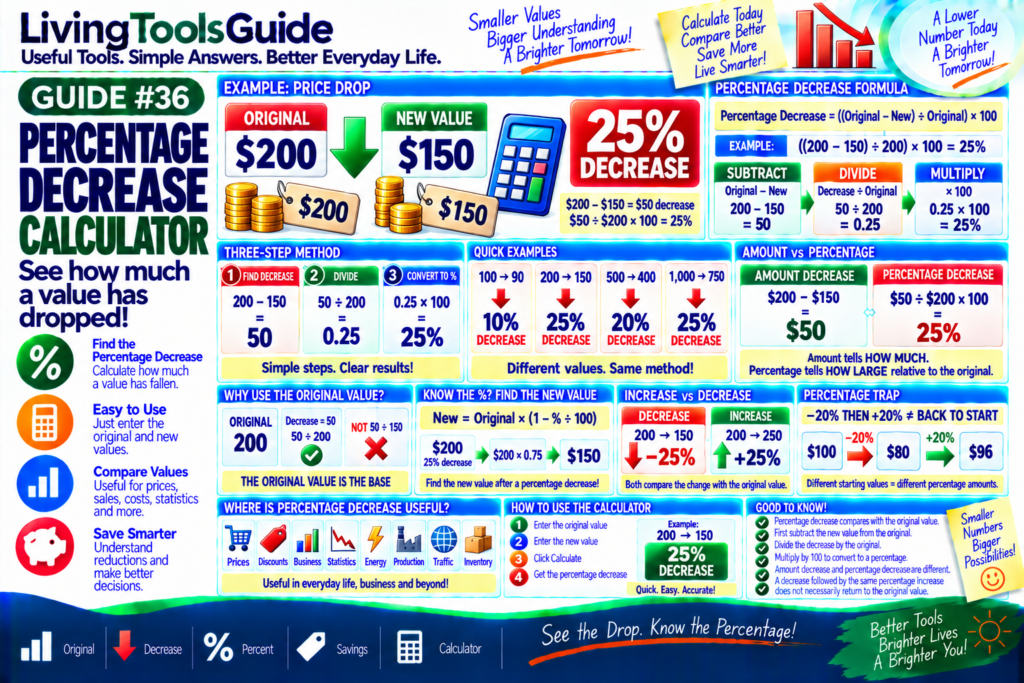
Percentage decrease is a simple way to measure how much a value has fallen compared with its original amount.
It is useful when comparing prices, costs, sales, measurements, populations, website traffic, business results, and many other values.
A Percentage Decrease Calculator makes it easy to compare an original value with a lower value and quickly measure the percentage decrease.
For example, if a product originally costs $200 and its price drops to $150, the decrease is $50.
Compared with the original $200 value, that represents a:
25% Decrease
A Percentage Decrease Calculator makes this calculation quick. Simply enter the original value and the new value to find the percentage decrease.
What Is Percentage Decrease?
Percentage decrease measures the reduction from an original value to a smaller new value as a percentage of the original.
For example:
Original Value = 200
New Value = 150
Difference:
200 − 150 = 50
Now compare the decrease with the original value:
50 ÷ 200 = 0.25
Convert to a percentage:
0.25 × 100 = 25%
Therefore:
200 → 150 = 25% Decrease
Percentage Decrease Calculator Formula
The standard formula is:
Percentage Decrease = ((Original Value − New Value) ÷ Original Value) × 100
Or more simply:
Decrease = Original − New
Then:
Percentage Decrease = (Decrease ÷ Original) × 100
For an official explanation of how percent changes are calculated, see the U.S. Bureau of Labor Statistics guide to calculating percent changes.
Example 1 — Price Drops From $200 to $150
Original price:
$200
New price:
$150
First calculate the decrease:
$200 − $150 = $50
Then:
$50 ÷ $200 = 0.25
Finally:
0.25 × 100 = 25%
Result:
25% Decrease
Example 2 — Price Drops From $80 to $60
Original:
$80
New:
$60
Decrease:
80 − 60 = 20
Calculation:
20 ÷ 80 × 100
Result:
25% Decrease
Although the numbers are different from the first example, the percentage decrease is the same.
Example 3 — Value Drops From 500 to 400
Original:
500
New:
400
Difference:
500 − 400 = 100
Then:
100 ÷ 500 × 100
Result:
20% Decrease
Example 4 — Value Drops From 1,000 to 750
Original:
1,000
New:
750
Decrease:
1,000 − 750 = 250
Calculation:
250 ÷ 1,000 × 100
Result:
25% Decrease
Quick Percentage Decrease Examples
| Original | New | Decrease | % Decrease |
|---|---|---|---|
| 100 | 90 | 10 | 10% |
| 100 | 75 | 25 | 25% |
| 200 | 150 | 50 | 25% |
| 500 | 400 | 100 | 20% |
| 800 | 600 | 200 | 25% |
| 1,000 | 750 | 250 | 25% |
Why Divide by the Original Value?
This is one of the most important parts of the calculation.
Suppose a value falls:
200 → 150
The decrease is:
50
The percentage decrease compares that 50 with the starting value of 200.
Therefore:
50 ÷ 200 × 100 = 25%
You normally do not divide by the new value when calculating percentage decrease.
The original value is the reference point.
Percentage Decrease vs Amount Decrease
These two values are related but different.
Suppose:
Original = $200
New = $150
Amount Decrease
$200 − $150
=
$50
Percentage Decrease
$50 ÷ $200 × 100
=
25%
So:
$50 tells you how much the value decreased.
25% tells you how large that decrease was relative to the original value.
How to Find the New Value After a Percentage Decrease
Sometimes you know the original amount and percentage decrease but want to calculate the new amount.
Use:
New Value = Original × (1 − Percentage ÷ 100)
Example:
Original price:
$200
Decrease:
25%
Calculation:
$200 × (1 − 0.25)
$200 × 0.75
Result:
$150
Example — 15% Decrease From $500
Original:
$500
Percentage decrease:
15%
First calculate the reduction:
$500 × 0.15 = $75
Then:
$500 − $75 = $425
Therefore:
$500 decreased by 15% = $425
Percentage Decrease vs Percentage Increase
The formulas are similar, but the direction changes.
Percentage Decrease
Original → Smaller Value
Example:
200 → 150
=
25% Decrease
Percentage Increase
Original → Larger Value
Example:
200 → 250
Increase:
50
Then:
50 ÷ 200 × 100
=
25% Increase
In both cases, the original value is normally used as the comparison base.
A Common Percentage Mistake
Percentage changes are not always reversible using the same percentage.
For example:
Start with:
$100
Decrease by 20%:
$100 → $80
Now increase $80 by 20%:
$80 × 1.20 = $96
You do not return to $100.
Why?
Because the second percentage is calculated from a different starting value.
So:
−20% followed by +20% ≠ original value
This is an important concept when comparing percentage changes.
Where Is Percentage Decrease Useful?
Percentage decrease is commonly used for:
💰 Prices — measuring price reductions.
🏷️ Discounts — understanding reduced prices.
📊 Business — comparing declining sales or costs.
📉 Statistics — measuring reductions in values.
⚡ Energy — comparing reduced consumption.
🏭 Production — measuring output changes.
🌐 Website Traffic — comparing decreases in visits or activity.
📦 Inventory — measuring reductions in stock.
How to Use the Percentage Decrease Calculator
Using your LivingToolsGuide calculator is simple:
1 — Enter the Original Value
2 — Enter the New Value
3 — Click Calculate
4 — View the Percentage Decrease
Example:
Original Value: 200
New Value: 150
↓
25% DECREASE
The calculator handles the subtraction, division, and percentage conversion automatically.
Calculate Your Percentage Decrease
Need to find how much a value has fallen?
Use our Percentage Decrease Calculator to quickly compare an original value with a lower new value and calculate the percentage decrease.
👉 Use the Percentage Decrease Calculator
Use our Percentage Decrease Calculator whenever you need a quick way to measure reductions in prices, costs, sales, budgets or other values.
📊 Original | 📉 Decrease | % Percent | 🏷️ Savings | 🧮 Calculator
See the Drop. Know the Percentage!