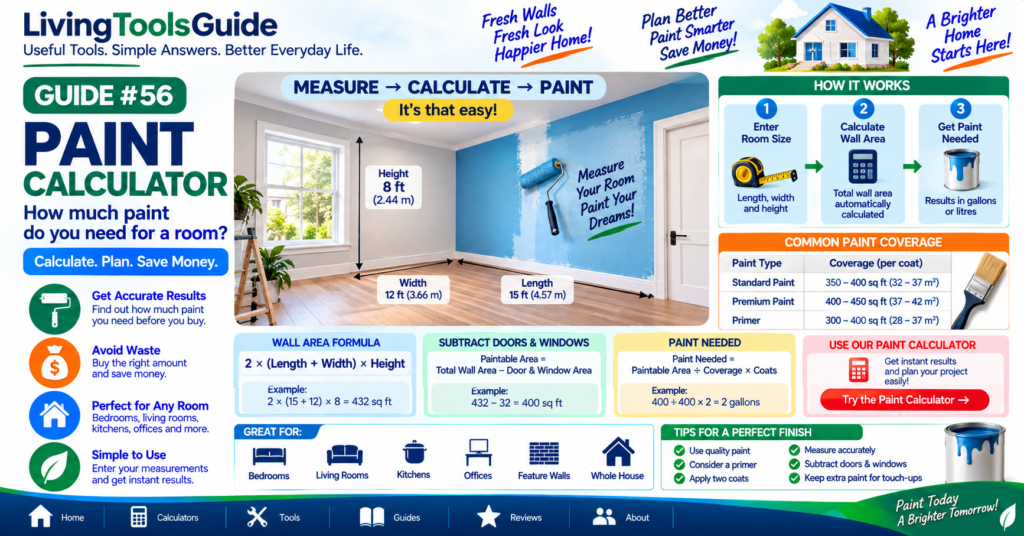
The Paint Calculator helps you quickly estimate how much paint you need for a room based on its wall dimensions and paint coverage.
Painting a room can completely change its appearance, but buying the correct amount of paint is important. Too little paint means another trip to the store, while buying too much can waste money.
Fortunately, you can estimate the amount of paint you need using a few simple measurements.
How to Calculate Paint Needed for a Room
Start by measuring the length, width, and height of the room.
For a rectangular room, you can estimate the total wall area with:
Wall Area = 2 × (Length + Width) × Height
For more information about calculating geometric areas, see the Area reference from Wolfram MathWorld.
For example, suppose your room is:
Length = 15 ft
Width = 12 ft
Height = 8 ft
The wall area is:
2 × (15 + 12) × 8 = 432 sq ft
You can then subtract the approximate area occupied by doors and windows.
How Much Area Does One Gallon of Paint Cover?
A gallon of paint commonly covers roughly 350–400 square feet with one coat, although actual coverage varies depending on the paint, surface, application method, and manufacturer instructions.
If your paintable wall area is 400 sq ft and your paint covers 400 sq ft per gallon:
400 ÷ 400 = 1 gallon per coat
If you plan to apply two coats:
1 × 2 = 2 gallons
Always check the coverage information printed on the paint container.
Why Are Two Coats of Paint Often Used?
A second coat can provide more even color, better coverage, and a more consistent finish.
You may particularly need additional coverage when changing from a very dark color to a light color or painting a porous or previously unpainted surface.
Primer may also be recommended depending on the wall condition and type of paint.
Don’t Forget Doors and Windows
Doors and windows reduce the amount of wall surface that needs painting.
For a more accurate estimate, measure their height and width and subtract their combined area from the total wall area.
Paintable Area = Total Wall Area − Doors and Windows
Use Our Paint Calculator
Instead of calculating everything manually, use the LivingToolsGuide Paint Calculator.
Enter your room measurements and other required information to quickly estimate how much paint your project may require.
This is especially useful when planning bedrooms, living rooms, offices, and other home painting projects.
Tips Before Buying Paint
Measure the room carefully before purchasing paint. Check the manufacturer’s stated coverage, decide how many coats you plan to apply, and consider whether the walls require primer.
It can also be useful to have a small amount of matching paint left over for future touch-ups.
Frequently Asked Questions
How much paint do I need for one room?
It depends on the room’s paintable surface area, number of coats, and the coverage rate of your chosen paint.
Is one gallon enough for a bedroom?
It may be enough for some rooms for a single coat, but room dimensions, doors, windows, wall texture, and paint coverage all affect the amount required.
Should I apply one coat or two coats?
Two coats are commonly used for better and more consistent coverage, but the appropriate number depends on the existing surface, color change, and paint manufacturer’s instructions.
Do I need to subtract windows and doors?
For a more precise estimate, yes. Subtracting areas that won’t be painted prevents them from being counted as part of the paintable wall area.
How can I calculate paint faster?
Use the LivingToolsGuide Paint Calculator to estimate your paint requirements from your measurements.
Tips for Estimating Paint More Accurately
Measure each wall carefully and subtract large doors and windows from the total paintable area. Remember that paint coverage can vary depending on the surface, paint type, color, and application method.
Most projects also require more than one coat for an even finish. Keeping a small amount of extra paint can be useful for future touch-ups and minor repairs.
The Paint Calculator makes it easy to estimate paint requirements quickly and avoid buying too much or too little paint.