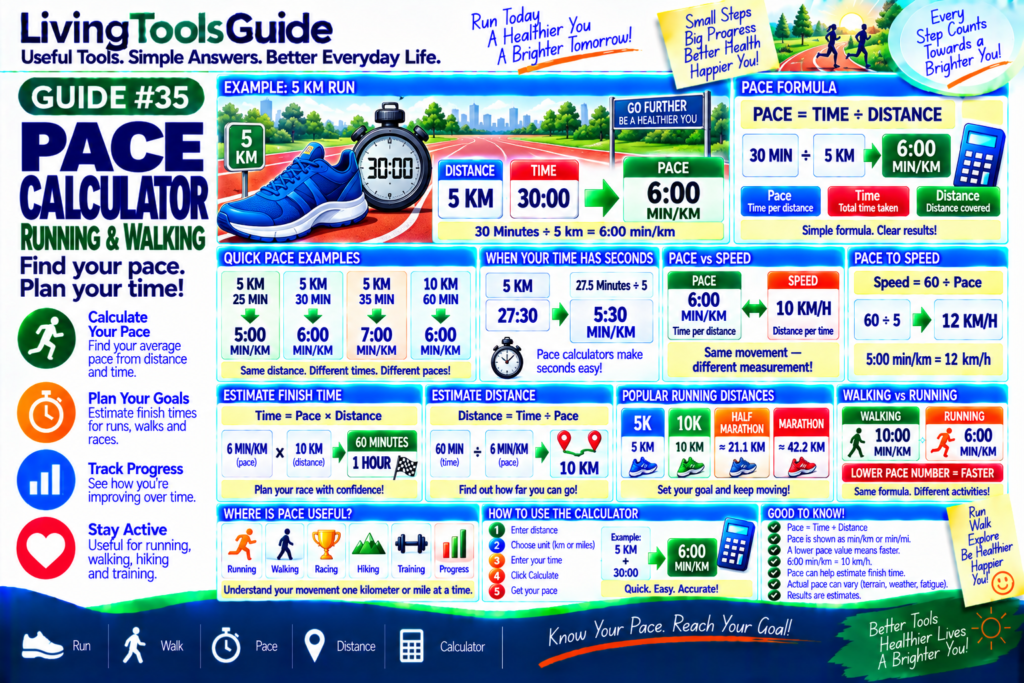
Whether you’re running, jogging, walking, hiking, or training for a race, pace is a useful way to understand how quickly you’re covering a certain distance.
Instead of simply showing speed, pace tells you how much time you take to travel one unit of distance.
For example, if you run 5 kilometers in 30 minutes, your average pace is:
6:00 minutes per kilometer
A Pace Calculator makes this calculation easy. Enter your distance and total time, and the calculator determines your average pace.
It can also help runners and walkers estimate how long a distance may take at a particular pace.
For more information about physical activity and its health benefits, see the CDC Physical Activity Basics.
What Is Pace?
Pace measures the amount of time required to cover a specific distance.
For more information about walking, running, and exercise intensity, see the CDC guide to measuring physical activity intensity.
Common pace formats include:
Minutes per kilometer — min/km
and
Minutes per mile — min/mi
For example:
6:00 min/km
means you take approximately 6 minutes to travel each kilometer.
Similarly:
10:00 min/mi
means you take approximately 10 minutes to travel each mile.
Pace Formula
The basic formula is:
Pace = Time ÷ Distance
For example:
Time = 30 minutes
Distance = 5 km
Calculation:
30 ÷ 5 = 6
Therefore:
Pace = 6:00 min/km
Example 1 — 5K Run
Suppose you complete:
Distance: 5 km
Time: 30 minutes
Calculation:
30 ÷ 5 = 6
Result:
6:00 min/km
At this average pace, each kilometer takes approximately six minutes.
Example 2 — 10K Run
Distance:
10 km
Time:
60 minutes
Calculation:
60 ÷ 10 = 6
Result:
6:00 min/km
Maintaining that pace would result in approximately a 60-minute 10K.
Example 3 — Walking Pace
Suppose you walk:
5 km
in:
50 minutes
Calculation:
50 ÷ 5 = 10
Therefore:
10:00 min/km
Pace calculations work for walking just as they do for running.
Example 4 — Pace With Seconds
Suppose you run:
5 km in 27 minutes 30 seconds
Convert the total time:
27 minutes 30 seconds = 27.5 minutes
Then:
27.5 ÷ 5 = 5.5 minutes
The decimal 0.5 minute equals:
0.5 × 60 = 30 seconds
Therefore:
Pace = 5:30 min/km
This is why a calculator is especially useful when times include seconds.
Pace vs Speed
Pace and speed describe movement differently.
Pace
Tells you:
Time needed per unit of distance
Example:
6:00 min/km
Speed
Tells you:
Distance traveled per unit of time
Example:
10 km/h
For a 6:00 min/km pace:
60 ÷ 6 = 10
Therefore:
6:00 min/km = 10 km/h
They describe the same movement in different ways.
Pace to Speed Formula
When pace is expressed in minutes per kilometer:
Speed (km/h) = 60 ÷ Pace (min/km)
Example:
Pace = 5 min/km
Calculation:
60 ÷ 5 = 12
Therefore:
5:00 min/km = 12 km/h
Quick Running Pace Examples
| Distance | Time | Average Pace |
|---|---|---|
| 5 km | 25 min | 5:00 min/km |
| 5 km | 30 min | 6:00 min/km |
| 5 km | 35 min | 7:00 min/km |
| 10 km | 50 min | 5:00 min/km |
| 10 km | 60 min | 6:00 min/km |
| 10 km | 70 min | 7:00 min/km |
These examples assume an even average pace over the full distance.
Estimating Finish Time From Pace
You can reverse the calculation if you already know your target pace.
Use:
Time = Pace × Distance
For example:
Pace = 6 minutes/km
Distance = 10 km
Calculation:
6 × 10 = 60 minutes
Result:
Estimated Time = 1 Hour
Estimating Distance From Pace
If you know the time and pace:
Distance = Time ÷ Pace
Example:
Time = 60 minutes
Pace = 6 min/km
Calculation:
60 ÷ 6 = 10
Therefore:
Distance = 10 km
Common Running Distances
Pace calculators are especially useful when planning popular running distances.
🏃 5K — 5 kilometers
🏃 10K — 10 kilometers
🏃 Half Marathon — approximately 21.1 km
🏃 Marathon — approximately 42.2 km
You can use pace to estimate finish times for these distances, but actual performance may vary because of terrain, weather, elevation, fatigue, stops, and other factors.
Running Pace vs Walking Pace
The same calculation applies to both activities:
Pace = Time ÷ Distance
A faster runner will generally have a lower minutes-per-kilometer or minutes-per-mile value.
For example:
5:00 min/km
is faster than:
8:00 min/km
This sometimes seems counterintuitive at first because a smaller pace number means faster movement.
Why Use a Pace Calculator?
A Pace Calculator can help with:
🏃 Running — calculate average training pace.
🚶 Walking — understand walking pace.
🏁 Race Planning — estimate target finish times.
🥾 Hiking — estimate travel duration.
⏱️ Training — compare workouts.
📊 Progress Tracking — monitor changes over time.
Remember that calculated pace is an average; actual pace can vary throughout an activity.
How to Use the Pace Calculator
Using your LivingToolsGuide calculator is simple:
1 — Enter your distance
2 — Select the distance unit
3 — Enter your total time
4 — Click Calculate
5 — View your average pace
Example:
Distance: 5 km
Time: 30:00
↓
PACE = 6:00 MIN/KM
If your calculator supports miles, visitors can also calculate results in minutes per mile.
Calculate Your Running or Walking Pace
Want to know your average pace?
Use our Pace Calculator to calculate running or walking pace from your distance and total time.
🏃 Run | 🚶 Walk | ⏱️ Pace | 📏 Distance | 🧮 Calculator
Know Your Pace. Reach Your Goal!