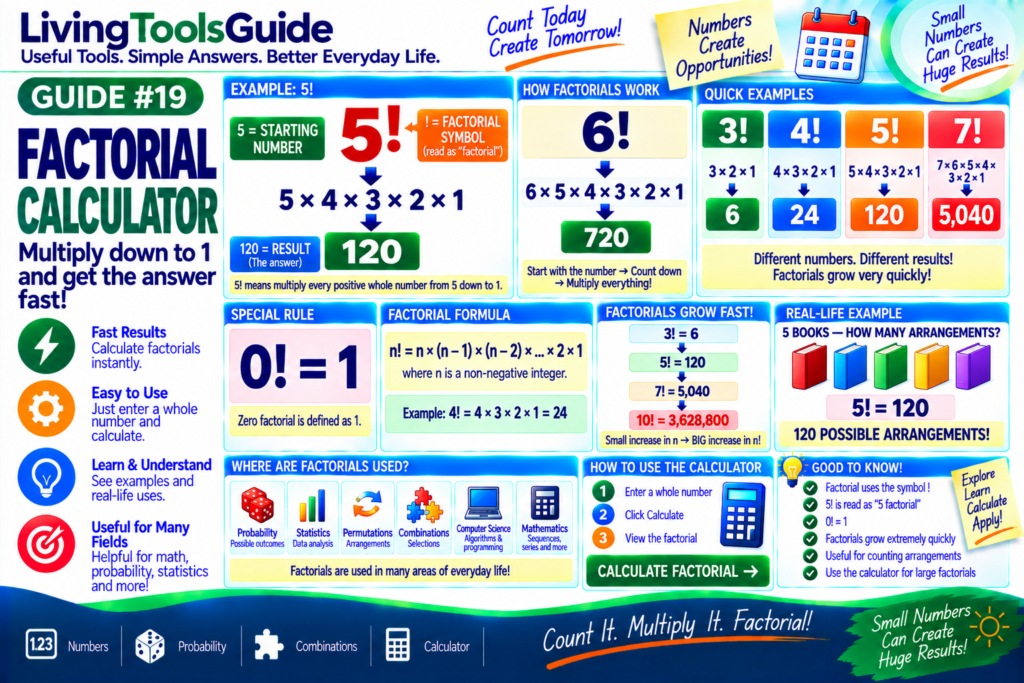
A factorial is a mathematical operation that multiplies a positive whole number by every positive whole number below it.
Factorials are commonly used in mathematics, probability, statistics, combinations, permutations, and computer science.
They are written using an exclamation mark (!) after a number.
For example:
5!
is read as:
“5 factorial.”
A Factorial Calculator makes it easy to calculate factorials instantly, especially when working with larger numbers.
What Is a Factorial?
The factorial of a positive integer n is the product of all positive integers from n down to 1.
For more information about factorials and their mathematical properties, see the Factorial reference from Wolfram MathWorld.
For example:
5! = 5 × 4 × 3 × 2 × 1
Therefore:
5! = 120
Factorial Formula
The general formula is:
n! = n × (n − 1) × (n − 2) × … × 2 × 1
where:
n = a non-negative integer
For example:
4! = 4 × 3 × 2 × 1 = 24
Example 1 — 3!
Calculate:
3!
Expand the factorial:
3 × 2 × 1
Therefore:
3! = 6
Example 2 — 5!
Calculate:
5!
Expand:
5 × 4 × 3 × 2 × 1
Step by step:
5 × 4 = 20
20 × 3 = 60
60 × 2 = 120
120 × 1 = 120
Therefore:
5! = 120
Example 3 — 7!
Calculate:
7!
Expand:
7 × 6 × 5 × 4 × 3 × 2 × 1
Therefore:
7! = 5,040
As the starting number increases, factorial values grow very quickly.
What Is 0 Factorial?
One important factorial rule is:
0! = 1
Although there are no positive integers below zero to multiply, mathematics defines zero factorial as 1.
This definition is especially useful in formulas involving combinations, permutations, and probability.
Factorials Grow Very Quickly
Compare these values:
| Number | Factorial | Result |
|---|---|---|
| 0 | 0! | 1 |
| 1 | 1! | 1 |
| 2 | 2 × 1 | 2 |
| 3 | 3 × 2 × 1 | 6 |
| 4 | 4 × 3 × 2 × 1 | 24 |
| 5 | 5 × 4 × 3 × 2 × 1 | 120 |
| 6 | 6 × 5 × 4 × 3 × 2 × 1 | 720 |
| 7 | 7 × 6 × 5 × 4 × 3 × 2 × 1 | 5,040 |
| 8 | 8! | 40,320 |
| 9 | 9! | 362,880 |
| 10 | 10! | 3,628,800 |
Notice how quickly the results become large.
For example:
5! = 120
but:
10! = 3,628,800
Factorial Recurrence Rule
Factorials also have a useful relationship:
n! = n × (n − 1)!
For example:
5! = 5 × 4!
Since:
4! = 24
we get:
5 × 24 = 120
Therefore:
5! = 120
Where Are Factorials Used?
Factorials are especially important when counting how many different arrangements or selections are possible.
🎲 Probability — calculating possible outcomes.
📊 Statistics — probability distributions and statistical formulas.
🔢 Permutations — finding the number of possible arrangements.
🧩 Combinations — determining how many selections can be made.
💻 Computer Science — algorithms and mathematical programming.
🧮 Mathematics — sequences, series and combinatorics.
Factorials and Permutations
Suppose 5 different books are placed on a shelf.
How many different arrangements are possible?
The calculation is:
5!
Therefore:
5! = 120
So the five books can be arranged in:
120 different ways
This is one reason factorials are so useful in counting problems.
Why Use a Factorial Calculator?
Small factorials are easy to calculate manually.
For example:
4! = 24
But factorials become large extremely quickly.
For example:
15! = 1,307,674,368,000
Calculating numbers like this manually can be time-consuming and prone to mistakes.
A Factorial Calculator lets you simply:
Enter Number → Calculate → Get Factorial
and immediately see the result.
🧮 Calculate a Factorial
Enter a non-negative whole number into our Factorial Calculator to calculate its factorial instantly.
👉 Use the Factorial Calculator
The Factorial Calculator makes it easy to calculate factorials quickly and check your answers accurately.
🔢 Numbers | 🎲 Probability | 🧩 Combinations | 🧮 Calculator
Count It. Multiply It. Factorial!
Small Numbers Can Create Huge Results!