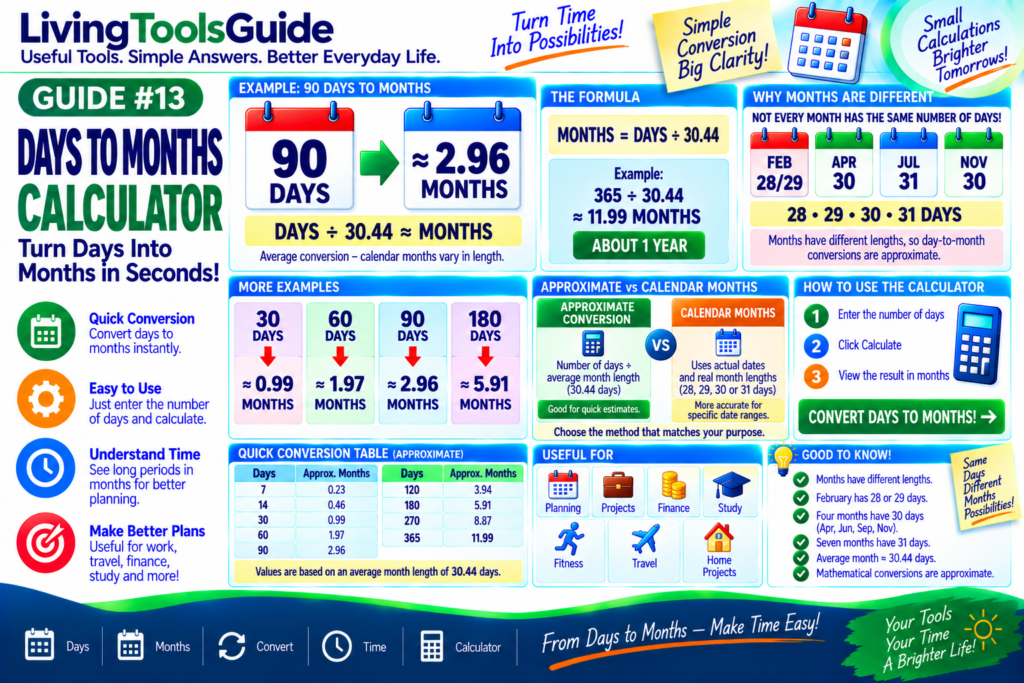
The Days to Months Calculator makes it easy to convert a number of days into an approximate number of months. It is useful for planning schedules, projects, travel, study periods, finances, and other longer time spans.
Converting days into months sounds simple, but there is an important complication: months do not all have the same number of days.
Some months contain 30 days, others contain 31 days, and February contains 28 or 29 days. Because of this, converting days to months can either be an approximate mathematical conversion or an exact calendar-based calculation, depending on what you need.
A Days to Months Calculator makes the process quick and easy.
How Many Days Are in a Month?
There is no single fixed number of days in every calendar month.
Calendar months contain:
28 days — February in a common year
29 days — February in a leap year
30 days — April, June, September and November
31 days — January, March, May, July, August, October and December
For general mathematical conversions, an average month length can be used.
Using the average Gregorian year:
365.2425 ÷ 12 ≈ 30.436875 days per month
So approximately:
1 month ≈ 30.44 days
Days to Months Formula
For an approximate conversion:
Months = Days ÷ 30.44
For example, if you have:
90 days
Then:
90 ÷ 30.44 ≈ 2.96 months
So:
90 days ≈ 2.96 months
or roughly:
3 months
Example 1 — 30 Days to Months
30 ÷ 30.44 ≈ 0.99
Therefore:
30 days ≈ 0.99 months
In everyday conversation, this is usually described as approximately 1 month.
Example 2 — 60 Days to Months
60 ÷ 30.44 ≈ 1.97
Therefore:
60 days ≈ 1.97 months
That’s approximately:
2 months
Example 3 — 90 Days to Months
90 ÷ 30.44 ≈ 2.96
Therefore:
90 days ≈ 2.96 months
That’s roughly:
3 months
Example 4 — 180 Days to Months
180 ÷ 30.44 ≈ 5.91
Therefore:
180 days ≈ 5.91 months
That’s approximately:
6 months
Example 5 — 365 Days to Months
Using the average month length:
365 ÷ 30.44 ≈ 11.99
Therefore:
365 days ≈ 12 months
This is approximately one year.
Quick Days to Months Conversion Table
| Days | Approx. Months |
|---|---|
| 7 | 0.23 |
| 14 | 0.46 |
| 30 | 0.99 |
| 60 | 1.97 |
| 90 | 2.96 |
| 120 | 3.94 |
| 180 | 5.91 |
| 270 | 8.87 |
| 365 | 11.99 |
These are approximate conversions based on an average month length of about 30.44 days.
Why Isn’t 30 Days Always One Month?
It is tempting to use:
1 month = 30 days
for every calculation.
That can be useful as a rough estimate, but it is not an exact calendar conversion.
For example:
January = 31 days
February = 28 or 29 days
April = 30 days
Therefore, 60 calendar days starting from one date may cover a different combination of months and days than 60 days starting from another date.
Approximate Months vs Calendar Months
This distinction is important.
Approximate conversion
When you simply have a number of days, such as:
100 days
you can divide by the average month length to estimate the number of months.
Calendar calculation
If you have actual dates, such as:
January 15 → April 15
it is usually better to calculate the difference using calendar months and remaining days.
That avoids treating every month as if it had the same length.
Where Is Days-to-Months Conversion Useful?
📅 Planning — understand long periods more easily.
💼 Projects — convert project durations into months.
💰 Finance — estimate longer financial periods.
🎓 Education — convert study periods and schedules.
🏃 Fitness — understand training-program durations.
👶 Age & development — estimate periods expressed in days.
✈️ Travel — understand long stays and trip durations.
🏠 Home projects — convert project timelines into easier-to-read units.
How to Use the Days to Months Calculator
Using your LivingToolsGuide calculator is simple.
Step 1: Enter the number of days.
Step 2: Click Calculate.
Step 3: View the equivalent number of months according to the conversion method used by the calculator.
For example:
90 Days → Approximately 2.96 Months
Convert Days to Months Instantly
Instead of doing the calculation manually, use our Days to Months Calculator for a quick conversion.
👉 Use the Days to Months Calculator
For more information about calendar months and their different lengths, see the U.S. Naval Observatory’s calendar reference.