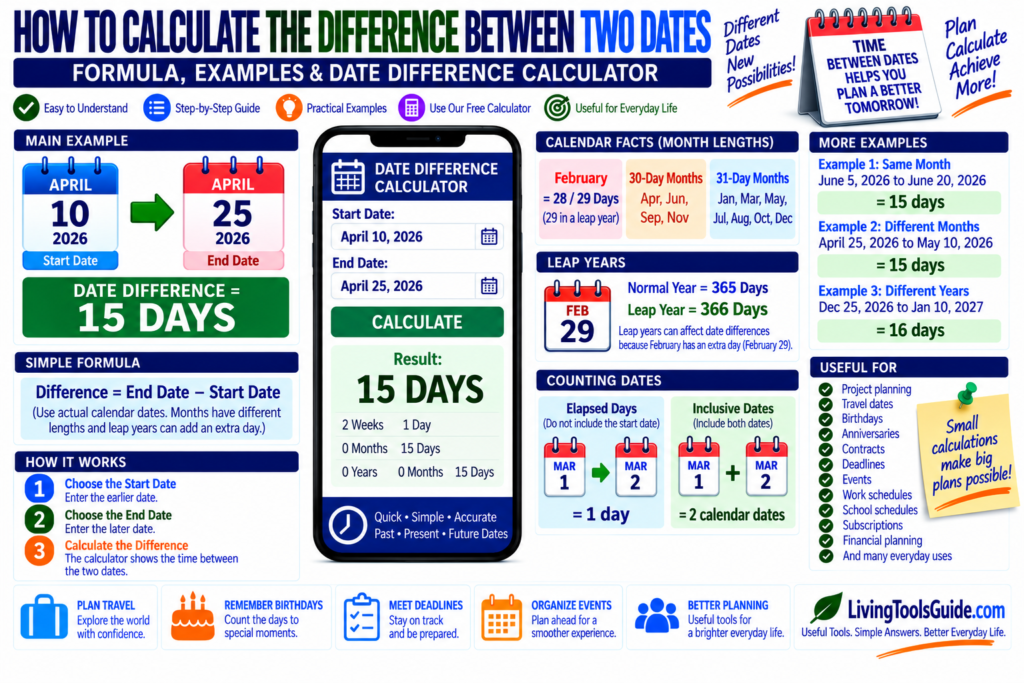
Calculating the difference between two dates tells you how much time passes from one calendar date to another.
This is useful for birthdays, project deadlines, travel planning, work schedules, contracts, subscriptions, events, school schedules, financial planning, and many other everyday situations.
For example, you might want to know how many days there are between:
January 1, 2026 and January 31, 2026
or how much time remains between today and an important future date.
Because months have different lengths and leap years can add an extra day, calculating date differences manually can sometimes be confusing.
A Date Difference Calculator makes the process much easier.
What Is a Date Difference?
A date difference is the amount of time between a start date and an end date.
For example:
Start Date: March 1, 2026
End Date: March 11, 2026
The elapsed difference is:
10 days
The start and end dates themselves are important because date-difference calculations normally measure the elapsed time from one date to another.
For official information about calendars and date calculations, see the U.S. Naval Observatory’s calendar resources.
How to Calculate the Difference Between Two Dates
For simple dates within the same month, subtract the earlier day number from the later day number.
For example:
March 20 − March 5
Calculate:
20 − 5 = 15
Therefore:
March 5 to March 20 = 15 days
Calculations become more complicated when the dates cross different months or years.
How to Calculate Date Difference Step by Step
Step 1: Enter the Start Date
Choose the earlier date.
Example:
Start Date: April 10, 2026
Step 2: Enter the End Date
Choose the later date.
Example:
End Date: April 25, 2026
Step 3: Calculate the Difference
Subtract the earlier date from the later date.
25 − 10 = 15
Therefore:
Date Difference = 15 days
Example: Difference Between Two Dates in the Same Month
Suppose you want to calculate the difference between:
June 5, 2026
and:
June 20, 2026
Calculate:
20 − 5 = 15
Therefore:
June 5 to June 20 = 15 days
Example: Difference Between Dates in Different Months
Now consider:
April 25, 2026
to:
May 10, 2026
April has 30 days.
From April 25 to April 30:
5 elapsed days
Then from April 30 to May 10:
10 more days
Therefore:
Total difference = 15 days
A calculator handles this automatically, which reduces the chance of mistakes when crossing month boundaries.
Example: Difference Between Dates in Different Years
Suppose the dates are:
December 25, 2026
and:
January 10, 2027
The calculation crosses from one calendar year into another.
A Date Difference Calculator can account for the remaining days in December and the days in January automatically.
This is particularly helpful for longer date ranges spanning several months or years.
Why Month Length Matters
Calendar months do not contain the same number of days.
They can have:
28 days
29 days
30 days
or:
31 days
For example:
April = 30 days
May = 31 days
February = 28 or 29 days
Because of these differences, you cannot accurately calculate longer date differences by assuming every month has 30 days.
How Leap Years Affect Date Differences
A normal year contains:
365 days
A leap year contains:
366 days
During a leap year, February contains:
29 days
instead of:
28 days
If a date range crosses February 29, that extra day affects the total elapsed time.
A properly designed date calculator handles leap years automatically.
Elapsed Days vs Inclusive Day Counting
There are two common ways to count dates.
Elapsed-day counting measures the time that passes between the two dates.
For example:
March 1 → March 2 = 1 elapsed day
Inclusive counting counts both calendar dates themselves.
For example:
March 1 and March 2 = 2 calendar dates
This distinction is important for contracts, bookings, work schedules, travel, and other applications.
Always check which method is required for your particular situation.
Date Difference vs Age Calculation
A date difference and an age calculation are related, but they are not always presented in the same way.
A Date Difference Calculator measures the time between any two dates.
An Age Calculator usually measures the time between a person’s date of birth and another date, commonly today.
For example:
Date Difference → Time between Date A and Date B
Age → Time since a person’s date of birth
Both calculations rely on calendar dates.
Date Difference vs Days Between Dates
The terms date difference and days between dates are often used to describe similar calculations.
However, some date-difference calculators may also display results in:
Years
Months
Weeks
and:
Days
while a simple days-between-dates calculator may focus only on the total number of days.
The exact output depends on the calculator.
Why Use a Date Difference Calculator?
Manual calculations become difficult when dates cross multiple months, years, or leap years.
A calculator can automatically account for:
- Different month lengths
- Leap years
- Year boundaries
- Long date ranges
- Past dates
- Future dates
This makes date calculations faster and reduces arithmetic mistakes.
Use Our Free Date Difference Calculator
You can use the free Date Difference Calculator on LivingToolsGuide to calculate the time between two dates.
Enter your start date and end date, then calculate the difference.
It can help with project schedules, travel dates, birthdays, events, contracts, deadlines, and everyday date planning.
Where Is Date Difference Useful?
Date-difference calculations are useful for:
- Project deadlines
- Travel planning
- Birthdays
- Anniversaries
- Work schedules
- School schedules
- Contracts
- Subscriptions
- Event planning
- Financial dates
- Rental periods
- General calendar calculations
Frequently Asked Questions
How do I calculate the number of days between two dates?
For simple dates within the same month, subtract the earlier day from the later day. For longer periods crossing months or years, a Date Difference Calculator is easier and less error-prone.
Does a date difference include the start date?
Usually, elapsed-time calculations do not count the starting instant as a full elapsed day. Inclusive counting is different and counts both calendar dates. Check the method required for your situation.
Do leap years affect date differences?
Yes. If the date range includes February 29, a leap year can add an additional day to the elapsed period.
Can I calculate the difference between dates in different years?
Yes. A Date Difference Calculator can calculate periods that cross months and years.
Why not assume every month has 30 days?
Because calendar months contain 28, 29, 30, or 31 days. Using the actual calendar is necessary for accurate date calculations.
Final Thoughts
Calculating the difference between two dates can be simple for short periods but more complicated when different months, years, and leap years are involved.
For simple dates:
Difference = End Date − Start Date
For longer or more complicated periods, use actual calendar dates rather than assuming every month has the same length.
For a quick calculation, use the free Date Difference Calculator on LivingToolsGuide.