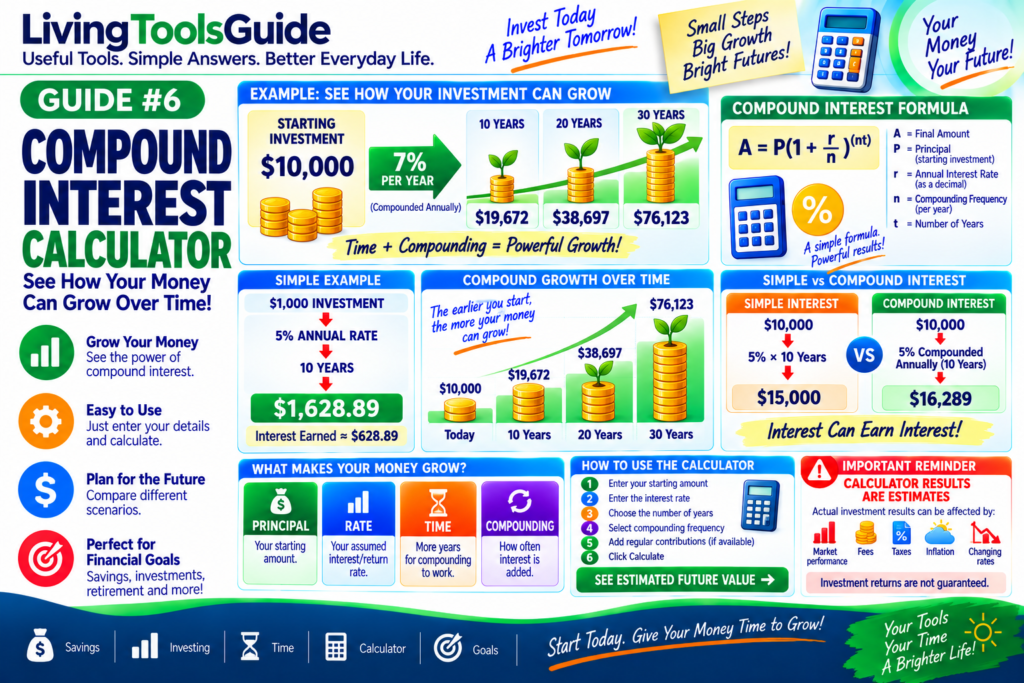
Saving and investing money becomes much more powerful when your earnings begin generating earnings of their own. This effect is called compound interest.
Unlike simple interest, which calculates interest only on the original principal, compound interest calculates interest on the principal plus previously accumulated interest.
Over long periods, this can make a significant difference to the growth of savings and investments.
A Compound Interest Calculator makes it easy to estimate how an initial investment may grow based on the starting amount, interest rate, compounding frequency, time period, and—when supported—additional contributions.
A Compound Interest Calculator makes it easy to estimate how your money may grow when interest is repeatedly added to the balance over time.
What Is Compound Interest?
Compound interest means earning interest on both:
Your original investment
and
The interest already earned
Imagine you invest $1,000 and earn 10% per year, compounded annually.
After the first year:
$1,000 + $100 interest = $1,100
During the second year, the 10% interest is calculated on $1,100, not just the original $1,000.
So:
$1,100 × 10% = $110 interest
Your balance becomes:
$1,210
This is why compound interest can accelerate investment growth over time.
You can also explore different growth scenarios using the Investor.gov Compound Interest Calculator from the U.S. Securities and Exchange Commission.
Compound Interest Formula
For a lump sum compounded a fixed number of times per year, the standard formula is:
A = P(1 + r/n)^(nt)
Where:
A = final amount
P = principal or starting investment
r = annual interest rate as a decimal
n = number of compounding periods per year
t = number of years
The amount of compound interest earned is:
Compound Interest = A − P
Example 1 — $1,000 at 5% for 10 Years
Suppose you invest:
Principal: $1,000
Annual Rate: 5%
Time: 10 years
Compounding: Annually
Using the formula:
A = 1000(1 + 0.05)^10
The approximate final balance is:
$1,628.89
Therefore:
Starting Investment = $1,000
Interest Earned ≈ $628.89
Final Balance ≈ $1,628.89
Your money has grown by more than $600 without adding another contribution.
Example 2 — $5,000 at 6% for 20 Years
Suppose you invest:
$5,000
at:
6% annually
for:
20 years
with annual compounding.
The approximate future value is:
$16,035.68
That means approximately:
Original Principal = $5,000
Growth = $11,035.68
Final Balance = $16,035.68
This demonstrates why time can be one of the most important factors in compound growth.
Why Does Compounding Frequency Matter?
Interest can be compounded at different intervals.
Common examples include:
Annually — once per year
Semiannually — twice per year
Quarterly — four times per year
Monthly — twelve times per year
Daily — typically 365 times per year
When the stated annual rate is the same, more frequent compounding generally produces a slightly higher ending balance because interest is added to the balance sooner.
However, the difference depends on the rate, time period and financial product.
Compound Interest vs Simple Interest
Consider $10,000 invested at 5% for 10 years.
With simple interest:
Interest = $10,000 × 5% × 10
Interest = $5,000
Final amount:
$15,000
With annual compound interest:
$10,000 × (1.05)^10 ≈ $16,288.95
The difference occurs because compound interest allows previous interest to generate additional interest.
Simple Interest
Principal → Interest
Compound Interest
Principal → Interest → More Interest → More Growth
The Power of Time
Compound growth can become more noticeable over longer periods.
For example, consider $10,000 at 7% annually, compounded annually, with no additional contributions:
| Time | Approximate Value |
|---|---|
| 5 years | $14,025.52 |
| 10 years | $19,671.51 |
| 20 years | $38,696.84 |
| 30 years | $76,122.55 |
The investment does not grow by the same dollar amount each year. As the balance increases, the amount on which future interest is calculated also increases.
That is the compounding effect.
The Effect of Regular Contributions
Many people do not invest just once. They add money regularly.
For example:
Initial investment: $5,000
Monthly contribution: $200
Investment period: 20 years
Regular contributions can substantially increase the final balance because you are adding new principal throughout the investment period.
The exact result depends on factors such as the assumed return, contribution timing and compounding method.
If your Compound Interest Calculator supports regular contributions, you can compare different contribution amounts to see how they affect projected growth.
How to Use the Compound Interest Calculator
Using the calculator is simple.
Step 1 — Enter Your Starting Amount
Enter your initial savings or investment.
For example:
$10,000
Step 2 — Enter the Interest Rate
Enter the expected annual rate.
For example:
6%
Step 3 — Enter the Investment Period
Choose how long the money will remain invested.
For example:
20 years
Step 4 — Select Compounding Frequency
Choose the available option that matches your scenario, such as:
Annually, quarterly or monthly
Step 5 — Add Contributions, If Available
Enter regular deposits if you plan to continue adding money.
Step 6 — Calculate
The calculator can then estimate your:
Final Balance
Total Contributions
Estimated Interest/Growth
What Affects Compound Growth?
Several factors can change the result.
💰 Starting Principal
A larger initial amount gives compound growth a larger base.
📈 Interest or Return Rate
Higher rates can produce greater projected growth, although investment returns are generally not guaranteed.
⏳ Time
Longer periods give compounding more opportunities to work.
🔄 Compounding Frequency
More frequent compounding can increase the ending value when other assumptions are unchanged.
💵 Additional Contributions
Regular deposits can have a major effect on long-term savings.
Where Is Compound Interest Used?
Compound-interest calculations can be useful when exploring:
🏦 Savings accounts
📈 Long-term investments
🎓 Education savings
🏠 Long-term financial goals
👴 Retirement planning
💰 Investment comparisons
Compound interest can also work against you when interest is charged on debt, depending on how the loan or account calculates interest.
Why Use a Compound Interest Calculator?
Calculating compound growth manually becomes difficult when you introduce different rates, compounding periods and regular contributions.
A calculator lets you quickly test scenarios such as:
What if I invest for another 10 years?
What if I increase my monthly contribution?
What happens if the assumed rate changes from 5% to 7%?
How much of the final balance comes from contributions versus growth?
This makes the calculator useful as an educational and planning tool.
Important: Investment Returns Are Not Guaranteed
A Compound Interest Calculator provides an estimate based on the numbers you enter.
Real investments may experience changing returns, fees, taxes, inflation, market losses and other factors that are not reflected in a simple calculation.
Therefore, calculator results should not be treated as guaranteed future investment returns or personalized financial advice.
Use our Compound Interest Calculator to compare different rates, time periods and compounding frequencies before planning your savings or investment goals.