Power Calculator
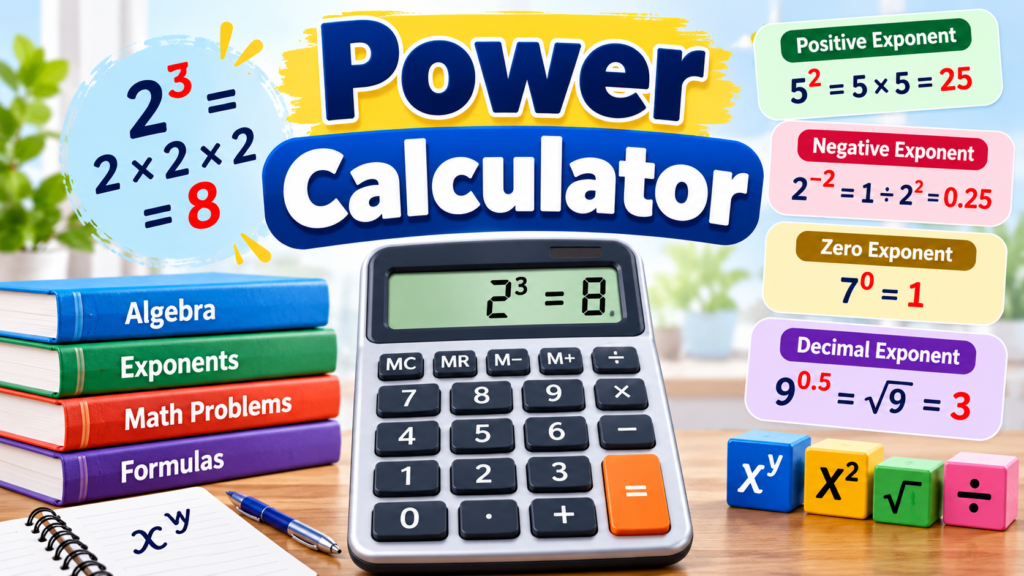
Calculate a number raised to a positive, negative, zero, or decimal exponent.
2 ^ 3 = 8
How this calculator works
Enter a base and exponent. For example, 2³ means 2 × 2 × 2 = 8.
Power Calculator – Calculate Exponents Easily
Our free Power Calculator helps you calculate the result of raising a number to a positive, negative, zero, or decimal exponent. Simply enter the base number and exponent to calculate the power quickly and accurately.
Whether you are studying mathematics, solving algebra problems, or working with scientific calculations, this online tool makes exponent calculations simple.
What Is a Power in Mathematics?
A power represents a base number raised to an exponent.
It is written as:
xʸ
Where:
- x = Base number
- y = Exponent
- xʸ = Result
For example:
2³ = 2 × 2 × 2 = 8
The base is 2, the exponent is 3, and the result is 8.
How to Use the Power Calculator
Follow these three easy steps:
Step 1: Enter the base number.
Step 2: Enter the exponent.
Step 3: Click Calculate Power to see the result.
For example, entering base 5 and exponent 3 gives:
5³ = 5 × 5 × 5 = 125
Understanding Different Types of Exponents
Positive Exponents
Positive whole-number exponents indicate repeated multiplication.
Example:
3⁴ = 3 × 3 × 3 × 3 = 81
Negative Exponents
A negative exponent represents the reciprocal of the corresponding positive power.
Example:
2⁻³ = 1 ÷ 2³ = 0.125
Zero Exponents
Any nonzero number raised to the power of zero equals 1.
Example:
7⁰ = 1
Decimal Exponents
Decimal exponents can represent roots and fractional powers.
Example:
9⁰·⁵ = √9 = 3
Our Power Calculator makes it easy to evaluate exponential expressions using positive, negative, zero, and decimal exponents. It provides a convenient way to check mathematical calculations and understand powers.
Where Are Power Calculations Used?
A Power Calculator is useful for:
- Solving algebra and mathematics problems.
- Calculating squares and cubes.
- Working with scientific formulas.
- Understanding exponential growth.
- Performing engineering calculations.
- Studying powers and roots.
- Checking homework calculations.
Important Rules
When calculating powers, remember:
- Any number raised to the power of 1 equals itself.
- Any nonzero number raised to the power of 0 equals 1.
- Zero raised to a negative exponent is undefined.
- A negative base raised to a non-integer exponent may not have a real-number result.
Understanding these rules helps you interpret calculations correctly and avoid common mathematical mistakes.
Want to calculate square roots without using fractional exponents? Try our Square Root Calculator to find square roots quickly and easily.
Understanding Powers and Exponents in Mathematics
Powers and exponents are important mathematical concepts used to represent repeated multiplication. Instead of writing the same number multiplied several times, exponential notation provides a shorter and easier method.
For example:
4³ = 4 × 4 × 4 = 64
Here, 4 is the base, 3 is the exponent, and 64 is the result.
Exponents are commonly used in algebra, geometry, scientific calculations, engineering, and financial mathematics.
How to Calculate Powers Step by Step
Calculating a power involves identifying the base and exponent before applying the appropriate mathematical rule.
Step 1: Identify the Base
The base is the number being raised to a power.
For example, in 5³, the base is 5.
Step 2: Identify the Exponent
The exponent indicates how the base is used in the calculation.
In 5³, the exponent is 3.
Step 3: Calculate the Result
Multiply the base by itself according to the positive whole-number exponent.
5³ = 5 × 5 × 5 = 125
Therefore, the answer is 125.
For negative, fractional, or decimal exponents, use the corresponding exponent rules rather than repeated multiplication.
Common Powers and Their Values
The following table shows several frequently used exponential calculations.
| Base | Exponent | Expression | Result |
|---|---|---|---|
| 2 | 2 | 2² | 4 |
| 2 | 3 | 2³ | 8 |
| 3 | 3 | 3³ | 27 |
| 4 | 2 | 4² | 16 |
| 5 | 3 | 5³ | 125 |
| 10 | 2 | 10² | 100 |
| 10 | 3 | 10³ | 1,000 |
| 2 | -2 | 2⁻² | 0.25 |
| 16 | 0.5 | 16⁰·⁵ | 4 |
These examples demonstrate how changing the base or exponent affects the final result.
Use the Power Calculator to verify these examples and explore how different base numbers and exponents affect the final result.
Important Exponent Rules
Understanding exponent rules makes calculations faster and helps simplify algebraic expressions.
Want to learn more about exponent rules and powers? Explore the free mathematics lessons and practice exercises at Khan Academy to strengthen your understanding of exponents.
Multiplication Rule
When multiplying powers with the same base, add their exponents.
aᵐ × aⁿ = aᵐ⁺ⁿ
Example:
2³ × 2² = 2⁵ = 32
Division Rule
When dividing powers with the same nonzero base, subtract their exponents.
aᵐ ÷ aⁿ = aᵐ⁻ⁿ
Example:
5⁴ ÷ 5² = 5² = 25
Power of a Power Rule
When raising an existing power to another power, multiply the exponents.
(aᵐ)ⁿ = aᵐⁿ
Example:
(2³)² = 2⁶ = 64
Negative Exponent Rule
A negative exponent represents the reciprocal of the corresponding positive power.
a⁻ⁿ = 1 ÷ aⁿ, where a is not zero.
Example:
4⁻² = 1 ÷ 16 = 0.0625
Fractional Exponent Rule
Fractional exponents can represent roots.
For a positive base:
a¹⁄² = √a
Example:
25⁰·⁵ = √25 = 5
Real-Life Applications of Exponents
Scientific Calculations
Scientists use powers of ten to represent extremely large or small numbers.
For example:
10⁶ = 1,000,000
This notation is useful when working with distances, measurements, and scientific data.
Geometry and Measurements
Powers are commonly used when calculating areas and volumes.
The area of a square is:
Area = Side²
If each side measures 6 meters:
6² = 36
The area is 36 square meters.
Compound Growth
Exponents are also used to describe repeated percentage growth.
For example, an amount growing by 5% annually for three years uses the growth factor:
1.05³ = 1.157625
This represents approximately 15.76% total growth over three years.
Common Mistakes to Avoid
- Confusing multiplication with exponentiation: 3⁴ means 3 × 3 × 3 × 3, not 3 × 4.
- Ignoring negative exponents: 2⁻³ equals 0.125, not -8.
- Assuming every zero power is valid: 0⁰ requires special treatment and is not generally assigned a value in elementary arithmetic.
- Forgetting parentheses: (-2)² equals 4, while -2² equals -4 under standard order of operations.
- Using invalid real-number inputs: Negative bases with some fractional exponents may not produce real-number results.
Frequently Asked Questions
What is 2 raised to the power of 5?
2⁵ = 2 × 2 × 2 × 2 × 2 = 32
Answer: 32
What is 10 raised to the power of zero?
Any nonzero number raised to the power of zero equals 1.
10⁰ = 1
What does a negative exponent mean?
A negative exponent indicates a reciprocal.
For example:
5⁻¹ = 1 ÷ 5 = 0.2
What is the difference between squares and cubes?
A square uses an exponent of 2, while a cube uses an exponent of 3.
For example:
4² = 16
4³ = 64
Can decimal exponents be calculated?
Yes. Decimal exponents can represent fractional powers and roots.
For example:
81⁰·⁵ = 9
Can exponents produce very large numbers?
Yes. Even small bases can produce large results when raised to high powers.
For example:
2¹⁰ = 1,024
2²⁰ = 1,048,576
Final Thoughts
Understanding powers and exponents helps simplify mathematical expressions and solve problems involving repeated multiplication, roots, scientific notation, and exponential growth.
By learning the basic rules and practicing different examples, you can perform exponential calculations more confidently and interpret the results accurately.