Percentage Calculator
Calculate percentages, percentage ratios and percentage change.
How this percentage calculator works
Use the tabs above to calculate a percentage of a value, find what percentage one number is of another, or measure the percentage increase or decrease between two values.
Table of Contents
Percent Change Calculator – Calculate Percentage Changes Easily
Our free Percent Change Calculator helps you measure how much a number has increased or decreased compared with its original value. Whether you are comparing prices, tracking business growth, reviewing financial information, or analyzing everyday numbers, this tool makes percentage calculations easier.
Percentage change is useful when you need to understand the difference between two values as a percentage of the original amount.
What Is Percent Change?
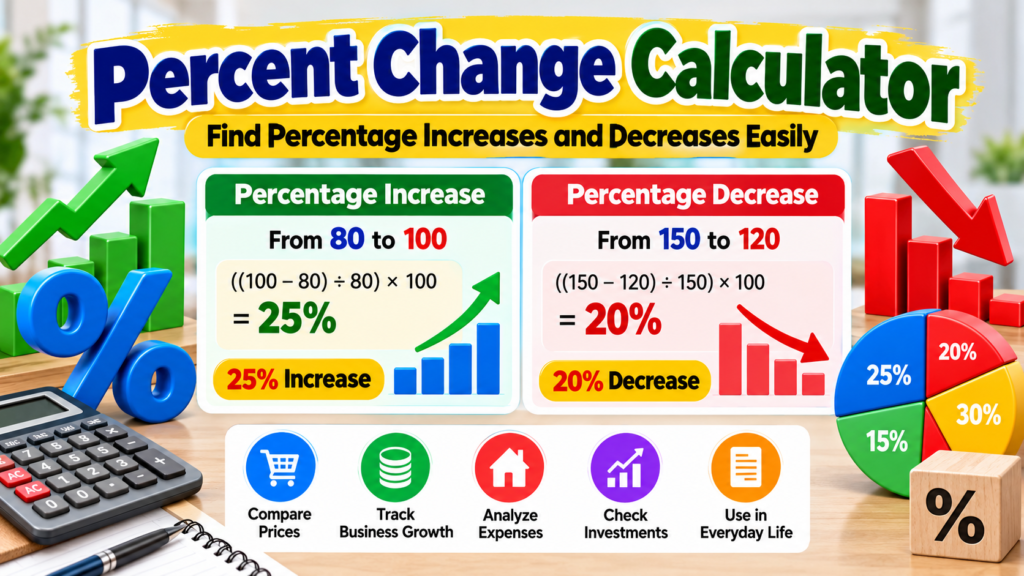
Percent change measures the relative difference between an original value and a new value.
A positive result indicates an increase, while a negative result indicates a decrease.
For example, if a product price rises from $80 to $100, the price has increased by 25%.
How to Calculate Percent Change
Use this formula:
Percent Change = ((New Value − Original Value) ÷ Original Value) × 100
Example 1: Percentage Increase
Suppose a product originally costs $200 and its new price is $250.
((250 − 200) ÷ 200) × 100 = 25%
The price increased by 25%.
Example 2: Percentage Decrease
Suppose a product originally costs $150 and its new price is $120.
((120 − 150) ÷ 150) × 100 = −20%
The price decreased by 20%.
When to Use This Tool
A Percent Change Calculator is useful for:
- Comparing old and new product prices.
- Measuring business revenue growth.
- Tracking changes in expenses.
- Understanding investment performance.
- Comparing sales figures over time.
- Analyzing changes in numerical data.
Note: The standard percentage-change formula requires a nonzero original value. If the original value is zero, the percentage change is undefined.
Understanding Percentage Change in Everyday Life
Percentage change is a useful mathematical concept that measures how much a value increases or decreases compared with its original amount. It is commonly used in shopping, finance, business, education, and everyday calculations.
Instead of comparing only the numerical difference between two values, percentage change expresses that difference relative to the starting value.
For example, a $20 increase has a different impact on a $100 product than on a $1,000 product.
Our Percent Change Calculator helps you compare original and new values to understand percentage increases and decreases quickly and accurately.
How to Calculate Percentage Increase
Percentage increase measures how much a value has grown relative to its original amount.
Formula:
Percentage Increase = ((New Value − Original Value) ÷ Original Value) × 100
Example:
A monthly electricity bill increases from $80 to $100.
Step 1: Subtract the original amount from the new amount.
100 − 80 = 20
Step 2: Divide the difference by the original amount.
20 ÷ 80 = 0.25
Step 3: Multiply by 100.
0.25 × 100 = 25%
Answer: The electricity bill increased by 25%.
How to Calculate Percentage Decrease
Percentage decrease measures how much a value has fallen relative to its original amount.
Formula:
Percentage Decrease = ((Original Value − New Value) ÷ Original Value) × 100
Example:
A television originally costs $600 but is reduced to $480.
600 − 480 = 120
120 ÷ 600 × 100 = 20%
Answer: The television price decreased by 20%.
Percentage Change Examples
The following table shows common examples of increases and decreases.
| Original Value | New Value | Percentage Change |
|---|---|---|
| 100 | 120 | 20% increase |
| 200 | 150 | 25% decrease |
| 50 | 75 | 50% increase |
| 500 | 550 | 10% increase |
| 80 | 60 | 25% decrease |
| 1,000 | 900 | 10% decrease |
These examples demonstrate why the original value matters when calculating relative changes.
Use the Percent Change Calculator to check these examples and calculate the relative difference between two values.
Percentage Change in Business
Businesses use percentage changes to compare sales, expenses, revenue, and performance over different periods.
For example, suppose a store earns $5,000 in January and $6,000 in February.
Revenue Change = ((6,000 − 5,000) ÷ 5,000) × 100
Revenue Change = 20%
This indicates that monthly revenue increased by 20%.
Business owners can use similar calculations to identify trends, compare performance, and support planning decisions.
Percentage Change in Personal Finance
Percentage changes are useful when reviewing household expenses, savings balances, and investment values.
For example, if a savings balance grows from $2,000 to $2,200:
((2,200 − 2,000) ÷ 2,000) × 100 = 10%
The balance increased by 10%.
However, an increase in account balance does not necessarily represent investment profit because deposits and withdrawals can also affect the total.
Common Mistakes to Avoid
When calculating relative changes, remember these important points:
- Use the original value: Divide the difference by the starting amount, not the ending amount.
- Check the direction: A positive result indicates an increase when the starting value is positive; a negative result indicates a decrease.
- Avoid dividing by zero: The standard formula is undefined when the original value equals zero.
- Use consistent units: Compare values measured in the same units.
- Round carefully: Keep sufficient decimal places until the final result.
Frequently Asked Questions
What is the difference between percentage increase and percentage decrease?
Percentage increase describes growth, while percentage decrease describes a reduction. Both compare the difference against the original value.
How do I calculate a 15% increase?
Multiply the original amount by 1.15.
For example:
200 × 1.15 = 230
The new amount is 230.
How do I calculate a 20% decrease?
Multiply the original amount by 0.80.
For example:
500 × 0.80 = 400
The new amount is 400.
Can percentage change exceed 100%?
Yes. A value increasing from 50 to 125 represents a 150% increase.
Does a 20% increase followed by a 20% decrease return to the original value?
No. Starting with 100, a 20% increase gives 120. Decreasing 120 by 20% gives 96, not 100.
What happens when the original value is zero?
The standard formula cannot calculate a percentage change because division by zero is undefined. In this situation, reporting the absolute difference may be more appropriate.
The Percent Change Calculator makes it easier to measure changes in prices, expenses, revenue, and other everyday numerical values.
Need to calculate a percentage of a number instead? Try our Percentage Calculator to find percentage values, calculate proportions, and solve everyday math problems quickly.
Final Thoughts
Understanding percentage changes helps you compare numerical values and recognize growth or decline.
Whether you are analyzing prices, tracking expenses, comparing business results, or reviewing financial information, using the correct formula provides a clearer picture of how values change over time.
Want to understand percentage increases and decreases in more detail? Explore Khan Academy's arithmetic lessons for free explanations, examples, and practice exercises covering essential percentage concepts.