Lawn Area Calculator
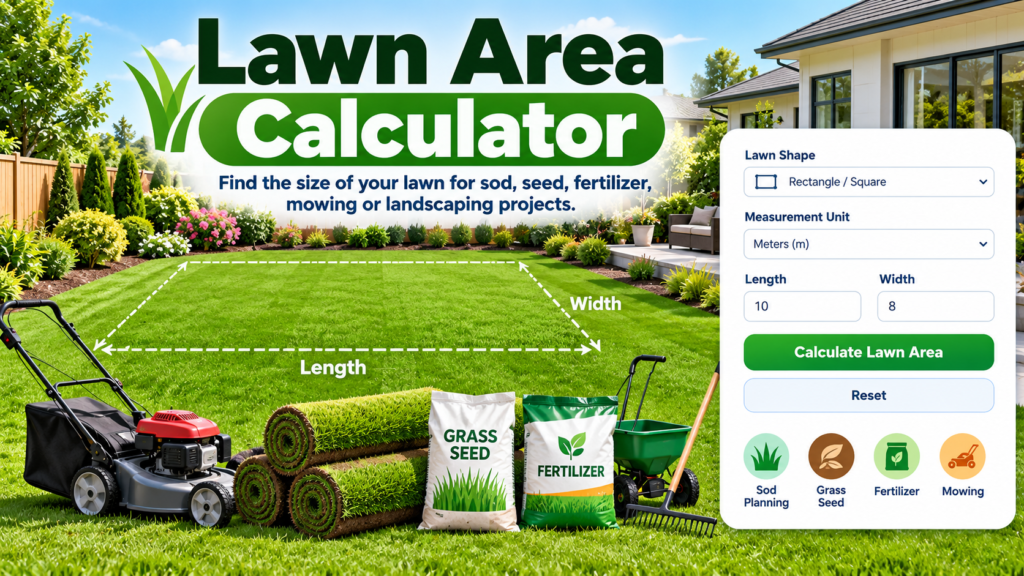
Calculate the size of your lawn for sod, seed, fertilizer, mowing, or landscaping projects.
How this calculator works
Select your lawn shape and measurement unit, then enter the required dimensions. The calculator finds the total lawn area and perimeter and also converts the result to square meters and square feet.
Table of Contents
Lawn Area Calculator makes it easy to estimate the size of your lawn for sod, grass seed, fertilizer, mowing, and landscaping projects. Select your lawn shape and measurement unit, enter the required dimensions, and calculate the total area instantly.
For a rectangular or square lawn, the basic formula is:
Lawn Area = Length × Width
For example, a lawn measuring 10 meters long and 8 meters wide has an area of:
10 × 8 = 80 square meters
Accurate lawn measurements can help you estimate how much material you may need and reduce unnecessary purchases.
How to Measure Your Lawn Area
Measuring a lawn accurately is an important first step when planning landscaping, mowing, seeding, fertilizing, or installing new sod. The method you use depends mainly on the shape of the lawn.
For simple rectangular or square areas, measure the length and width and multiply the two measurements.
The Lawn Area Calculator helps you estimate the total size quickly using your lawn measurements.
Area = Length × Width
For example, if a lawn is 15 meters long and 10 meters wide:
15 × 10 = 150 square meters
This means the total lawn area is 150 m².
Measuring a Square Lawn
A square lawn has four equal sides. Measure one side and multiply it by itself.
Area = Side × Side
For example, a square lawn measuring 12 meters on each side has an area of:
12 × 12 = 144 square meters
Always use the same measurement unit for both dimensions.
Measuring Irregular Lawns
Many gardens are not perfect rectangles or squares. An irregular lawn can often be divided into several smaller, simple shapes.
For example, divide the lawn into two or three rectangles. Calculate the area of each section separately and then add the results together.
If the sections measure 100 m², 60 m², and 40 m²:
100 + 60 + 40 = 200 m²
The total area is therefore 200 square meters.
This method can make complicated lawn layouts much easier to measure.
The Lawn Area Calculator can simplify planning when your yard contains several measurable sections.
Square Meters and Square Feet
Lawn size is commonly expressed in either square meters (m²) or square feet (ft²).
If you measure the dimensions in meters, the result will be in square meters. If you measure them in feet, the result will be in square feet.
As a useful reference:
1 square meter ≈ 10.764 square feet
1 square foot ≈ 0.0929 square meters
Using consistent units helps prevent calculation errors.
Planning for Grass Seed
Knowing your lawn size helps when estimating grass seed. Seed packages normally provide a recommended coverage rate.
For example, if a package covers 50 square meters and your lawn measures 200 square meters, you can estimate:
200 ÷ 50 = 4 packages
Actual coverage varies by grass variety and product, so always check the manufacturer's instructions before purchasing or applying seed.
Estimating Sod Requirements
Accurate measurements are especially useful when installing sod because purchasing too little can interrupt the project, while purchasing too much may create unnecessary waste.
After calculating the total area, compare it with the coverage information provided by your sod supplier.
Some projects may require a small additional allowance for cutting, trimming, or unusual lawn shapes.
Fertilizer Planning
Fertilizer products generally provide application instructions based on lawn area. Once you know the total size, you can compare it with the coverage stated on the product label.
For example, if one bag is designed to cover 250 square meters and your lawn measures 500 square meters, approximately two bags would cover that area according to the stated coverage rate.
Always follow the manufacturer's application and safety instructions.
Using the Lawn Area Calculator gives you a useful area estimate before comparing fertilizer coverage rates.
Mowing and Lawn Maintenance
Lawn size can also help you estimate the time required for mowing and routine maintenance.
A small garden may be manageable with a compact mower, while a much larger lawn may take considerably more time and could benefit from equipment designed for larger areas.
Knowing the area can therefore be useful when comparing mowing equipment or estimating landscaping services.
Planning a boundary around your lawn? Try our Fence Calculator to estimate the fencing needed for your project.
Landscaping Projects
Area measurements are helpful for many outdoor projects beyond grass maintenance.
You may need them when planning:
- Grass seed
- Sod installation
- Fertilizer
- Irrigation
- Lawn treatments
- Landscaping services
- Mowing schedules
- Garden redesigns
Accurate measurements provide a better starting point for estimating quantities and project costs.
For more guidance on measuring lawns and planning turf areas, see the University of Georgia Cooperative Extension lawn resources.
Frequently Asked Questions
How do I calculate the area of a rectangular lawn?
Measure the length and width using the same unit and multiply them together.
Length × Width = Area
What if my lawn has an unusual shape?
Divide it into smaller rectangles, squares, triangles, or other simple sections. Calculate each section separately and add the results.
Should I measure in feet or meters?
Either is fine. Choose the unit that is most convenient, but keep all measurements in the same unit during the calculation.
Why is accurate lawn measurement important?
Knowing the approximate area can help you estimate materials more effectively and avoid buying substantially too much or too little.
Use the Lawn Area Calculator whenever you need a quick area estimate for lawn care or landscaping projects.
Final Thoughts
Calculating lawn size provides a useful foundation for many garden and landscaping projects. Accurate measurements can make it easier to plan grass seed, sod, fertilizer, mowing, irrigation, and other maintenance needs.
Measure each section carefully, keep your units consistent, and use the resulting area as the basis for your project estimates.