Cube Root Calculator
Calculate the cube root of a number and see whether it is a perfect cube.
How this calculator works
The cube root of a number is a value that, when multiplied by itself three times, gives the original number.
What Is a Cube Root?
A cube root is a number that, when multiplied by itself three times, produces the original number. It is the opposite operation of cubing a number.
For example:
2 × 2 × 2 = 8
Therefore:
∛8 = 2
Similarly:
3 × 3 × 3 = 27
So:
∛27 = 3
The cube root symbol is ∛. It looks similar to the square root symbol, but the small number 3 indicates that you are finding a cube root rather than a square root.
Our Cube Root Calculator makes it easy to calculate these values without performing the calculation manually.
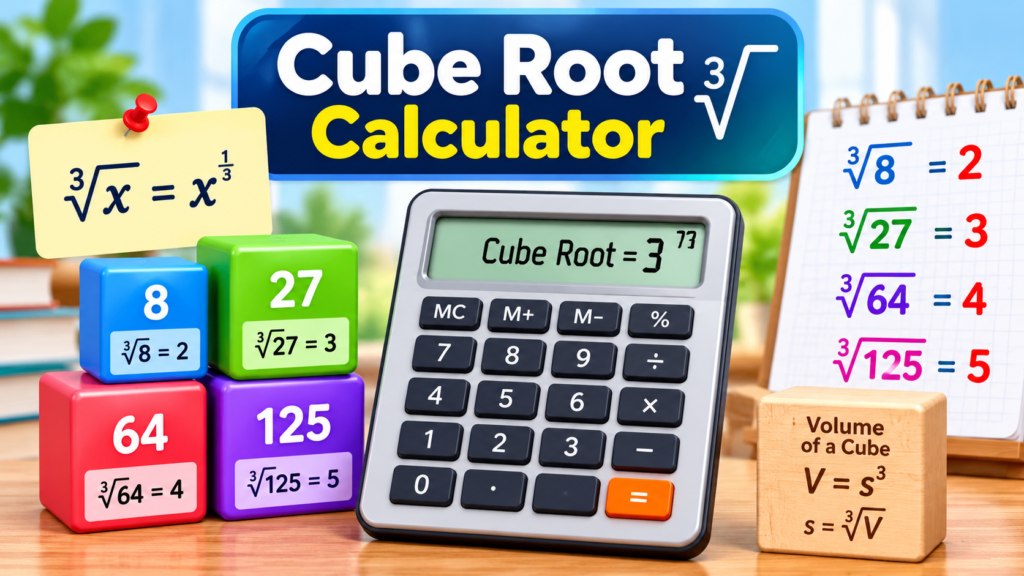
Cube Root Formula
The basic cube root formula can be written as:
Cube Root = ∛x
It can also be expressed using exponents:
Cube Root = x^(1/3)
Here, x represents the number whose cube root you want to calculate.
For example, to find the cube root of 64:
∛64 = 4
This is because:
4 × 4 × 4 = 64
For additional mathematics learning resources, visit Khan Academy.
What Are Perfect Cubes?
A perfect cube is a number produced by multiplying an integer by itself three times.
Some common perfect cubes are:
1³ = 1
2³ = 8
3³ = 27
4³ = 64
5³ = 125
6³ = 216
7³ = 343
8³ = 512
9³ = 729
10³ = 1,000
Perfect cubes have whole-number cube roots.
For example:
∛125 = 5
because:
5 × 5 × 5 = 125
Knowing common perfect cubes can make many mathematical problems faster and easier to solve.
Cube Roots of Numbers That Are Not Perfect Cubes
Not every number has a whole-number cube root.
For example:
∛2 ≈ 1.2599
and:
∛10 ≈ 2.1544
These results are irrational or decimal values and may continue for many decimal places.
For everyday calculations, the result can usually be rounded to a practical number of decimal places.
A calculator is especially useful when working with numbers that are not perfect cubes.
Cube Roots of Negative Numbers
Unlike square roots in the real-number system, cube roots can be calculated for negative numbers.
For example:
∛−8 = −2
because:
−2 × −2 × −2 = −8
Another example is:
∛−125 = −5
because:
−5 × −5 × −5 = −125
This happens because multiplying three negative numbers produces a negative result.
Therefore, every negative real number has a negative real cube root.
Cube Root vs. Square Root
Cube roots and square roots are related mathematical concepts, but they are not the same.
A square root asks which number multiplied by itself produces the original value.
For example:
√25 = 5
because:
5 × 5 = 25
A cube root asks which number multiplied by itself three times produces the original value.
For example:
∛125 = 5
because:
5 × 5 × 5 = 125
Understanding this difference is important when working with powers, exponents, geometry, and algebra.
How to Calculate a Cube Root
For perfect cubes, you may be able to find the answer mentally.
Suppose you want to calculate:
∛216
Think of a number that can be multiplied by itself three times to produce 216.
Since:
6 × 6 × 6 = 216
the answer is:
∛216 = 6
For larger numbers or values that are not perfect cubes, using a calculator is usually faster and more accurate.
Practical Uses of Cube Roots
Cube roots appear in several areas of mathematics and everyday problem-solving.
One common application involves the dimensions of cubes.
The volume of a cube is calculated using:
Volume = Side³
If you know the volume and need to find the length of one side, you can use:
Side = ∛Volume
For example, suppose a cube has a volume of 1,000 cubic centimeters.
The side length is:
∛1000 = 10 cm
Cube roots can also appear in engineering, physics, geometry, statistics, scientific calculations, and mathematical formulas.
How to Use the Calculator
Enter the number whose cube root you want to find into the calculator.
The tool calculates the result automatically, allowing you to work with perfect cubes, decimal values, large numbers, and negative numbers without performing lengthy manual calculations.
For example, entering 343 gives:
∛343 = 7
You can verify the answer:
7 × 7 × 7 = 343
This makes the calculator useful for checking homework, solving mathematical problems, or quickly verifying calculations.
Use the Cube Root Calculator to quickly check cube roots for perfect cubes, decimals, negative numbers, and larger values.
Understanding Your Result
When the input is a perfect cube, the result may be a whole number.
When the input is not a perfect cube, the answer will usually contain decimal places.
For example:
∛27 = 3
but:
∛30 ≈ 3.107
The number of decimal places you need depends on the purpose of your calculation. School exercises may request a particular level of rounding, while scientific or technical calculations may require greater precision.
Final Note
Cube roots are useful for understanding powers, dimensions, volume, algebra, and many other mathematical concepts. Remember that finding a cube root reverses the process of cubing a number.
For quick calculations, the Cube Root Calculator can help you find results without manually testing numbers or working through complicated decimal calculations.
Paste this after the existing Custom HTML block so you don’t disturb the working calculator.
Explore more useful calculation tools on our Calculators page.