Body Fat Calculator
Estimate your body fat percentage using body measurements.
How this body fat calculator works
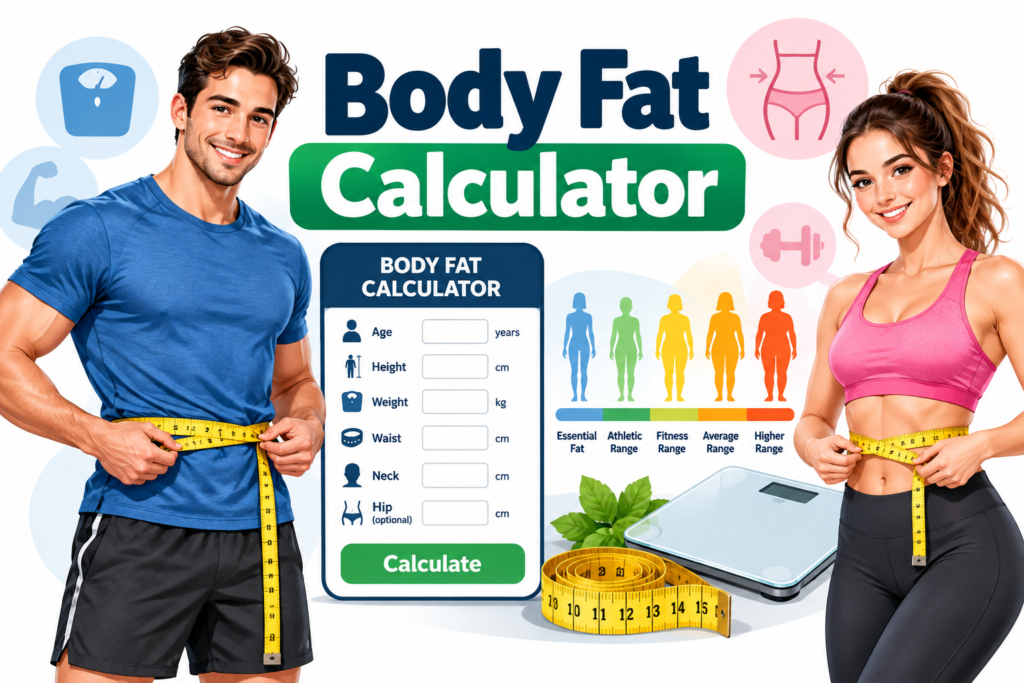
This calculator estimates body fat percentage from body measurements using a circumference-based formula. Measurements should be taken carefully and consistently for the best estimate.
Results are estimates and may differ from measurements obtained with professional methods such as DEXA scans or clinical assessments.
What Is Body Fat Percentage?
Body fat percentage is the proportion of your total body weight that comes from fat. Unlike body weight alone, it provides additional information about body composition by considering how much of your body consists of fat compared with other tissues such as muscle, bone, and water.
For example, a person who weighs 80 kg with 20% body fat has approximately 16 kg of body fat. The remaining weight includes muscle, bones, organs, water, and other tissues.
Body fat is a normal and necessary part of the human body. It helps store energy, protect organs, support hormone production, and regulate body temperature.
How Is Body Fat Percentage Estimated?
There are several ways to estimate body fat. Some methods use body measurements, while others require specialized equipment.
Common approaches include:
- Circumference measurements
- Skinfold measurements
- Bioelectrical impedance scales
- Air displacement measurements
- DEXA scans
Online calculation tools generally use mathematical formulas based on measurements such as height, waist, neck, and sometimes hip circumference.
The Body Fat Calculator provides an estimate based on the information entered rather than directly measuring body fat tissue.
Body Fat Percentage Example
Suppose a person weighs 75 kg and has an estimated body fat percentage of 20%.
The approximate amount of body fat can be calculated as:
Body Fat Weight = Total Weight × Body Fat Percentage
Therefore:
75 × 0.20 = 15 kg
This means approximately 15 kg of the person’s total weight is estimated to be body fat.
Their remaining 60 kg represents fat-free mass, which includes muscle, bone, water, organs, and other tissues.
Body Fat Percentage vs. BMI
Body fat percentage and Body Mass Index (BMI) are different measurements.
BMI compares a person’s weight with their height. It is useful as a general screening measurement but does not distinguish between fat and muscle.
Body fat percentage attempts to estimate how much of a person’s total weight consists specifically of fat.
For example, two people with the same height and weight could have identical BMI values but different body compositions. One person may have more muscle, while another may have a higher proportion of body fat.
Neither measurement provides a complete picture of health on its own.
Factors That Can Affect Body Fat
Body composition varies considerably between individuals. Several factors can influence body fat levels, including:
Age: Body composition can change naturally over time.
Sex: Typical body-fat distributions and levels differ between men and women.
Genetics: Inherited characteristics may influence how and where the body stores fat.
Physical activity: Regular activity, especially resistance training, can influence muscle mass and body composition.
Nutrition: Long-term energy intake and dietary habits can affect body weight and composition.
These factors are important when interpreting an estimated result.
Our Body Fat Calculator makes it easy to estimate your body fat percentage using your measurements.
Tips for Taking Measurements
Accurate measurements can improve the consistency of an estimate.
When measuring your waist, neck, hips, or other areas, keep the measuring tape level and comfortably close to the skin without pulling it excessively tight.
Try to measure under similar conditions each time. Changes in hydration, meals, clothing, and measurement technique can affect results.
If you are tracking changes over several weeks or months, consistency is often more useful than focusing on a single measurement.
You can use the Body Fat Calculator again over time to help track changes in your estimated body composition.
Why Results May Differ Between Methods
You may receive different body-fat estimates from different calculators, smart scales, skinfold tests, or professional assessments.
This does not necessarily mean that one result is wrong. Different methods use different formulas, assumptions, and measurement techniques.
Consumer devices and online formulas should therefore be viewed primarily as estimation tools.
Understanding Your Result
Body fat percentage can provide useful information about body composition, but the number should be interpreted carefully.
A single result cannot determine a person’s overall fitness or health. Factors such as muscle mass, physical activity, nutrition, medical history, and other health measurements may also be relevant.
It can be more useful to observe long-term trends using the same measurement method rather than comparing results from several different methods.
For more information about healthy weight and body composition, visit the Centers for Disease Control and Prevention.
Important Note
Body-fat calculations are estimates and are intended for general informational purposes. They should not be considered a medical diagnosis.
People with questions about body composition, weight management, nutrition, or health risks should consider discussing their individual circumstances with a qualified healthcare professional.
Used appropriately, body-fat estimates can provide another way to understand changes in body composition alongside other measurements and health information.
Explore more useful health and everyday calculation tools on our Calculators page.