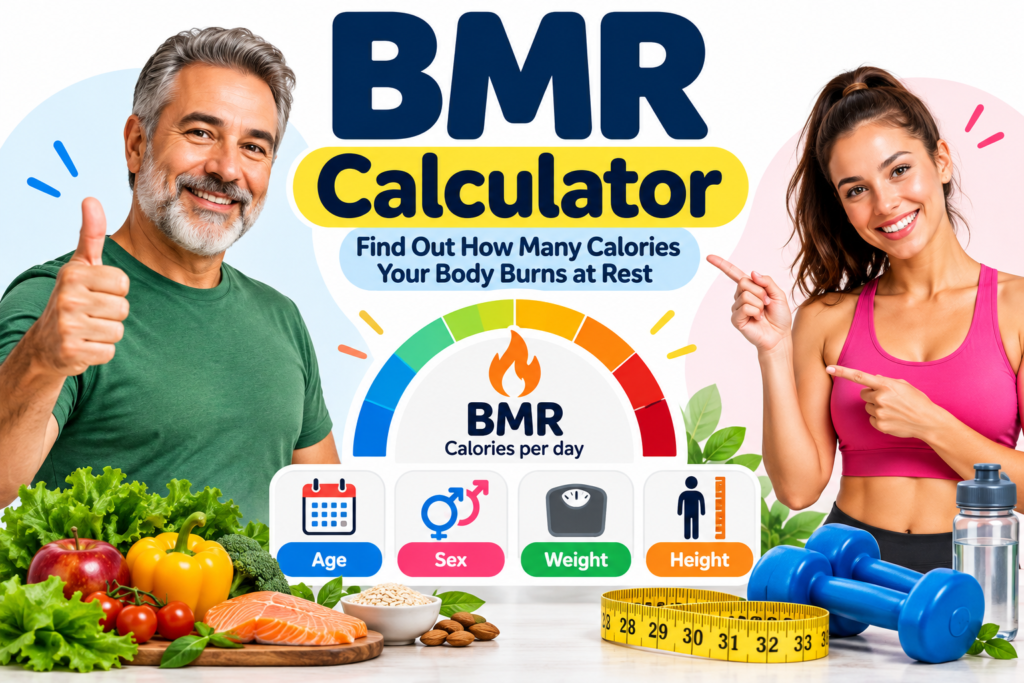
BMR Calculator
Calculate how many calories your body burns each day at complete rest.
Your estimated Basal Metabolic Rate
This is approximately how many calories your body needs each day to maintain essential functions while at complete rest.
What is BMR?
Basal Metabolic Rate (BMR) estimates the energy your body uses while at rest to support essential functions such as breathing, circulation and maintaining body temperature.
This calculator provides an estimate for general informational purposes and should not replace professional medical advice.
What Is BMR?
Basal Metabolic Rate, or BMR, is an estimate of the number of calories your body needs to maintain essential functions while at rest. Even when you are sleeping or relaxing, your body continues to use energy for breathing, blood circulation, temperature regulation, cell production, and other basic processes.
Understanding your BMR can provide a useful starting point when estimating your daily energy needs.
How Is BMR Calculated?
BMR is commonly estimated using formulas based on factors such as age, sex, height, and weight. One widely used method is the Mifflin-St Jeor equation.
For men:
BMR = (10 × weight in kg) + (6.25 × height in cm) − (5 × age) + 5
For women:
BMR = (10 × weight in kg) + (6.25 × height in cm) − (5 × age) − 161
These equations provide an estimate rather than an exact measurement of individual metabolism.
Our BMR Calculator makes it easy to estimate your basal metabolic rate using your age, height, weight, and sex.
Example BMR Calculation
Consider a 40-year-old man who weighs 75 kg and is 175 cm tall.
Using the formula:
BMR = (10 × 75) + (6.25 × 175) − (5 × 40) + 5
First calculate each part:
750 + 1,093.75 − 200 + 5 = 1,648.75
His estimated basal metabolic rate is therefore approximately 1,649 calories per day.
The BMR Calculator performs this calculation automatically after the required information is entered.
Use the BMR Calculator whenever you want a quick estimate of the calories your body may burn while at rest.
BMR vs. TDEE
BMR and Total Daily Energy Expenditure, or TDEE, are related but they are not the same measurement.
BMR estimates the energy your body needs for essential functions at rest. TDEE estimates your total daily calorie expenditure after taking physical activity into account.
For example, walking, exercising, working, household activities, and other movement require additional energy beyond your basal needs.
Therefore, your TDEE will generally be higher than your BMR.
Factors That Can Affect BMR
Several factors can influence how much energy the body uses at rest.
Age: Metabolic rate may gradually change as people get older.
Body size: Larger bodies generally require more energy to maintain basic functions.
Body composition: Muscle tissue typically requires more energy than fat tissue, so body composition can influence energy expenditure.
Sex: Common BMR formulas use different equations for men and women.
Genetics: Individual biological differences can affect metabolism.
Other factors may also influence energy expenditure, which is why formula-based results should be considered estimates.
Why Knowing Your BMR Can Be Useful
Knowing your estimated basal energy requirement can help you better understand how your body uses calories.
It can also provide a starting point for estimating total daily calorie needs when combined with an appropriate activity level.
People may use this information when planning nutrition, maintaining weight, or understanding the relationship between food intake and energy expenditure.
However, calorie requirements can vary considerably between individuals.
Tips for Getting a Better Estimate
Enter your age, height, and weight carefully. Incorrect measurements can significantly affect the calculated result.
If possible, use a recent weight measurement and accurate height measurement. Also make sure you select the correct units before calculating.
If your weight changes substantially over time, you can calculate your BMR again to obtain an updated estimate.
Understanding Your Result
The result represents an estimated number of calories your body may use at rest during a 24-hour period. It does not mean this is the exact number of calories you should eat every day.
Normal daily activity increases energy expenditure beyond basal metabolism. Exercise and physically demanding activities can increase it further.
For this reason, BMR should generally be viewed as a starting point rather than a complete daily calorie target.
For reliable information about calorie needs and healthy nutrition, visit the National Institutes of Health.
Important Note
BMR equations provide general estimates and cannot account for every individual difference. Medical conditions, medications, pregnancy, body composition, and other factors may affect energy requirements.
If you need personalized guidance about nutrition, weight management, or calorie intake, consider consulting an appropriately qualified healthcare professional.
For everyday informational purposes, BMR provides a convenient way to understand the approximate amount of energy the body requires to support its most basic functions.
Explore more useful health and everyday calculation tools on our Calculators page.