Area Calculator
Calculate the area of a rectangle, square, triangle, or circle quickly and easily.
How this calculator works
Select a shape, choose your measurement unit, and enter the required dimensions. The calculator uses the correct formula to calculate the total area.
Understanding Area Measurements
Area tells you how much flat space is contained inside the boundaries of a two-dimensional shape. It is commonly used when measuring rooms, floors, walls, gardens, land, tiles, carpets, and many other everyday surfaces.
Unlike length, which measures distance in one direction, area uses two dimensions. This is why area results are expressed in square units such as square meters, square feet, square centimeters, or square inches.
Before calculating, make sure all measurements use the same unit. For example, if the length is measured in meters, the width should also be entered in meters.
Our Area Calculator makes it easy to calculate the area of common shapes using your measurements.
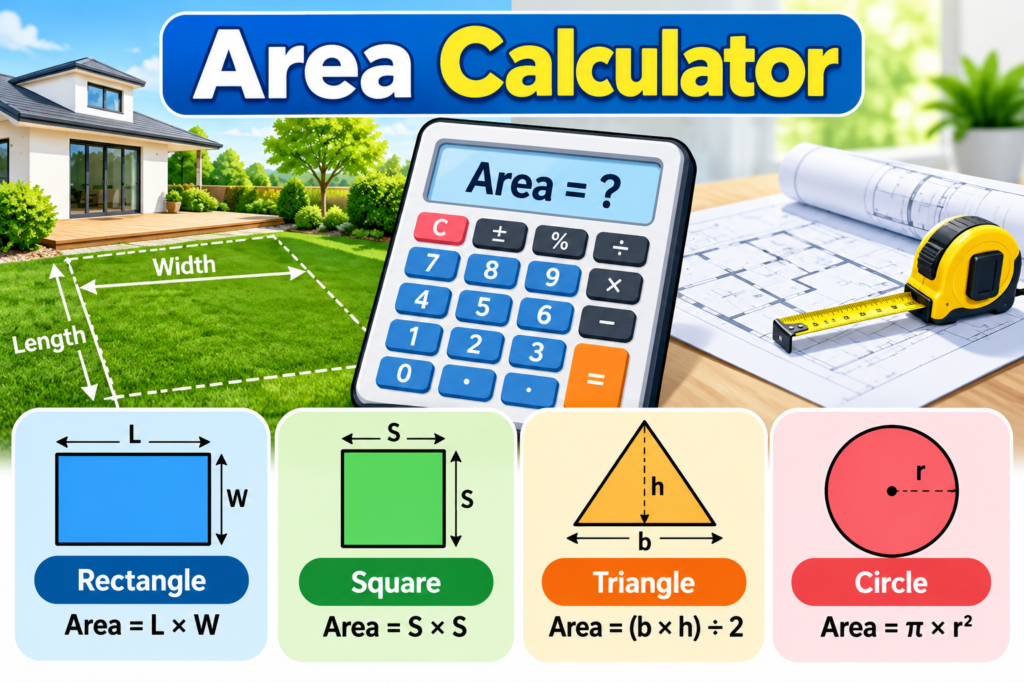
Rectangle Area Formula
A rectangle has four sides with opposite sides of equal length. To find its area, multiply the length by the width.
Formula:
Area = Length × Width
For example, suppose a rectangular room is 10 meters long and 5 meters wide:
10 × 5 = 50 square meters
This type of calculation is useful when estimating flooring, carpet, paint coverage, lawn space, or the size of a rectangular property.
Square Area Formula
A square has four equal sides. Because the length and width are identical, you only need one side measurement.
Formula:
Area = Side × Side
For example, if each side measures 6 meters:
6 × 6 = 36 square meters
Square measurements are frequently used for rooms, tiles, gardens, panels, and other evenly shaped spaces.
Triangle Area Formula
A triangle requires its base and perpendicular height.
Formula:
Area = (Base × Height) ÷ 2
If a triangle has a base of 12 meters and a height of 8 meters:
(12 × 8) ÷ 2 = 48 square meters
Make sure the height represents the perpendicular distance from the base to the opposite point of the triangle.
Circle Area Formula
To calculate the area of a circle, you need its radius. The radius is the distance from the center of the circle to its outer edge.
Formula:
Area = π × Radius²
For example, a circle with a radius of 5 meters has an area of approximately:
3.1416 × 5² = 78.54 square meters
Because π is an irrational number, circular results are normally rounded to a practical number of decimal places.
Choosing the Correct Measurement Unit
Selecting the correct unit is important when working with area. Small objects may be measured in square centimeters or square inches, while rooms and gardens are commonly measured in square meters or square feet.
Larger properties may use acres, hectares, or other land-measurement units.
Always check your measurements before calculating. Mixing units—for example, entering one measurement in meters and another in centimeters—can produce an incorrect result.
For additional information about measurement units and standards, visit the National Institute of Standards and Technology.
Practical Uses for Area Calculations
Area calculations are useful for many household, construction, landscaping, and planning projects. You may need to determine floor space before purchasing tiles or carpet, measure a wall before buying paint, calculate garden space before planting, or estimate the size of a surface before ordering materials.
Accurate measurements can also help reduce waste and improve cost estimates. However, real projects may require additional material for cutting, fitting, breakage, overlaps, or irregular spaces.
The Area Calculator can also be useful when estimating flooring, landscaping, painting, and other projects where surface measurements are important.
Using the Calculator
The Area Calculator makes these calculations faster by applying the appropriate formula for the selected shape. Choose the shape, select your measurement unit, enter the required dimensions, and calculate the result.
For irregular spaces, divide the area into simpler shapes such as rectangles and triangles. Calculate each section separately and then add the results together.
Always verify important measurements before purchasing materials or making construction decisions.
Explore more useful calculation tools on our Calculators page.