Average Calculator
Enter a list of numbers to calculate the average, sum, count, minimum value, and maximum value.
How this calculator works
The arithmetic average is calculated by adding all the numbers together and dividing the total by the number of values.
What Is an Average?
An average is a useful way to represent a group of numbers with one central value. It is commonly used in mathematics, education, finance, business, sports, science, and everyday life. When people refer to the average of several numbers, they usually mean the arithmetic mean.
To find the arithmetic mean, add all the numbers together and divide the total by the number of values in the group.
Our Average Calculator helps you quickly find the arithmetic mean of a group of numbers without doing the calculation manually.
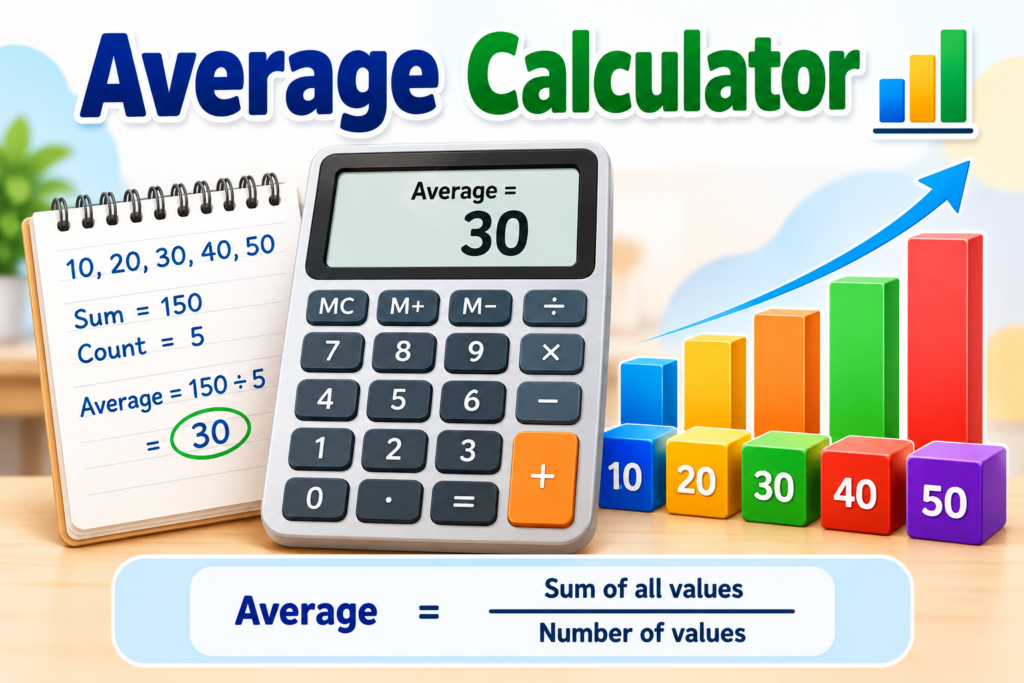
Formula:
Average = Sum of all values ÷ Number of values
For example, suppose you have the numbers 10, 20, 30, 40, and 50. First, add them together:
10 + 20 + 30 + 40 + 50 = 150
There are five numbers, so divide 150 by 5:
150 ÷ 5 = 30
Therefore, the average is 30.
How to Calculate an Average
Calculating an average manually is straightforward when you have only a few values. Start by checking that all numbers you want to include are entered correctly. Add the values together, count how many numbers are included, and divide the total by that count.
For larger sets of numbers, manual calculations can become time-consuming and increase the possibility of arithmetic mistakes. Using the Average Calculator can make the process faster because the addition, counting, and division are handled automatically.
Always check your original values before relying on the result. A typing error in one number can significantly affect the final answer.
Example Average Calculation
Imagine a student receives five test scores:
72, 80, 85, 90, and 93
Add the scores:
72 + 80 + 85 + 90 + 93 = 420
There are five test scores:
420 ÷ 5 = 84
The student’s average test score is therefore 84.
The same method can be applied to expenses, temperatures, measurements, sales figures, travel distances, working hours, or many other numerical datasets.
Common Uses of Averages
Averages are useful whenever you want to summarize several values with a single number. Students may calculate average grades, while households may calculate average monthly expenses. Businesses can use averages to examine sales, costs, customer activity, or productivity.
Averages are also common in sports. For example, several performances can be combined to provide a general indication of performance over a particular period.
Another everyday example is calculating average spending. If you record grocery expenses for several weeks, finding the average can provide a useful estimate of typical weekly spending.
Average vs. Median
The average and median are related concepts, but they are not the same.
The average is calculated by adding all values and dividing by the number of values. The median is the middle value after arranging the numbers from smallest to largest.
Consider these numbers:
10, 12, 14, 16, 100
The unusually large value of 100 increases the average considerably. However, the median remains 14.
This illustrates why an average may sometimes be affected by unusually high or low values, often called outliers. Depending on the data being analyzed, the median may provide another useful perspective.
For additional information about statistical concepts and data analysis, explore the NIST Statistics Handbook.
Tips for Accurate Results
Before calculating, make sure every value belongs to the same type of measurement. For example, avoid mixing dollars with percentages or kilograms with pounds unless the values have first been converted into consistent units.
Also check whether every value should receive equal importance. A standard arithmetic average treats each number equally. Situations where some values have greater importance may require a weighted average instead.
For financial, scientific, academic, or professional decisions, verify the original data and use the appropriate statistical method for your situation.
Using the Calculator
Enter the numbers you want to evaluate into the calculator according to the instructions provided on the page. The tool will process the values and display the result without requiring you to perform the arithmetic manually.
The Average Calculator is particularly convenient when working with several values or when you want to quickly verify a manual calculation.
Explore more useful calculation tools on our Calculators page.