Months to Hours Calculator
Convert months into total hours, approximate days, approximate weeks, total minutes, and total seconds.
How this calculator works
This calculator uses the average Gregorian month length of 30.436875 days. One average month is approximately 730.485 hours.
Table of Contents
Months to Hours Calculator helps you quickly convert months into hours for scheduling, planning, and everyday time calculations. Enter the number of months to find the estimated equivalent number of hours.
Because calendar months have different lengths, converting months into hours requires an average month length or actual calendar dates.
Using an average of 30.44 days per month, the formula is:
Hours ≈ Months × 730.485
For example, to convert 3 months into hours:
3 × 730.485 = 2,191.455 hours
Therefore, 3 average months ≈ 2,191.46 hours.
Therefore, three average months equal approximately 2,191.68 hours.
This conversion is useful for project planning, work schedules, subscriptions, travel planning, and estimating longer time periods.
For exact calendar-hour calculations, use actual starting and ending dates because months contain different numbers of days.
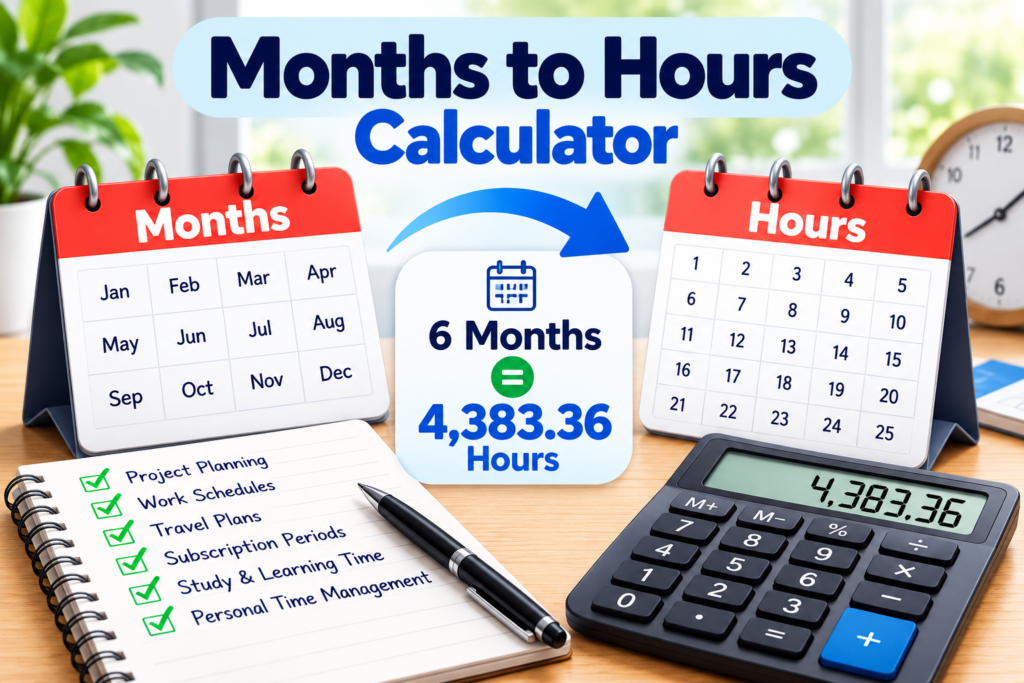
How to Convert Months to Hours
Converting months into hours is useful for understanding long periods of time in a more detailed way. Whether you are planning projects, tracking subscriptions, or organizing schedules, knowing the approximate number of hours can help.
Since calendar months have different lengths, an average month is commonly estimated as 30.44 days.
Formula:
Hours ≈ Months × 30.44 × 24
This simplifies to:
Hours ≈ Months × 730.56
For example, to convert 5 months into hours:
5 × 730.56 = 3,652.8 hours
Therefore, five average months equal approximately 3,652.8 hours.
The Months to Hours Calculator helps you quickly estimate the total number of hours in any given number of months.
Understanding Hours in an Average Month
A standard calendar year contains 12 months. However, each month can contain a different number of days.
Some months have 30 days, others have 31 days, and February contains either 28 or 29 days.
Therefore, one average month contains approximately 730.56 hours.
This is an estimate rather than the exact duration of a specific calendar month.
Common Months to Hours Conversions
The following table uses an average of 730.56 hours per month.
| Months | Approximate Hours |
|---|---|
| 1 month | 730.56 hours |
| 2 months | 1,461.12 hours |
| 3 months | 2,191.68 hours |
| 4 months | 2,922.24 hours |
| 5 months | 3,652.80 hours |
| 6 months | 4,383.36 hours |
| 9 months | 6,575.04 hours |
| 12 months | 8,766.72 hours |
| 18 months | 13,150.08 hours |
| 24 months | 17,533.44 hours |
These values are useful for approximate calculations, but exact calendar periods may contain different numbers of hours.
Use the Months to Hours Calculator to convert monthly durations into approximate hours for planning and scheduling.
How to Convert Decimal Months into Hours
You can also convert fractional month values.
For example, suppose you want to convert 2.5 months into hours.
2.5 × 730.56 = 1,826.4 hours
Therefore, 2.5 average months equal approximately 1,826.4 hours.
Another example:
1.5 × 730.56 = 1,095.84 hours
Decimal conversions are useful when estimating partial months for projects, planning, and time tracking.
Need to convert months into days instead? Try our Months to Days Calculator to quickly estimate the number of days in any given number of months.
Converting Hours Back to Months
You can reverse the calculation by dividing the total hours by the average number of hours in a month.
Months ≈ Hours ÷ 730.56
For example:
1,500 ÷ 730.56 ≈ 2.05 months
Therefore, 1,500 hours represent approximately 2.05 average months.
This method is useful when you know the total hours and want to express the duration in months.
Calendar Months vs. Average Months
Calendar months do not contain identical numbers of hours.
For example:
- A 28-day month contains 672 hours.
- A 29-day month contains 696 hours.
- A 30-day month contains 720 hours.
- A 31-day month contains 744 hours.
These figures assume 24 hours per calendar day and do not account for local clock changes such as daylight saving time.
When exact durations matter, calculate the difference between specific dates and times.
Project Planning and Work Schedules
Long-term projects are often planned in months, while individual tasks may be tracked in hours.
For example, a four-month project represents approximately:
4 × 730.56 = 2,922.24 hours
This represents the entire estimated calendar duration, not the number of working hours.
To estimate actual working time, consider working days, daily schedules, holidays, and time off.
Subscription and Travel Planning
Monthly subscriptions, training programs, and extended travel plans may involve durations measured in months.
For example, a six-month period represents approximately:
6 × 730.56 = 4,383.36 hours
This can help compare long periods, but actual billing dates and travel durations depend on calendar dates.
Frequently Asked Questions
How many hours are in one month?
Using an average of 30.44 days, one month contains approximately 730.56 hours.
How many hours are in 3 months?
3 × 730.56 = 2,191.68 hours
How many hours are in 6 months?
6 × 730.56 = 4,383.36 hours
How many hours are in 12 months?
Using the average conversion:
12 × 730.56 = 8,766.72 hours
Is one month always 720 hours?
No. A 30-day month contains 720 hours, but calendar months vary in length.
Can I convert fractional months into hours?
Yes. Multiply the number of months by 730.56 to obtain an approximate result.
The Months to Hours Calculator provides a convenient way to estimate hours from months without performing manual calculations.
The Months to Hours Calculator is useful for estimating project timelines, planning work schedules, tracking long-term activities, and converting months into approximate hours quickly and easily.
Final Thoughts
Converting months into hours helps simplify long-term time calculations for planning, scheduling, travel, and projects.
Using an average of 730.56 hours per month provides a convenient estimate.
For precise results involving actual calendar dates, use a date-and-time calculation that accounts for month lengths and relevant time changes.
For official information about calendar months and time calculations, see the U.S. Naval Observatory Calendar FAQ.