Date Difference Calculator
Calculate the time between two dates in years, months, days, weeks and hours.
How this date difference calculator works
Select a start date and an end date. The calculator will show the calendar difference as well as the total number of days, weeks and hours between the two dates.
What Is the Difference Between Two Dates?
The difference between two dates tells you how much time passes from one calendar date to another. This can be measured in days and, depending on the calculation, may also be expressed in weeks, months, or years.
For example, if the start date is October 1 and the end date is October 11, the standard difference between those dates is 10 days.
Our Date Difference Calculator makes this calculation automatically, helping you avoid manually counting days on a calendar.
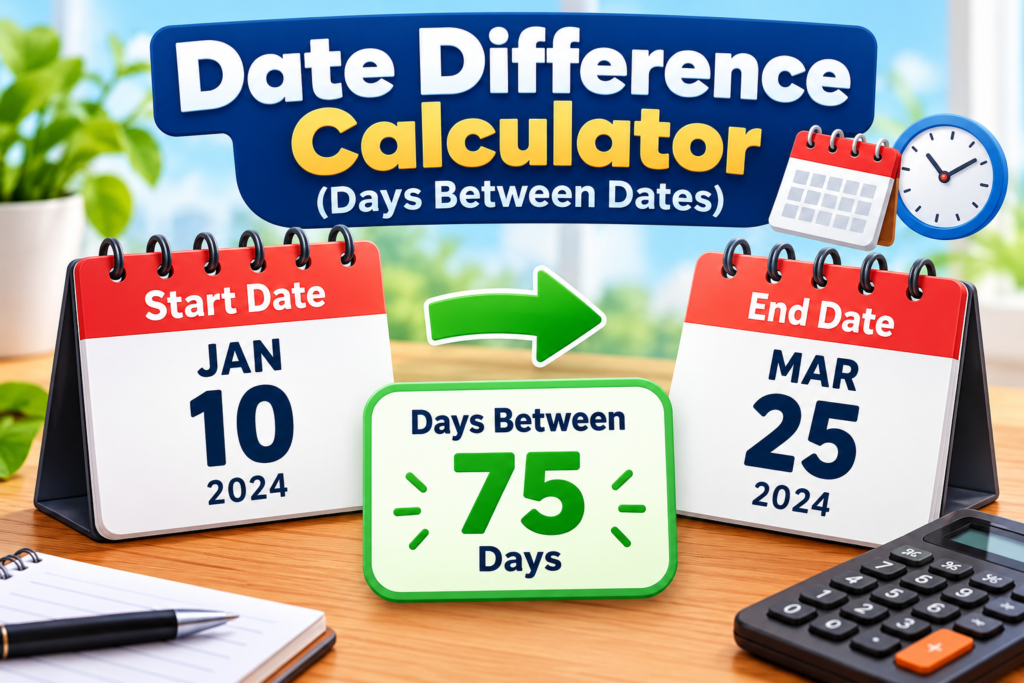
How to Calculate Days Between Dates
The basic idea is simple:
Date Difference = End Date − Start Date
However, manual calculations can become more complicated when the dates cross different months or years.
For example:
Start Date: March 15
End Date: April 10
Because March and April contain different numbers of days, counting manually requires extra care.
A calculator handles the calendar structure automatically and provides the result quickly.
Example Date Difference Calculation
Suppose you want to know how many days there are between January 1 and January 31.
Using standard elapsed-time counting:
January 31 − January 1 = 30 days
This may initially seem surprising because January contains 31 calendar days. The difference is 30 because the calculation measures the amount of time that passes after the starting date.
If both the starting and ending dates are intentionally included, the count would instead be 31 calendar days.
Understanding whether a calculation is inclusive or exclusive is important when interpreting the result.
Inclusive vs. Exclusive Date Counting
There are two common ways to count a date range.
Exclusive counting measures the elapsed time between the two dates without counting the starting date as a complete day.
For example:
May 1 to May 5 = 4 days
Inclusive counting includes both the starting date and ending date.
Using the same example:
May 1 through May 5 = 5 calendar days
Which method you need depends on what you are calculating. Travel plans, booking periods, deadlines, contracts, and event schedules may use different counting rules.
How Leap Years Affect Date Calculations
A normal calendar year contains 365 days, while a leap year contains 366 days.
During a leap year, February has 29 days instead of 28.
For example, a date range that crosses February 29 may contain one additional day compared with the same period in a non-leap year.
Leap years generally occur every four years, although there are special rules for century years.
Modern date calculation tools can account for leap years automatically, reducing the chance of manual counting errors.
For official information about time and calendar standards, visit the National Institute of Standards and Technology.
Months Have Different Numbers of Days
Another challenge when calculating date differences is that calendar months are not all the same length.
Months can contain:
28 days
29 days
30 days
31 days
This means that a “one month” difference does not always represent the same number of days.
For example, February 1 to March 1 can represent 28 or 29 days, while July 1 to August 1 represents 31 days.
For precise planning, calculating the actual number of days is often more useful than assuming every month has a fixed length.
Practical Uses for Date Calculations
Calculating the time between two dates can be useful in many everyday situations.
You might use it to determine:
Days remaining until an event
Length of a vacation
Time between appointments
Project duration
Days between payments
Time remaining before a deadline
Length of a study period
Days between important personal dates
Businesses may also calculate date differences when planning projects, tracking delivery schedules, reviewing contracts, or measuring periods between transactions.
Calendar Days vs. Business Days
Calendar days and business days are different concepts.
Calendar days normally include every day of the week, including Saturdays and Sundays.
Business days usually exclude weekends and may also exclude public holidays.
For example, a period of seven calendar days normally contains seven days, but it may contain only five standard working days.
If your calculation relates to employment, shipping, banking, or business deadlines, make sure you know whether the requirement refers to calendar days or working days.
How to Use the Calculator
Using the calculator is straightforward.
Choose your start date, then select your end date. The tool calculates the difference between the selected dates automatically.
The Date Difference Calculator is especially useful for longer date ranges where manual counting could be inconvenient or prone to mistakes.
You can also try different start and end dates to compare several time periods quickly.
Why Manual Date Counting Can Be Difficult
Counting a few days manually is easy, but longer periods can become confusing.
You need to consider different month lengths, leap years, year changes, and whether the first or last day should be included.
For example, calculating a period that begins late in one year and finishes several months into the following year requires counting across multiple months with different lengths.
An automated calculation simplifies this process and provides a consistent result.
Use the Date Difference Calculator to quickly compare two calendar dates and find the exact number of days between them.
Understanding Your Result
Always consider what the result represents before using it for an important decision.
A result expressed as days between dates usually represents elapsed calendar time. It does not automatically mean business days, working days, nights, or inclusive days unless the calculator specifically provides those options.
For legal, financial, employment, immigration, contractual, or official deadlines, verify the applicable counting rules with the relevant authority or document.
Final Note
Finding the number of days between dates is useful for scheduling, planning, deadlines, events, travel, projects, and many other everyday activities.
By entering a start date and an end date, you can quickly determine the elapsed time without manually counting every day on a calendar.
A clear understanding of calendar days, inclusive counting, leap years, and different month lengths will also help you interpret date calculations correctly.
Explore more useful date, time, and everyday calculation tools on our Calculators page.