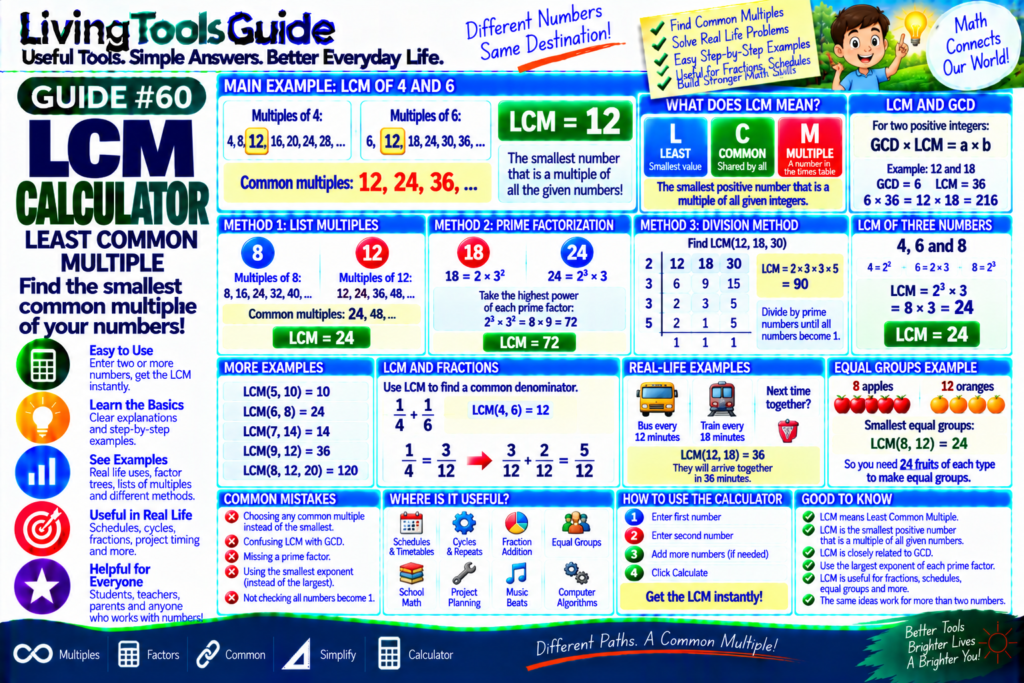
The Least Common Multiple (LCM) is the smallest positive number that is a multiple of two or more whole numbers.
For example, let’s find the LCM of:
4 and 6
Multiples of 4 are:
4, 8, 12, 16, 20, 24, 28…
Multiples of 6 are:
6, 12, 18, 24, 30, 36…
The first positive number appearing in both lists is:
12
Therefore:
LCM(4, 6) = 12
An LCM Calculator makes this process quick and easy, especially when working with larger numbers or several numbers at once.
What Does LCM Mean?
For a more detailed mathematical reference, you can also read the Least Common Multiple explanation on Wolfram MathWorld.
LCM stands for:
Least Common Multiple
Let’s break it down.
Least
The smallest positive value.
Common
Shared by all the numbers.
Multiple
A number obtained by multiplying an integer by another whole number.
So the LCM is:
THE SMALLEST POSITIVE NUMBER THAT IS A MULTIPLE OF ALL THE GIVEN NUMBERS
What Is a Multiple?
A multiple is the result of multiplying a number by an integer.
For example, multiples of 5 include:
5, 10, 15, 20, 25, 30, 35…
because:
5 × 1 = 5
5 × 2 = 10
5 × 3 = 15
5 × 4 = 20
and so on.
Example — LCM of 8 and 12
List the multiples.
Multiples of 8
8, 16, 24, 32, 40, 48…
Multiples of 12
12, 24, 36, 48, 60…
The smallest common positive multiple is:
24
Therefore:
LCM(8, 12) = 24
Method 1 — Listing Multiples
Listing multiples is one of the easiest methods for small numbers.
Let’s find:
LCM(5, 10)
Multiples of 5:
5, 10, 15, 20, 25, 30…
Multiples of 10:
10, 20, 30, 40…
The first common multiple is:
10
Therefore:
LCM(5, 10) = 10
This method is simple, but it can become time-consuming when the numbers are large.
Method 2 — Prime Factorization
Prime factorization is another useful way to calculate LCM.
Let’s find:
LCM(18, 24)
Prime factorization:
18
18 = 2 × 3²
24
24 = 2³ × 3
For the LCM, take every prime factor needed to represent both numbers, using the highest exponent that appears.
For 2:
2³
For 3:
3²
Therefore:
LCM = 2³ × 3²
= 8 × 9
= 72
So:
LCM(18, 24) = 72
Why Use the Highest Exponent?
Compare:
18 = 2¹ × 3²
24 = 2³ × 3¹
To create a number divisible by both 18 and 24, we need enough of every prime factor.
The highest power of 2 is:
2³
The highest power of 3 is:
3²
Therefore:
LCM = 2³ × 3² = 72
This is the opposite of the prime-factor rule used for GCD.
GCD
Use the smallest shared exponent.
LCM
Use the largest required exponent.
Method 3 — Division Method
Another approach is the division or ladder method.
Suppose we want:
LCM(12, 18, 30)
Divide the numbers by suitable prime numbers until every value becomes 1.
The required prime divisors are:
2 × 3 × 3 × 5
Therefore:
LCM = 90
So:
LCM(12, 18, 30) = 90
LCM of Three Numbers
The LCM is not limited to two numbers.
Suppose:
4, 6 and 8
Prime factorizations:
4 = 2²
6 = 2 × 3
8 = 2³
Take the highest powers:
2³ × 3
=
8 × 3
=
24
Therefore:
LCM(4, 6, 8) = 24
LCM of More Than Three Numbers
The same idea can be extended to additional numbers.
For example:
LCM(2, 3, 4, 5)
Prime requirements are:
2²
3
5
Therefore:
4 × 3 × 5
=
60
So:
LCM(2, 3, 4, 5) = 60
Quick LCM Examples
| Numbers | LCM |
|---|---|
| 2, 3 | 6 |
| 4, 6 | 12 |
| 5, 10 | 10 |
| 6, 8 | 24 |
| 7, 14 | 14 |
| 8, 12 | 24 |
| 9, 12 | 36 |
| 12, 18 | 36 |
| 18, 24 | 72 |
| 8, 12, 20 | 120 |
What If One Number Is a Multiple of the Other?
Suppose:
6 and 18
Since 18 is already a multiple of 6:
6 × 3 = 18
Therefore:
LCM(6, 18) = 18
Another example:
LCM(7, 21) = 21
This gives us a useful rule:
If one positive integer divides the other exactly, the LCM is the larger number.
LCM of Equal Numbers
Suppose:
LCM(15, 15)
Since both numbers are identical:
LCM = 15
In general, for a positive integer:
LCM(a, a) = a
LCM and Coprime Numbers
Two integers are coprime when their GCD is 1.
For example:
8 and 15
Their GCD is:
1
When two positive integers are coprime:
LCM = Their Product
Therefore:
8 × 15
=
120
So:
LCM(8, 15) = 120
LCM and GCD
LCM and GCD are closely related.
For two positive integers:
GCD(a,b) × LCM(a,b) = a × b
This gives another way to calculate LCM:
LCM(a,b) = (a × b) ÷ GCD(a,b)
Example Using GCD
Find:
LCM(12,18)
First find the GCD:
GCD(12,18) = 6
Then:
LCM = (12 × 18) ÷ 6
= 216 ÷ 6
= 36
Therefore:
LCM(12,18) = 36
This creates a perfect connection with your GCD Calculator — GUIDE #59.
GCD vs LCM
These two concepts are easy to confuse.
GCD
Finds the:
GREATEST COMMON DIVISOR
Example:
GCD(12,18) = 6
LCM
Finds the:
LEAST COMMON MULTIPLE
Example:
LCM(12,18) = 36
A simple way to remember:
GCD → DIVIDES THE NUMBERS
LCM → IS DIVISIBLE BY THE NUMBERS
LCM and Fractions
LCM is extremely useful when adding or subtracting fractions with different denominators.
Suppose:
1/4 + 1/6
The denominators are:
4 and 6
Find:
LCM(4,6) = 12
Therefore, 12 can be used as the least common denominator.
Convert:
1/4 = 3/12
and:
1/6 = 2/12
Then:
3/12 + 2/12
=
5/12
Another Fraction Example
Calculate:
1/3 + 1/4
Find:
LCM(3,4) = 12
Convert:
1/3 = 4/12
1/4 = 3/12
Then:
4/12 + 3/12
=
7/12
LCM makes finding a common denominator much easier.
Real-Life Example — Bus Schedules
Imagine:
🚌 Bus A arrives every:
12 Minutes
🚌 Bus B arrives every:
18 Minutes
If they arrive together now, when will they next arrive together?
Find:
LCM(12,18)
=
36
Therefore:
THEY WILL ARRIVE TOGETHER AGAIN IN 36 MINUTES
Real-Life Example — Flashing Lights
Suppose:
💡 Light A flashes every:
4 Seconds
and:
💡 Light B flashes every:
6 Seconds
Find:
LCM(4,6) = 12
Therefore:
THE LIGHTS FLASH TOGETHER EVERY 12 SECONDS
Real-Life Example — Exercise Schedule
Suppose:
🏃 Activity A happens every:
3 Days
and:
🚴 Activity B happens every:
5 Days
If both happen today, when will they next happen together?
Calculate:
LCM(3,5) = 15
Therefore:
15 DAYS
Real-Life Example — Machine Cycles
Suppose two machines complete cycles every:
Machine A = 8 minutes
Machine B = 12 minutes
Find:
LCM(8,12) = 24
Therefore, if they begin together:
THEY COMPLETE A CYCLE TOGETHER EVERY 24 MINUTES
Why Is LCM Useful?
LCM can help with:
📅 Schedules
🔄 Repeating Cycles
🍕 Fractions
🎵 Rhythms
🏭 Machine Cycles
🎓 School Mathematics
💻 Algorithms
⏱️ Timing Problems
It is especially useful whenever several repeating events need to line up again.
LCM and Repeating Events
A useful way to think about LCM is:
WHEN WILL THEY MEET AGAIN?
If one event repeats every:
6 units
and another repeats every:
8 units
then:
LCM(6,8) = 24
So both events align again after:
24 UNITS
Those units might be:
seconds
minutes
hours
days
or another repeating interval.
LCM and Zero
A common mathematical convention is:
LCM(a,0) = 0
for an integer a.
For example:
LCM(12,0) = 0
This follows because 0 is a multiple of every integer, while no positive multiple of 0 exists other than 0 itself under this convention.
Your calculator should clearly state how zero inputs are handled.
LCM and Negative Numbers
LCM is generally reported as a:
NON-NEGATIVE NUMBER
For example:
LCM(-6,8) = 24
The signs do not affect the usual LCM result.
The calculation can be based on:
|−6| = 6
and:
|8| = 8
Therefore:
LCM(6,8) = 24
Prime Numbers and LCM
Suppose we have two different primes:
5 and 7
Because they share no positive divisor other than 1:
GCD(5,7) = 1
Therefore:
LCM(5,7) = 5 × 7
=
35
For two distinct prime numbers, their LCM is their product.
LCM of Consecutive Numbers
Suppose:
4 and 5
Because 4 and 5 are coprime:
LCM(4,5) = 20
But consecutive integers do not have to be prime themselves to be coprime.
For example:
8 and 9
GCD:
1
Therefore:
LCM(8,9) = 72
Common LCM Mistakes
❌ Choosing Any Common Multiple
For 4 and 6:
12, 24, 36…
are all common multiples.
But LCM means the:
SMALLEST POSITIVE COMMON MULTIPLE
Therefore:
LCM = 12
❌ Confusing LCM With GCD
LCM works with multiples.
GCD works with divisors.
❌ Using the Smallest Prime Exponent
For LCM, use the:
HIGHEST REQUIRED EXPONENT
❌ Missing a Prime Factor
Every prime factor needed by any of the numbers must be represented.
❌ Multiplying Numbers Automatically
Multiplying the numbers always gives a common multiple, but it may not be the least common multiple.
Example — Why Multiplying Can Be Wrong
Consider:
6 and 8
Multiplying gives:
6 × 8 = 48
48 is certainly a common multiple.
But:
24
is also divisible by both 6 and 8.
Since 24 is smaller:
LCM(6,8) = 24
not 48.
How to Use the LCM Calculator
Our LCM Calculator makes it easy to find the Least Common Multiple of two or more numbers. Enter your numbers into the LCM Calculator, then calculate the result instantly. You can also use the examples below to understand how the calculation works.
The LCM Calculator is especially useful when working with fractions, schedules, repeating events, and number problems. Instead of listing multiples manually, the LCM Calculator gives you the result quickly and helps you check your calculations.
Using your LivingToolsGuide calculator is simple:
1 — Enter First Number
Example:
18
2 — Enter Second Number
24
3 — Add More Numbers
If your calculator supports multiple values.
4 — Click Calculate
Result:
LCM = 72
The calculator instantly finds the smallest positive number that is a multiple of all the entered values.
Find the LCM Now
Need to find the smallest common multiple of two or more numbers?
Use our LCM Calculator to calculate the Least Common Multiple instantly.