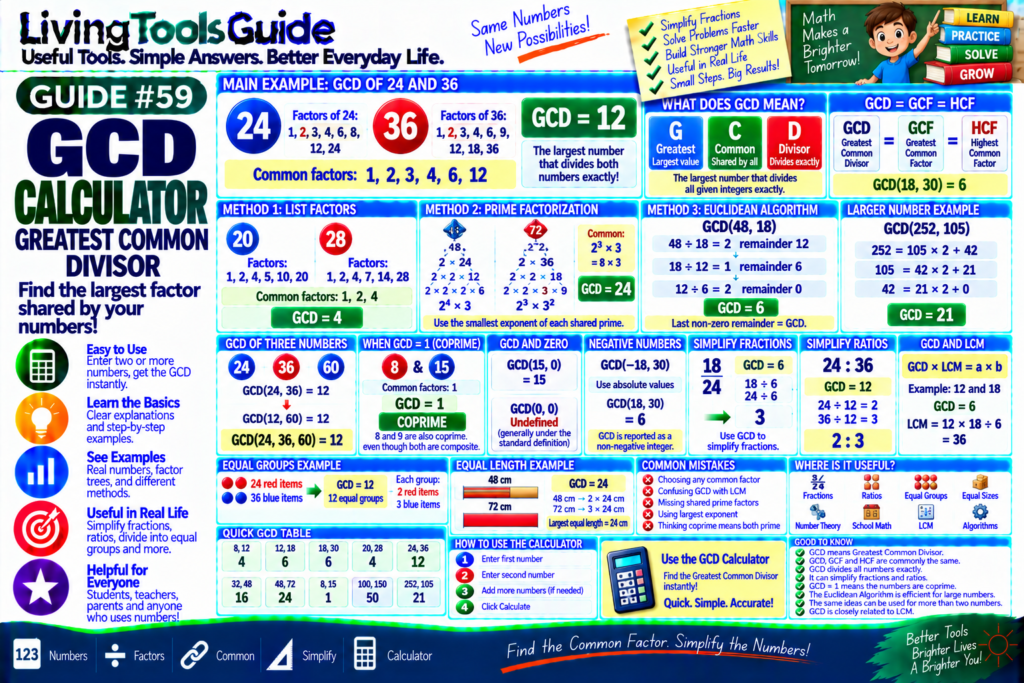
The Greatest Common Divisor (GCD) is the largest positive whole number that divides two or more integers without leaving a remainder.
It is also commonly called the:
Greatest Common Factor (GCF)
or:
Highest Common Factor (HCF)
For example, consider:
24 and 36
Factors of 24:
1, 2, 3, 4, 6, 8, 12, 24
Factors of 36:
1, 2, 3, 4, 6, 9, 12, 18, 36
Their common factors are:
1, 2, 3, 4, 6, 12
The greatest one is:
12
Therefore:
GCD(24, 36) = 12
A GCD Calculator finds this value instantly, especially when you’re working with larger numbers.
What Does GCD Mean?
For a more detailed mathematical reference, you can also read the Greatest Common Divisor explanation on Wolfram MathWorld.
A GCD Calculator works with the Greatest Common Divisor, often shortened to GCD. GCD stands for:
Greatest Common Divisor
The GCD Calculator helps you find the Greatest Common Divisor quickly. Let’s break down what this means.
Greatest
The largest value.
Common
Shared by all the numbers.
Divisor
A number that divides another number exactly.
Therefore, the GCD Calculator would return the following result:
THE LARGEST NUMBER THAT DIVIDES ALL GIVEN INTEGERS EXACTLY
GCD, GCF and HCF
These names describe the same basic idea, and a GCD Calculator can help you find the value instantly.
When using a GCD Calculator, you may see three different abbreviations for this mathematical concept:
GCD
Greatest Common Divisor
GCF
Greatest Common Factor
HCF
Highest Common Factor
In elementary arithmetic, these usually refer to the same value.
For example:
GCD(18, 30) = 6
GCF(18, 30) = 6
HCF(18, 30) = 6
Example — GCD of 18 and 30
Factors of 18:
1, 2, 3, 6, 9, 18
Factors of 30:
1, 2, 3, 5, 6, 10, 15, 30
Common factors:
1, 2, 3, 6
Largest common factor:
6
Therefore:
GCD(18, 30) = 6
Method 1 — Listing Factors
For small numbers, one of the easiest methods is to list every factor.
Let’s find:
GCD(20, 28)
Factors of 20:
1, 2, 4, 5, 10, 20
Factors of 28:
1, 2, 4, 7, 14, 28
Common factors:
1, 2, 4
Largest:
4
Therefore:
GCD(20, 28) = 4
This method is simple but becomes inconvenient with large numbers.
Method 2 — Prime Factorization
Another method is to break each number into prime factors.
Suppose we want:
GCD(48, 72)
Prime factorization of 48:
48 = 2⁴ × 3
Prime factorization of 72:
72 = 2³ × 3²
Take only the prime factors shared by both numbers, using the smallest exponent for each shared prime.
For 2:
2³
For 3:
3¹
Therefore:
2³ × 3
=
8 × 3
=
24
So:
GCD(48, 72) = 24
Why Use the Smallest Exponent?
Consider:
48 = 2⁴ × 3¹
72 = 2³ × 3²
Both numbers contain factors of 2 and 3.
But the largest power of 2 contained in both is:
2³
and the largest power of 3 contained in both is:
3¹
Therefore:
GCD = 2³ × 3 = 24
Method 3 — Euclidean Algorithm
For larger numbers, the Euclidean Algorithm is a very efficient method.
The idea is:
GCD(a, b) = GCD(b, a mod b)
Continue replacing the pair until the remainder becomes zero.
The last non-zero remainder is the GCD.
Euclidean Algorithm Example
Find:
GCD(48, 18)
First:
48 ÷ 18
remainder:
12
So:
GCD(48,18) = GCD(18,12)
Next:
18 ÷ 12
remainder:
6
So:
GCD(18,12) = GCD(12,6)
Next:
12 ÷ 6
remainder:
0
Therefore:
GCD(48,18) = 6
Another Euclidean Algorithm Example
Find:
GCD(252, 105)
First:
252 = 105 × 2 + 42
Then:
105 = 42 × 2 + 21
Then:
42 = 21 × 2 + 0
The last non-zero remainder is:
21
Therefore:
GCD(252,105) = 21
GCD of Three Numbers
The GCD can also be found for more than two numbers.
Suppose:
24, 36 and 60
First:
GCD(24,36) = 12
Then:
GCD(12,60) = 12
Therefore:
GCD(24,36,60) = 12
Formula for Multiple Numbers
For three integers:
GCD(a,b,c) = GCD(GCD(a,b),c)
The same idea can be continued for additional numbers.
For example:
GCD(12,18,24,30)
First:
GCD(12,18) = 6
Then:
GCD(6,24) = 6
Then:
GCD(6,30) = 6
Therefore:
GCD = 6
What If the GCD Is 1?
Suppose:
8 and 15
Factors of 8:
1, 2, 4, 8
Factors of 15:
1, 3, 5, 15
The only common positive factor is:
1
Therefore:
GCD(8,15) = 1
Numbers with a GCD of 1 are called:
COPRIME
or:
RELATIVELY PRIME
They do not need to be prime numbers themselves.
Coprime Example
Consider:
8 and 9
8 is composite.
9 is composite.
But:
GCD(8,9) = 1
Therefore:
8 AND 9 ARE COPRIME
GCD When One Number Divides the Other
Suppose:
12 and 36
Since:
36 ÷ 12 = 3
with no remainder, 12 divides both numbers.
Therefore:
GCD(12,36) = 12
General rule:
If a divides b exactly, then:
GCD(a,b) = |a|
assuming a is the nonzero smaller divisor.
GCD of Equal Numbers
Suppose:
GCD(25,25)
Every factor of 25 is shared.
The largest factor is:
25
Therefore:
GCD(25,25) = 25
In general:
GCD(a,a) = |a|
GCD and Zero
A useful mathematical convention is:
GCD(a,0) = |a|
for a nonzero integer a.
For example:
GCD(15,0) = 15
because every positive divisor of 15 also divides 0.
However:
GCD(0,0)
is generally left undefined under the standard greatest-positive-divisor definition.
Your calculator should clearly define how it handles zero inputs.
GCD and Negative Numbers
GCD is normally reported as a:
NON-NEGATIVE INTEGER
For example:
GCD(-18,30) = 6
The signs do not change the greatest positive common divisor.
A calculator can therefore work with the absolute values:
GCD(|a|,|b|)
Quick GCD Table
| Numbers | GCD |
|---|---|
| 8, 12 | 4 |
| 12, 18 | 6 |
| 18, 30 | 6 |
| 20, 28 | 4 |
| 24, 36 | 12 |
| 32, 48 | 16 |
| 48, 72 | 24 |
| 8, 15 | 1 |
| 100, 150 | 50 |
| 252, 105 | 21 |
GCD and Fractions
GCD is very useful for simplifying fractions.
Suppose:
18 / 24
Find:
GCD(18,24) = 6
Divide both numerator and denominator by 6:
18 ÷ 6 = 3
24 ÷ 6 = 4
Therefore:
18/24 = 3/4
This is one of the most common practical uses of GCD.
Another Fraction Example
Simplify:
42 / 56
Find:
GCD(42,56) = 14
Divide:
42 ÷ 14 = 3
56 ÷ 14 = 4
Therefore:
42/56 = 3/4
GCD and Ratios
GCD can also simplify ratios.
Suppose:
24 : 36
GCD:
12
Divide both terms:
24 ÷ 12 = 2
36 ÷ 12 = 3
Therefore:
24 : 36 = 2 : 3
This makes your Ratio Calculator — GUIDE #39 an excellent related tool.
GCD and LCM
GCD is closely related to the Least Common Multiple (LCM).
For two positive integers:
GCD(a,b) × LCM(a,b) = a × b
Therefore:
LCM(a,b) = (a × b) ÷ GCD(a,b)
Example:
a = 12
b = 18
GCD:
6
Then:
12 × 18 ÷ 6
=
36
Therefore:
LCM(12,18) = 36
Prime Numbers and GCD
Suppose two different prime numbers are:
7 and 11
Factors of 7:
1, 7
Factors of 11:
1, 11
The only common factor is:
1
Therefore:
GCD(7,11) = 1
Different prime numbers are always coprime.
Why Is GCD Useful?
GCD appears in many areas of mathematics and everyday problem solving.
It can help with:
➗ Simplifying Fractions
📐 Simplifying Ratios
📦 Dividing Items Into Equal Groups
📏 Finding Largest Equal Sizes
🔢 Number Theory
🎓 School Mathematics
🧮 LCM Calculations
💻 Computer Algorithms
Equal Groups Example
Suppose you have:
24 Red Items
and:
36 Blue Items
You want to create the greatest possible number of identical groups without leftovers.
Calculate:
GCD(24,36) = 12
Therefore, you can create:
12 EQUAL GROUPS
Each group contains:
2 red items
and:
3 blue items
Largest Equal Length Example
Suppose two pieces measure:
48 cm
and:
72 cm
You want to cut both into equal-length pieces with no remainder, using the greatest possible piece length.
Calculate:
GCD(48,72) = 24
Therefore:
LARGEST EQUAL PIECE = 24 cm
The 48 cm piece makes:
2 pieces
The 72 cm piece makes:
3 pieces
Common GCD Mistakes
❌ Choosing Any Common Factor
For 24 and 36, 6 is a common factor—but it is not the greatest.
The GCD is:
12
❌ Confusing GCD With LCM
GCD finds the greatest shared divisor.
LCM finds the smallest shared multiple.
❌ Forgetting Common Prime Factors
In prime factorization, use only primes shared by every number.
❌ Using the Largest Exponent
For GCD, use the smallest shared exponent.
❌ Assuming Coprime Means Both Numbers Are Prime
Composite numbers can also be coprime.
How to Use the GCD Calculator
Using your LivingToolsGuide calculator is simple:
The GCD Calculator is especially useful when working with fractions, ratios, equal groups, and number problems. Instead of checking factors manually, the GCD Calculator gives you the result quickly and helps you verify your calculations.
1 — Enter First Number
Example:
48
2 — Enter Second Number
72
3 — Add More Numbers
If your calculator supports multiple inputs.
4 — Click Calculate
Result:
GCD = 24
The calculator can instantly determine the greatest positive integer that divides all entered values exactly.
Find the GCD Now
Need to find the largest common divisor of two or more numbers?
Use our GCD Calculator to calculate the Greatest Common Divisor quickly and easily.
🔢 Numbers | ➗ Factors | 🔗 Common | 📐 Simplify | 🧮 Calculator
Find the Common Factor. Simplify the Numbers!