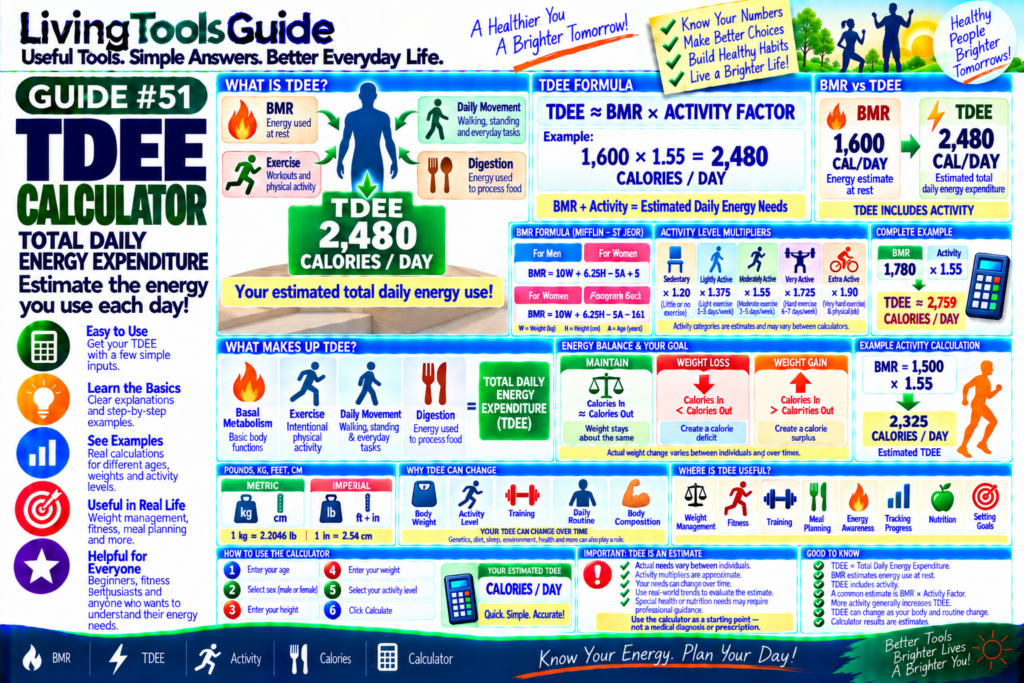
The TDEE Calculator helps you estimate how many calories your body uses each day based on your basal metabolic rate and activity level.
Your body uses energy every day—not only during exercise, but also while breathing, digesting food, maintaining body temperature, walking, working, and even sleeping.
Your estimated Total Daily Energy Expenditure (TDEE) is the total number of calories your body uses over a typical day.
For example, if your estimated TDEE is:
2,400 calories/day
then consuming around 2,400 calories per day may approximately maintain your current body weight if your activity and other factors remain similar over time.
A TDEE Calculator provides an estimate based on information such as your age, sex, height, weight, and activity level.
Important: TDEE is an estimate, not an exact measurement or medical recommendation. Individual energy needs can vary because of body composition, activity, health, medications, pregnancy, growth, and other factors.
What Does TDEE Mean?
TDEE stands for:
Total Daily Energy Expenditure
It represents your estimated total daily energy use.
For more information about energy balance, calorie needs, and maintaining a healthy weight, see the Healthy Weight and Growth information from the CDC.
A simple way to think about it is:
TDEE ≈ BMR × Activity Factor
Your BMR (Basal Metabolic Rate) estimates the calories your body needs at rest.
The activity factor adjusts that estimate based on your typical activity level.
BMR vs TDEE
These two terms are closely related but are not the same.
🔥 BMR
Basal Metabolic Rate
An estimate of the energy your body uses at rest to maintain basic functions.
⚡ TDEE
Total Daily Energy Expenditure
An estimate of your total daily energy use, including activity.
In simplified calculator models:
TDEE = BMR × Activity Factor
For example:
BMR = 1,600 calories/day
Activity Factor = 1.55
Calculation:
1,600 × 1.55
=
2,480 calories/day
Estimated TDEE:
≈ 2,480 Calories/Day
How Is BMR Estimated?
Many calculators use the Mifflin–St Jeor equation.
Using weight in kilograms, height in centimeters, and age in years:
For Men
BMR = 10W + 6.25H − 5A + 5
For Women
BMR = 10W + 6.25H − 5A − 161
Where:
W = weight in kg
H = height in cm
A = age in years
The resulting BMR is an estimate expressed in calories per day.
Example BMR Calculation
Suppose a man is:
30 years old
80 kg
180 cm
Using the Mifflin–St Jeor equation:
BMR = (10 × 80) + (6.25 × 180) − (5 × 30) + 5
Calculate:
800 + 1,125 − 150 + 5
=
1,780 calories/day
This is the estimated BMR.
The next step is to adjust it for activity.
Activity Levels
TDEE calculators commonly use activity multipliers similar to these:
| Activity Level | Example Multiplier |
|---|---|
| Sedentary | 1.20 |
| Lightly Active | 1.375 |
| Moderately Active | 1.55 |
| Very Active | 1.725 |
| Extra Active | 1.90 |
These categories are only approximations. Different calculators may define activity levels somewhat differently.
Example — Moderately Active
Using our previous BMR:
BMR = 1,780
Suppose the selected activity factor is:
1.55
Then:
1,780 × 1.55
=
2,759 calories/day
Estimated TDEE:
≈ 2,759 Calories/Day
This is an estimate of average daily energy expenditure, not a guarantee that exactly 2,759 calories will maintain body weight.
What Makes Up Daily Energy Expenditure?
Your total energy expenditure can be thought of as having several components.
🔥 Basal Metabolism
Energy used to maintain essential body functions.
🏃 Physical Activity
Energy used during exercise and other intentional movement.
🚶 Everyday Movement
Walking, standing, household activities, work, and other non-exercise movement.
🍽️ Digestion
Energy used to digest, absorb, and process food.
Together, these contribute to your total daily energy expenditure.
TDEE and Weight Maintenance
If your average calorie intake is approximately equal to your actual energy expenditure over time, your weight may tend to remain relatively stable.
Simplified concept:
Calories In ≈ Calories Out
↓
Weight Maintenance
But body weight can fluctuate from day to day because of water, food intake, glycogen, sodium, hormones, and other factors.
For this reason, longer-term trends are usually more informative than a single day’s scale reading.
TDEE and Weight Loss
A common approach to weight loss is to consume fewer calories than estimated energy expenditure.
This is called a:
Calorie Deficit
Conceptually:
Calories In < Calories Out
However, the appropriate calorie intake depends on the individual.
Very large calorie deficits can be difficult to sustain and may be inappropriate, particularly for children, teenagers, pregnant or breastfeeding people, people with certain medical conditions, or those with a history of disordered eating.
For personalized guidance, consult a qualified healthcare professional or registered dietitian.
TDEE and Weight Gain
For weight gain, calorie intake generally needs to exceed energy expenditure over time.
This is called a:
Calorie Surplus
Conceptually:
Calories In > Calories Out
The appropriate amount depends on factors such as training, goals, body composition, health, and individual response.
Why TDEE Is Only an Estimate
A calculator cannot directly measure how many calories your body burns.
Two people with similar:
Age
Height
Weight
and:
Activity level
may still have different energy requirements.
Differences can come from:
🧬 Genetics
💪 Body Composition
🏃 Activity
🚶 Daily Movement
🍽️ Diet
😴 Sleep
🌡️ Environment
💊 Health or medications
Therefore, treat the result as a starting estimate.
Activity Level Can Be Difficult to Choose
This is one of the biggest sources of uncertainty in a TDEE calculation.
For example, someone who exercises several times per week but spends most of the day sitting may not fit perfectly into a single activity category.
Avoid automatically selecting the highest activity level simply because you exercise.
Think about your overall daily and weekly movement, not just workouts.
TDEE Can Change
Your energy expenditure isn’t permanently fixed.
It can change when your:
Body weight changes
Activity changes
Training changes
Daily routine changes
Body composition changes
or other circumstances change.
This means it can be useful to recalculate your estimate periodically.
TDEE Example
Suppose your calculator estimates:
BMR
1,600 Calories
and your selected activity multiplier is:
1.375
Then:
1,600 × 1.375
=
2,200 Calories/Day
So your estimated TDEE is:
≈ 2,200 Calories/Day
Another Example
Suppose:
BMR = 1,500
Activity factor:
1.55
Calculation:
1,500 × 1.55
=
2,325 Calories/Day
Estimated TDEE:
≈ 2,325 Calories/Day
Metric and Imperial Units
Your calculator may allow users to enter measurements using either system.
Metric
Weight: kilograms (kg)
Height: centimeters (cm)
Imperial
Weight: pounds (lb)
Height: feet and inches
If necessary, imperial measurements can be converted before applying a metric-based BMR formula.
Useful conversions:
1 kg ≈ 2.2046 lb
1 inch = 2.54 cm
TDEE vs Calorie Calculator
A TDEE Calculator estimates how much energy you expend per day.
A Calorie Calculator may go further and provide estimated calorie-intake targets for different goals.
They are closely related, which makes this guide a perfect companion to your existing Calorie Calculator.
TDEE vs BMR Calculator
Remember:
BMR = Resting Energy Estimate
while:
TDEE = Total Daily Energy Estimate
A person might have:
BMR = 1,600 kcal/day
but:
TDEE = 2,480 kcal/day
because normal daily activity increases total energy use.
Where Is TDEE Useful?
TDEE estimates can be useful for:
⚖️ Weight Management
🏃 Fitness Planning
🏋️ Training
🍽️ Meal Planning
🔥 Understanding Energy Needs
📊 Tracking Progress
🥗 Nutrition Planning
🎯 Setting General Goals
How to Use the TDEE Calculator
Using your LivingToolsGuide calculator is simple:
1 — Enter Your Age
2 — Select the Required Sex Setting
3 — Enter Height
4 — Enter Weight
5 — Select Activity Level
6 — Click Calculate
The calculator estimates your:
BMR
and then your:
TDEE — Calories/Day
Example Calculator Result
Suppose the calculator gives:
BMR
1,600 kcal/day
Activity:
Moderately Active — 1.55
Then:
1,600 × 1.55
=
2,480 kcal/day
Your estimated TDEE would therefore be:
≈ 2,480 Calories Per Day
How to Use Your Result
Think of your calculated TDEE as a starting estimate, rather than a perfectly precise daily calorie requirement.
If you use it for nutrition planning, consider your real-world results over time.
Changes in body weight and other measurements can help indicate whether your actual average energy needs are higher or lower than the calculator’s estimate.
For individual nutrition or health decisions, especially if you have medical conditions or special nutritional needs, seek professional advice.
Calculate Your TDEE Now
Want an estimate of how much energy you use each day?
Use our TDEE Calculator to estimate your Total Daily Energy Expenditure based on your body measurements and activity level.
The TDEE Calculator makes it easy to estimate your daily energy needs and understand how activity level affects the number of calories your body uses.
🔥 BMR | ⚡ TDEE | 🏃 Activity | 🍽️ Calories | 🧮 Calculator
Know Your Energy. Plan Your Day!