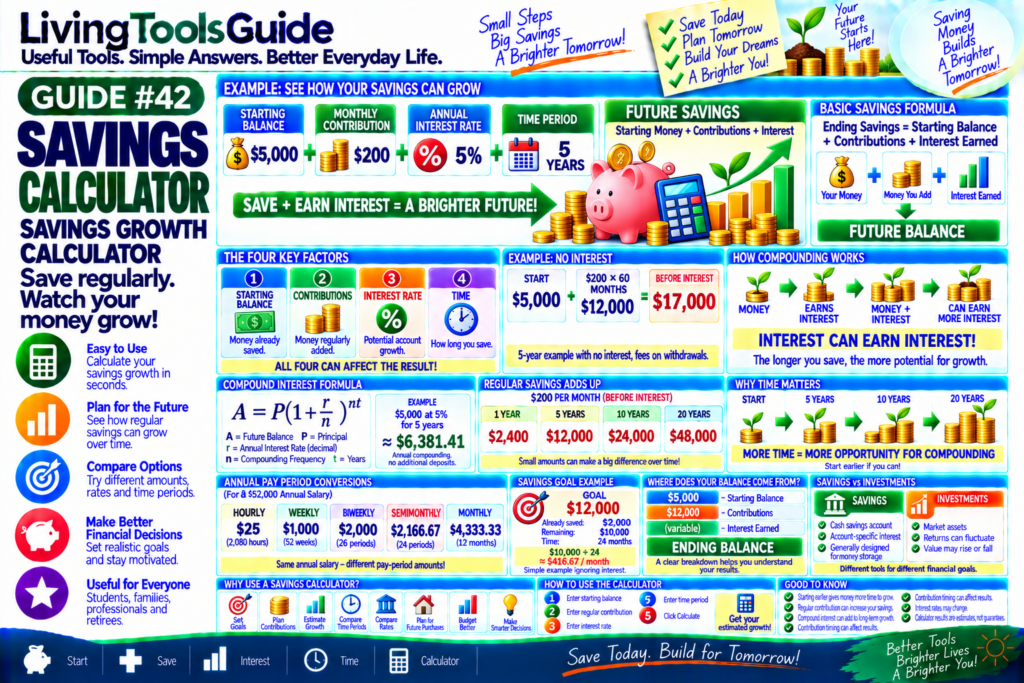
Saving money regularly can make a significant difference over time. Your final savings balance depends on several factors, including your starting balance, regular contributions, interest rate, and how long you save.
For example, imagine you start with:
$5,000
and add:
$200 every month
for:
5 years
Even without interest, your contributions would add:
$200 × 60 = $12,000
Together with the initial $5,000:
$17,000
If the account also earns interest, the ending balance can be higher.
A Savings Calculator helps estimate how your money may grow over time and lets you compare different saving scenarios.
What Is Savings Growth?
Savings growth is the increase in your savings balance over time.
It can come from two main sources:
💵 Your Contributions
Money you add to the account.
📈 Interest
Money potentially earned on the balance, depending on the account and its terms.
Therefore, a simplified view is:
Ending Savings = Starting Balance + Contributions + Interest Earned
The exact result depends on factors such as interest rate, compounding frequency, contribution timing, fees, withdrawals, and account rules.
The Four Main Savings Inputs
A useful savings calculation usually considers:
1 — Starting Balance
The amount you already have saved.
2 — Regular Contribution
The amount you plan to add regularly.
3 — Interest Rate
The assumed annual rate earned by the savings.
4 — Time
How long the money remains saved.
Changing any of these inputs can change the estimated ending balance.
Example 1 — Saving Without Interest
Suppose you start with:
$1,000
and save:
$100/month
for:
1 year
Annual contributions:
$100 × 12 = $1,200
Add the starting balance:
$1,000 + $1,200
Result:
$2,200
This example assumes no interest, fees, or withdrawals.
Example 2 — Five Years of Monthly Savings
Starting balance:
$5,000
Monthly contribution:
$200
Time:
5 years
Number of monthly contributions:
5 × 12 = 60
Total contributions:
$200 × 60 = $12,000
Add the starting balance:
$5,000 + $12,000
Result before interest:
$17,000
If interest is earned, the estimated ending balance may be higher.
How Compound Interest Helps Savings Grow
With compound interest, interest can be earned on both:
Your deposited money
and
previously credited interest
This creates the potential for savings growth to accelerate over longer periods.
A simplified compound-interest formula for a single initial deposit is:
A = P(1 + r/n)ⁿᵗ
Where:
A = Future balance
P = Starting principal
r = Annual interest rate as a decimal
n = Number of compounding periods per year
t = Number of years
This formula alone does not account for regular contributions. A savings calculator can incorporate those separately.
To explore how regular contributions, time and compound interest can affect savings growth, see the SEC’s compound interest resources on Investor.gov.
Example — $5,000 at 5% for 5 Years
Suppose you deposit:
$5,000
and earn a hypothetical:
5% annual interest
compounded annually for:
5 years
Calculation:
$5,000 × (1.05)⁵
Approximately:
$6,381.41
Interest earned:
$6,381.41 − $5,000
=
$1,381.41
This is a simplified example with no additional deposits, fees, taxes, or withdrawals.
Savings With Regular Contributions
Regular contributions can be especially important because you are continually adding new money.
Suppose you save:
$200 every month
That equals:
$2,400 per year
Over 10 years, your direct contributions alone would total:
$24,000
If those contributions also earn interest, the ending balance can exceed the amount you personally deposited.
The exact result depends on when deposits are made and how frequently interest compounds.
Starting Balance Matters
Compare two people who both save:
$200/month for 5 years
Saver A
Starts with:
$0
Direct contributions:
$12,000
Saver B
Starts with:
$5,000
Starting balance + direct contributions:
$17,000
before considering interest.
A larger starting balance gives interest more money to potentially work on from the beginning.
Time Can Make a Big Difference
Savings growth is influenced not only by how much you save but also by how long you save.
Consider regular contributions of:
$200/month
Without interest:
1 year = $2,400
5 years = $12,000
10 years = $24,000
20 years = $48,000
When positive compound interest is added, longer saving periods can increase the effect of compounding.
Interest Rate Matters
A higher positive interest rate generally produces a higher ending balance when all other assumptions are equal.
For example, the same savings plan could be compared at:
2%
4%
6%
However, calculator results based on assumed future rates are projections.
An assumed rate is not a guaranteed return.
Actual savings rates may change over time.
Compounding Frequency
Interest may be compounded at different intervals, depending on the account.
Examples include:
Annually
Quarterly
Monthly
Daily
The compounding method can affect the final balance.
For an advertised savings account, also pay attention to whether the institution states an interest rate, APY, AER, or another annualized measure, since terminology and calculation conventions vary by country and provider.
Contributions vs Interest Earned
A good Savings Calculator should help users understand where the ending balance comes from.
For example:
Starting Balance
$5,000
Contributions
$12,000
Interest
Calculated from the selected assumptions
↓
ENDING BALANCE
This breakdown is more informative than showing only one final number.
Savings Goal Example
A savings calculator can also help answer:
“How much should I save each month?”
Suppose your target is:
$12,000
and you have:
24 months
If we ignore interest:
$12,000 ÷ 24
=
$500/month
If you already have $2,000 saved:
$12,000 − $2,000 = $10,000
Then:
$10,000 ÷ 24
≈
$416.67/month
Interest could change the required amount slightly depending on the assumptions.
Monthly vs Annual Contributions
Suppose you plan to save:
$2,400 per year
That could be expressed as:
$200/month
because:
$2,400 ÷ 12 = $200
However, contributing $200 throughout the year is not mathematically identical to depositing $2,400 only at the end of the year when interest is being calculated.
Contribution timing matters because earlier deposits may have more time to earn interest.
Savings vs Investment Growth
Savings accounts and investments are not necessarily the same.
🏦 Savings
Typically designed for holding cash and earning an account-specific rate.
📈 Investments
May involve stocks, bonds, funds, or other assets whose values and returns can fluctuate.
A Savings Calculator should therefore be presented as an estimation tool based on the assumptions entered—not as a promise of future returns.
Why Use a Savings Calculator?
A Savings Calculator can help you:
💰 Set Savings Goals
📅 Plan Monthly Contributions
📈 Estimate Future Growth
⏳ Compare Saving Periods
🏦 Compare Rate Scenarios
🎯 Plan for Future Purchases
📊 Understand Compounding
💵 Build a Savings Plan
How to Use the Savings Calculator
Using your LivingToolsGuide calculator is simple:
1 — Enter Starting Balance
Example:
$5,000
2 — Enter Regular Contribution
Example:
$200/month
3 — Enter Interest Rate
Example:
5%
4 — Enter Saving Period
Example:
5 years
5 — Click Calculate
The calculator then estimates your savings growth based on its stated assumptions.
Calculate Your Savings Growth
Want to see how regular saving and interest could affect your future balance?
Use our Savings Calculator to estimate savings growth based on your starting balance, contributions, interest rate, and time.
💵 Start | ➕ Save | 📈 Interest | ⏳ Time | 🧮 Calculator
Save Today. Build for Tomorrow!