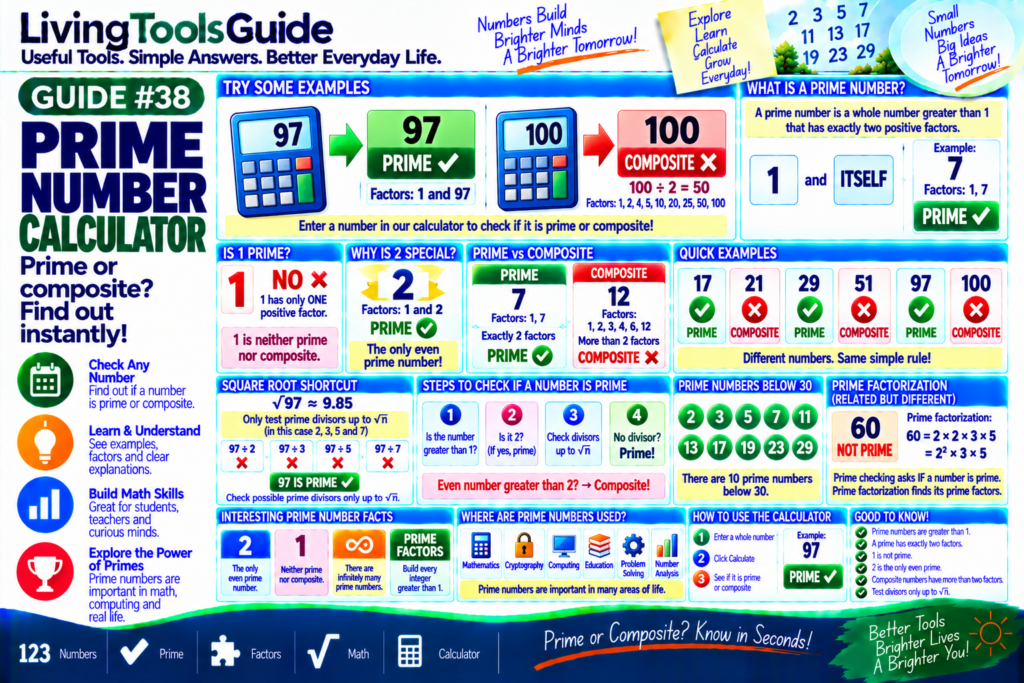
Prime numbers are some of the most important numbers in mathematics. A prime number is a whole number greater than 1 that has exactly two positive factors: 1 and itself.
For example, 7 is prime because its only positive factors are:
1 and 7
But 8 is not prime because it can be divided evenly by:
1, 2, 4 and 8
A Prime Number Calculator quickly checks whether a number is prime or composite, saving you from testing possible factors manually.
What Is a Prime Number?
A prime number must satisfy two conditions:
1 — It must be greater than 1
2 — It must have exactly two positive factors
Those factors are:
1 and the number itself
Examples of prime numbers include:
2, 3, 5, 7, 11, 13, 17, 19, 23, 29
Is 1 a Prime Number?
No.
1 is NOT prime.
Why?
A prime number needs exactly two distinct positive factors.
But 1 has only one positive factor:
1
Therefore:
1 is neither prime nor composite.
This is one of the most important facts to explain in this guide.
Is 2 a Prime Number?
Yes.
The factors of 2 are:
1 and 2
That means 2 has exactly two positive factors.
Therefore:
2 IS PRIME
It also has a special distinction:
2 is the only even prime number.
Every other even integer greater than 2 is divisible by 2 and therefore composite.
Prime vs Composite Numbers
Whole numbers greater than 1 can be classified as prime or composite.
Prime Number
Has exactly two positive factors.
Example:
7
Factors:
1, 7
Therefore:
7 = PRIME
Composite Number
Has more than two positive factors.
Example:
12
Factors:
1, 2, 3, 4, 6, 12
Therefore:
12 = COMPOSITE
Example 1 — Is 17 Prime?
Test possible factors.
17 is not divisible evenly by:
2
3
4
Its only positive factors are:
1 and 17
Therefore:
17 IS PRIME
Example 2 — Is 21 Prime?
21 can be divided by:
3
because:
21 ÷ 3 = 7
So its factors include:
1, 3, 7, 21
Therefore:
21 IS COMPOSITE
Example 3 — Is 29 Prime?
29 has no positive divisors other than:
1 and 29
Therefore:
29 IS PRIME
Example 4 — Is 100 Prime?
100 is divisible by many numbers.
For example:
100 ÷ 2 = 50
Therefore, we already know it has factors other than 1 and 100.
So:
100 IS COMPOSITE
Quick Prime Number Table
Here are the prime numbers below 100:
| Range | Prime Numbers |
|---|---|
| 1–10 | 2, 3, 5, 7 |
| 11–20 | 11, 13, 17, 19 |
| 21–30 | 23, 29 |
| 31–40 | 31, 37 |
| 41–50 | 41, 43, 47 |
| 51–60 | 53, 59 |
| 61–70 | 61, 67 |
| 71–80 | 71, 73, 79 |
| 81–90 | 83, 89 |
| 91–100 | 97 |
There are:
25 prime numbers below 100
How Do You Check Whether a Number Is Prime?
For a small number, you could try dividing it by possible factors.
However, there is a useful shortcut.
To determine whether an integer n > 1 is prime, you only need to test possible prime divisors up to:
√n
Why?
If a composite number has a factor larger than its square root, it must also have a corresponding factor smaller than its square root.
So if no integer divisor from 2 through √n divides the number evenly, the number is prime.
Example — Is 97 Prime?
Calculate approximately:
√97 ≈ 9.85
So we only need to test prime divisors up to 9.85:
2, 3, 5 and 7
97 is not evenly divisible by any of them.
Therefore:
97 IS PRIME
There is no need to test every number from 2 through 96.
A Simple Prime-Checking Method
For an integer greater than 1:
STEP 1
If the number is 2, it is prime.
STEP 2
If it is an even number greater than 2, it is composite.
STEP 3
Check possible prime divisors up to √n.
STEP 4
If any divides evenly, the number is composite.
STEP 5
If none divides evenly, the number is prime.
Prime Factorization Is Different
A Prime Number Calculator answers:
“Is this number prime?”
A Prime Factorization Calculator answers:
“Which prime numbers multiply together to make this number?”
For example:
60 is not prime.
Its prime factorization is:
60 = 2² × 3 × 5
These are related concepts, but they answer different questions.
Interesting Prime Number Facts
🔢 2 is the only even prime.
🔢 1 is neither prime nor composite.
🔢 There are infinitely many prime numbers.
🔢 Every integer greater than 1 is either prime or can be expressed as a product of primes.
That last property is the basis of the Fundamental Theorem of Arithmetic.
Where Are Prime Numbers Used?
Prime numbers are important in:
🔢 Mathematics — number theory and factorization.
🔐 Cryptography — many encryption methods rely on properties of large prime numbers.
💻 Computer Science — algorithms, hashing and mathematical computation.
📚 Education — learning factors, multiplication and divisibility.
🧮 Problem Solving — simplifying many mathematical questions.
📊 Number Analysis — understanding the structure and properties of integers.
How to Use the Prime Number Calculator
Using your LivingToolsGuide calculator is easy:
1 — Enter a Whole Number
Example:
97
2 — Click Calculate
3 — View the Result
Result:
✅ 97 IS A PRIME NUMBER
Another example:
100
↓
❌ 100 IS NOT PRIME
Because:
100 = 2 × 50
Check a Prime Number
Want to know whether a number is prime?
For more information about prime numbers and their mathematical properties, see the Prime Number reference from Wolfram MathWorld.
Use our Prime Number Calculator to instantly check whether an integer is prime or composite.
The Prime Number Calculator makes it easy to check numbers quickly and confirm whether they are prime or composite.