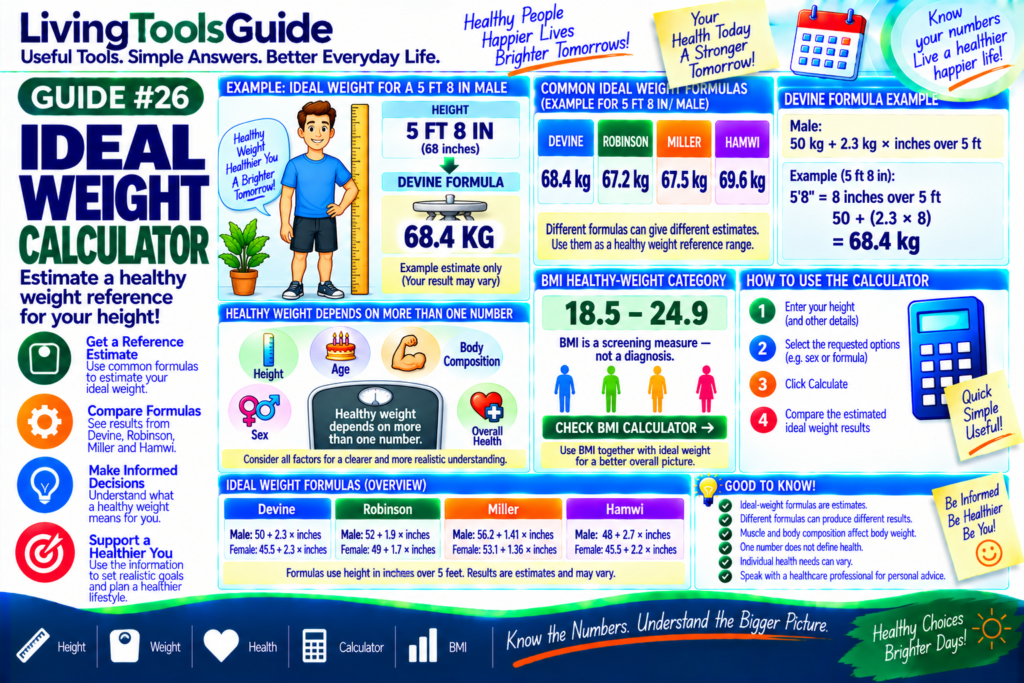
There is no single perfect weight that applies to everyone. A healthy body weight can vary depending on factors such as height, age, sex, body composition, muscle mass, and overall health.
However, several commonly used formulas can provide an estimated ideal body weight based primarily on height and sex.
An Ideal Weight Calculator makes these estimates easy to compare and can provide a useful general reference when thinking about healthy weight goals.
Important: Ideal-weight formulas provide estimates, not medical targets. They do not account fully for muscle mass, body composition, pregnancy, medical conditions, or individual health needs.
What Is Ideal Body Weight?
Ideal Body Weight, often abbreviated IBW, is an estimated body weight calculated using a person’s height and, in many formulas, sex.
IBW formulas were originally developed for practical medical purposes, including estimating medication dosages. Today, they are also commonly used as general weight references.
Rather than treating one calculated number as the “perfect” weight, it is better to consider it alongside other health information.
For more information about BMI and healthy weight assessment, see the CDC information about BMI and weight.
For more information about assessing weight relative to height, see the CDC guide to Body Mass Index (BMI).
What Factors Affect a Healthy Weight?
Several factors can influence what weight is appropriate for an individual.
📏 Height — Taller people generally have higher estimated healthy weights.
🧍 Body composition — Muscle, bone, and body fat contribute differently to total weight.
🎂 Age — Body composition often changes over time.
⚧ Sex — Some traditional IBW formulas use different constants for males and females.
🏃 Activity and muscle mass — Athletic people may weigh more because of additional muscle.
🩺 Overall health — Individual medical circumstances can matter more than a general formula.
Common Ideal Weight Formulas
Several formulas are commonly used to estimate ideal body weight.
Devine Formula
For adults at least 5 feet tall:
Male:
50 kg + 2.3 kg for each inch over 5 feet
Female:
45.5 kg + 2.3 kg for each inch over 5 feet
Robinson Formula
Male:
52 kg + 1.9 kg for each inch over 5 feet
Female:
49 kg + 1.7 kg for each inch over 5 feet
Miller Formula
Male:
56.2 kg + 1.41 kg for each inch over 5 feet
Female:
53.1 kg + 1.36 kg for each inch over 5 feet
Hamwi Formula
Male:
48 kg + 2.7 kg for each inch over 5 feet
Female:
45.5 kg + 2.2 kg for each inch over 5 feet
Because the formulas use slightly different values, they can produce different results for the same person.
Example — Ideal Weight for a 5 ft 8 in Male
Height:
5 feet 8 inches
This is:
8 inches over 5 feet
Using the Devine formula:
50 + (2.3 × 8)
50 + 18.4 = 68.4 kg
Estimated ideal body weight:
68.4 kg
Using another formula may produce a somewhat different estimate. This is why an ideal-weight calculation should be viewed as a reference range rather than an exact target.
Ideal Weight and BMI
Another common way to evaluate weight relative to height is Body Mass Index (BMI).
For most adults, the commonly used BMI “healthy weight” category is:
18.5–24.9
BMI can be useful for population-level screening, but it also has limitations because it does not directly measure body fat or distinguish between fat and muscle.
Your Ideal Weight Calculator and BMI Calculator can therefore complement each other, while neither should be treated as a diagnosis.
Why Calculate Ideal Weight?
An estimated ideal weight can be useful for:
⚖️ General weight awareness
🎯 Setting realistic goals
📏 Understanding height-to-weight relationships
🏃 Fitness planning
🥗 Supporting healthy lifestyle discussions
🩺 Preparing questions for a healthcare professional
The result should always be considered in the context of the individual’s overall health.
How to Use the Ideal Weight Calculator
Using the calculator is simple.
1. Enter your height.
2. Select the requested sex/formula options.
3. Click Calculate.
4. Review the estimated ideal-weight results.
If several formulas are displayed, you may notice slightly different answers. That is normal because each formula uses a different calculation method.
Your Result Is an Estimate
The most important point to remember is:
Ideal weight is not one universal number.
Two people of the same height and weight can have very different body compositions and health profiles.
Use calculator results for general informational purposes, not as a substitute for personalized medical advice.
Calculate Your Estimated Ideal Weight
Want to see your estimated weight using common formulas?
Use our Ideal Weight Calculator for a quick calculation based on your height and other selected information.
👉 Use the Ideal Weight Calculator
📏 Height | ⚖️ Weight | ❤️ Health | 🧮 Calculator | 📊 BMI
The Ideal Weight Calculator provides a quick estimate that can help you understand common healthy weight ranges based on your height.
Know the Numbers. Understand the Bigger Picture.