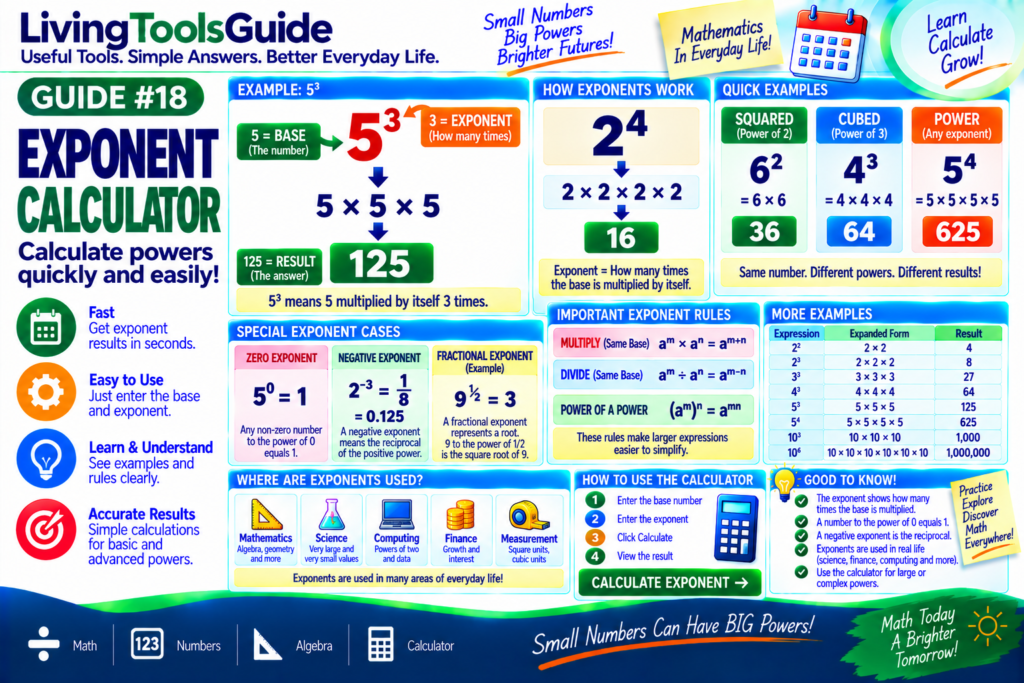
Exponents are a simple way to show that a number is multiplied by itself several times. They appear throughout mathematics, science, engineering, finance, computing, and many everyday calculations.
Instead of writing:
5 × 5 × 5 = 125
we can write:
5³ = 125
An Exponent Calculator makes these calculations quick and easy, especially when working with larger powers, negative exponents, or decimal values.
What Is an Exponent?
An exponent tells us how many times a number is multiplied by itself.
For example:
2⁴ = 2 × 2 × 2 × 2 = 16
In this expression:
2 = Base
4 = Exponent or power
16 = Result
The expression 2⁴ can be read as:
“two to the fourth power.”
Exponent Formula
For more information about exponents and powers, see the Exponentiation reference from Wolfram MathWorld.
The general formula is:
aⁿ = a × a × a × … × a
where:
a = Base
n = Exponent
The base is multiplied by itself n times.
Example 1 — 2³
Calculate:
2³
Expand the exponent:
2 × 2 × 2
Therefore:
2³ = 8
Example 2 — 5⁴
Calculate:
5⁴
Expand:
5 × 5 × 5 × 5
Calculate:
5 × 5 = 25
25 × 5 = 125
125 × 5 = 625
Therefore:
5⁴ = 625
Example 3 — 10⁶
Powers of 10 are particularly easy to recognize:
10⁶ = 1,000,000
The exponent tells us how many times 10 is multiplied by itself.
What Is a Squared Number?
When the exponent is 2, the number is said to be squared.
For example:
6² = 6 × 6 = 36
Other examples:
2² = 4
5² = 25
10² = 100
What Is a Cubed Number?
When the exponent is 3, the number is said to be cubed.
For example:
4³ = 4 × 4 × 4
Therefore:
4³ = 64
What Happens When the Exponent Is Zero?
For any non-zero base:
a⁰ = 1
For example:
5⁰ = 1
100⁰ = 1
2,000⁰ = 1
This is one of the fundamental exponent rules.
Negative Exponents
A negative exponent represents the reciprocal of the corresponding positive power.
The rule is:
a⁻ⁿ = 1 ÷ aⁿ
For example:
2⁻³
First calculate:
2³ = 8
Therefore:
2⁻³ = 1/8 = 0.125
Important Exponent Rules
Product rule
aᵐ × aⁿ = aᵐ⁺ⁿ
Example:
2³ × 2² = 2⁵ = 32
Quotient rule
aᵐ ÷ aⁿ = aᵐ⁻ⁿ
Example:
5⁴ ÷ 5² = 5² = 25
Power of a power
(aᵐ)ⁿ = aᵐⁿ
Example:
(2²)³ = 2⁶ = 64
Zero exponent
a⁰ = 1, when a ≠ 0
Negative exponent
a⁻ⁿ = 1/aⁿ
Quick Exponent Examples
| Expression | Expanded Form | Result |
|---|---|---|
| 2² | 2 × 2 | 4 |
| 2³ | 2 × 2 × 2 | 8 |
| 3³ | 3 × 3 × 3 | 27 |
| 4³ | 4 × 4 × 4 | 64 |
| 5³ | 5 × 5 × 5 | 125 |
| 5⁴ | 5 × 5 × 5 × 5 | 625 |
| 10³ | 10 × 10 × 10 | 1,000 |
| 10⁶ | 10 × 10 × 10 × 10 × 10 × 10 | 1,000,000 |
Where Are Exponents Used?
Exponents are useful in many areas.
📐 Mathematics — algebra, geometry and advanced calculations.
🔬 Science — extremely large and extremely small quantities.
💻 Computing — powers of two and data calculations.
💰 Finance — compound growth and interest calculations.
📏 Measurement — square units and cubic units.
📊 Statistics — mathematical formulas and data analysis.
Why Use an Exponent Calculator?
Simple powers can often be calculated mentally, but calculations quickly become more difficult when the base or exponent becomes large.
For example:
17⁸
is much less convenient to calculate manually.
An Exponent Calculator lets you enter the:
Base → Exponent → Calculate
and immediately see the result.
🧮 Calculate Your Exponents
Enter the base and exponent into our Exponent Calculator to calculate powers quickly.
The Exponent Calculator makes it easy to calculate powers quickly and check exponent calculations accurately.
📐 Math | 🔬 Science | 💻 Computing | 💰 Finance | 📏 Measurement
Small Numbers Can Have BIG Powers!