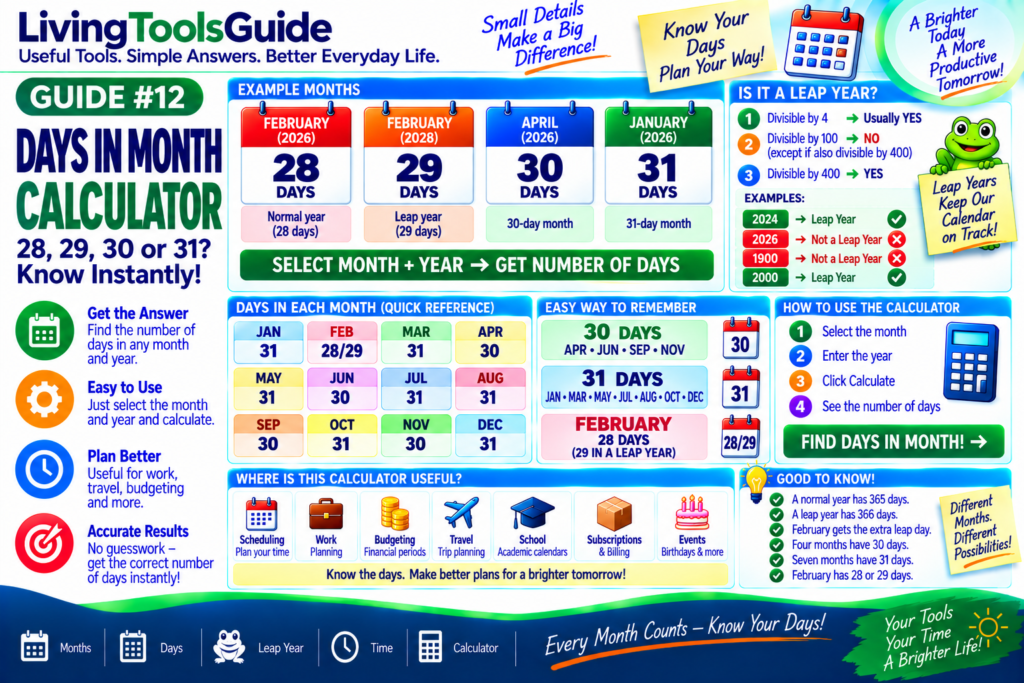
Not every month has the same number of days. Some months have 30 days, others have 31 days, while February normally has 28 days—or 29 days during a leap year.
A Days in Month Calculator makes it easy to select a month and year and instantly find the correct number of days.
This can be useful for scheduling, financial calculations, work planning, travel, deadlines, subscriptions, school calendars, and many other everyday situations.
For official information about calendar months and leap years, see the U.S. Naval Observatory’s calendar reference.
How Many Days Are in Each Month?
The Gregorian calendar has 12 months and normally 365 days.
Here is the standard breakdown:
| Month | Days |
|---|---|
| January | 31 |
| February | 28 or 29 |
| March | 31 |
| April | 30 |
| May | 31 |
| June | 30 |
| July | 31 |
| August | 31 |
| September | 30 |
| October | 31 |
| November | 30 |
| December | 31 |
Most years contain:
365 days
A leap year contains:
366 days
The extra day is added to February.
Why Does February Have 28 or 29 Days?
February normally contains:
28 days
During a leap year, February contains:
29 days
That extra day helps keep the calendar aligned with Earth’s journey around the Sun.
Therefore:
February 2025 = 28 days
but:
February 2028 = 29 days
How Do You Know If a Year Is a Leap Year?
A useful rule is:
1. If the year is divisible by 4, it is usually a leap year.
2. If it is divisible by 100, it is normally not a leap year.
3. However, if it is divisible by 400, it is a leap year.
Examples:
2024 ÷ 4 → Leap Year ✅
2026 → Not a Leap Year ❌
1900 → Not a Leap Year ❌
2000 → Leap Year ✅
This special rule keeps our calendar more accurately aligned with the solar year.
The 30-Day Months
Four months contain exactly 30 days:
April
June
September
November
A familiar memory rhyme begins:
“Thirty days hath September, April, June and November…”
This makes the 30-day months easier to remember.
The 31-Day Months
Seven months contain 31 days:
January
March
May
July
August
October
December
That means most months of the year actually contain 31 days.
Quick Month Examples
Example 1 — September
Select:
Month: September
The result is:
30 DAYS
Example 2 — January
Select:
Month: January
The result is:
31 DAYS
Example 3 — February 2026
Select:
Month: February
Year: 2026
Since 2026 is not a leap year:
28 DAYS
Example 4 — February 2028
Select:
Month: February
Year: 2028
Because 2028 is a leap year:
29 DAYS
Why Use a Days in Month Calculator?
Remembering whether a month has 30 or 31 days is usually easy, but February makes the calculation dependent on the year.
A calculator removes the guesswork.
Simply select:
Month + Year → Number of Days
The calculator automatically determines whether February should contain 28 or 29 days.
Where Is This Calculator Useful?
📅 Scheduling — determine exactly how many calendar days are available.
💼 Work planning — organize monthly schedules and projects.
💰 Budgeting — understand the length of monthly financial periods.
✈️ Travel — plan trips around particular months.
🎓 School calendars — organize study periods and activities.
🏠 Home planning — schedule monthly tasks and projects.
📦 Subscriptions & billing — understand different month lengths.
🎂 Events — plan birthdays, anniversaries and special occasions.
How to Use the Days in Month Calculator
Using the LivingToolsGuide calculator is simple.
Step 1: Select the month.
Step 2: Enter or select the year.
Step 3: Click Calculate.
Step 4: See the exact number of days in that month.
For February, the calculator automatically checks whether the selected year is a leap year.
Calculate the Days in Any Month
Need to know whether a particular month has 28, 29, 30 or 31 days?
Use our Days in Month Calculator and get the answer instantly.