Simple Interest Calculator: Formula, Examples and How to Calculate Interest
A Simple Interest Calculator helps you estimate the interest earned on an investment or charged on a loan when interest is calculated only on the original principal. It is a quick way to understand how the principal amount, annual interest rate, and time period affect the final result.
Simple interest is easier to calculate than compound interest because previously earned interest is not added to the principal for future calculations. This makes the formula useful for learning basic interest calculations and estimating certain loans, investments, and savings scenarios.
In this guide, you will learn the simple interest formula, what each part means, and how to calculate simple interest with practical examples.
What Is Simple Interest?
Simple interest is interest calculated using the original amount of money, known as the principal.
Unlike compound interest, simple interest does not calculate new interest on interest that has already accumulated.
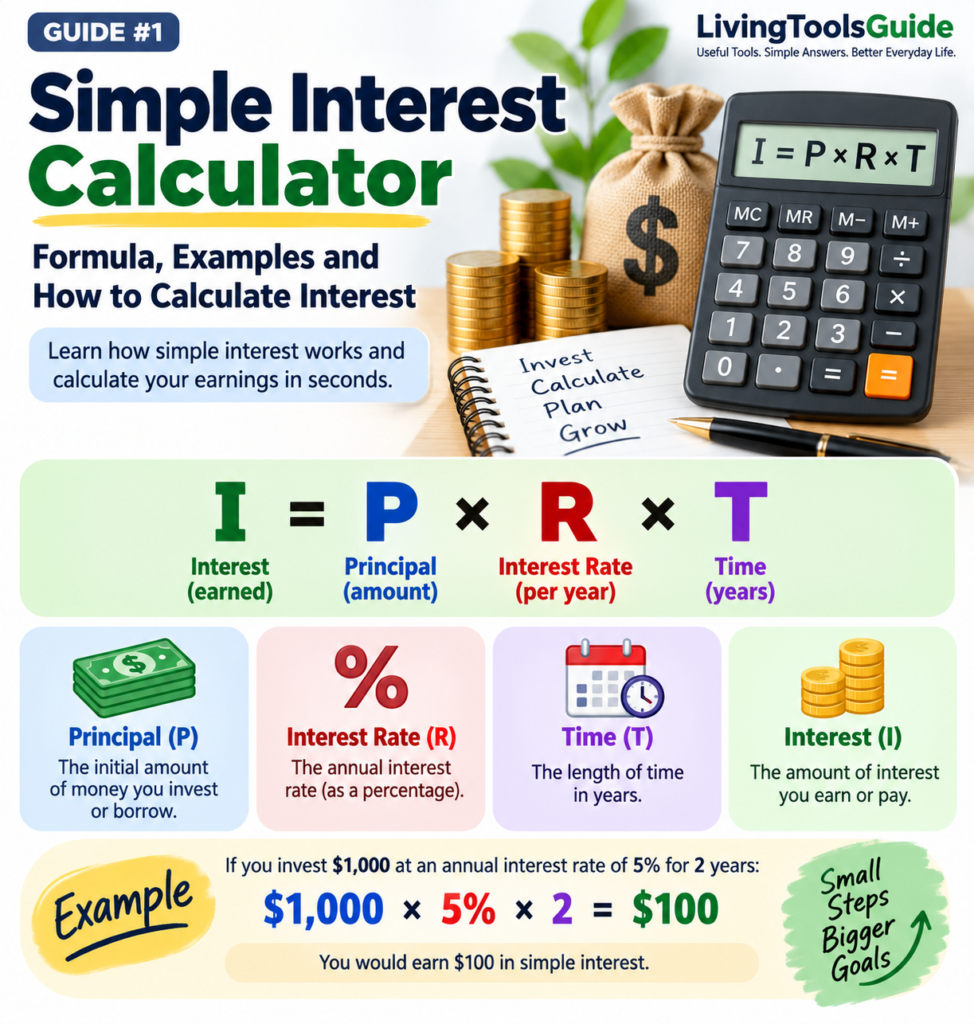
For example, suppose you invest $1,000 at a simple annual interest rate of 5% for 2 years.
You would earn:
$1,000 × 5% × 2 = $100
The total amount after two years would therefore be:
$1,000 + $100 = $1,100
Simple Interest Formula
The standard simple interest formula is:
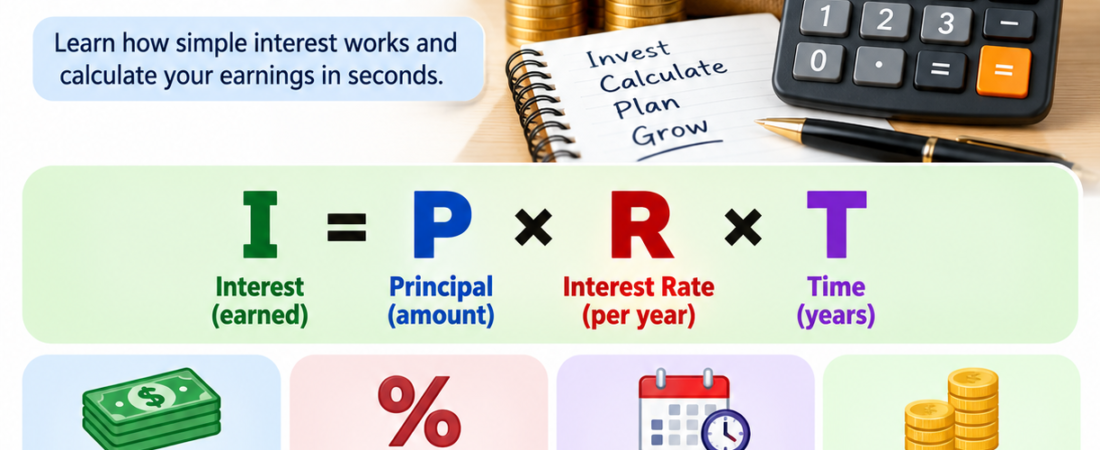
I = P × R × T
Where:
I = Interest
P = Principal amount
R = Annual interest rate expressed as a decimal
T = Time in years
For calculations, remember to convert the percentage interest rate into decimal form.
For example:
5% = 0.05
So if the principal is $1,000, the interest rate is 5%, and the time is 2 years:
I = 1,000 × 0.05 × 2
I = $100
How to Calculate Simple Interest Step by Step
Using a Simple Interest Calculator makes the process fast, but it is useful to understand how the calculation works manually.
Step 1: Find the Principal
The principal is the original amount borrowed or invested.
Example:
Principal = $2,000
Step 2: Find the Interest Rate
Identify the annual interest rate and convert the percentage to a decimal.
If the annual rate is 6%:
6 ÷ 100 = 0.06
Step 3: Find the Time Period
Determine how long the money will be borrowed or invested.
For example:
Time = 3 years
Step 4: Apply the Formula
Use:
I = P × R × T
Therefore:
I = 2,000 × 0.06 × 3
I = $360
Step 5: Calculate the Total Amount
To find the total amount after interest, add the interest to the principal:
Total Amount = Principal + Interest
$2,000 + $360 = $2,360
Simple Interest Example #1: Savings
Suppose you place $5,000 into an account that earns simple interest at 4% per year for 3 years.
Using the formula:
I = 5,000 × 0.04 × 3
I = $600
After three years, the total amount would be:
$5,000 + $600 = $5,600
This example assumes the rate remains unchanged and that interest is calculated using simple interest for the entire period.
Simple Interest Example #2: Loan
Suppose you borrow $10,000 at a simple annual interest rate of 7% for 2 years.
Calculate the interest:
I = 10,000 × 0.07 × 2
I = $1,400
The total principal plus simple interest would be:
$10,000 + $1,400 = $11,400
This simplified example does not include fees, payment schedules, taxes, penalties, or other charges that a real loan may contain.
Simple Interest Example #3: Shorter Than One Year
Time does not always have to be a whole number of years.
Suppose you invest $3,000 at 6% annual simple interest for 6 months.
First convert six months into years:
6 ÷ 12 = 0.5 years
Then calculate:
I = 3,000 × 0.06 × 0.5
I = $90
The total amount would be:
$3,090
Simple Interest vs. Compound Interest
The main difference between simple and compound interest is how interest is calculated.
With simple interest, interest is based only on the original principal.
With compound interest, accumulated interest may be added to the balance, allowing future interest to be calculated on a larger amount.
For example, $1,000 earning 5% simple interest generates the same $50 of interest each year.
Compound interest can produce a different result because the balance used to calculate future interest may increase over time.
When comparing financial products, check which interest method actually applies.
For more information about how simple interest can be applied to loans, see the Consumer Financial Protection Bureau’s Simple Interest Rate Guide.
When Is Simple Interest Useful?
Simple interest calculations can be useful when estimating straightforward financial situations where interest is based on the original principal.
Examples may include certain loans, short-term borrowing arrangements, educational examples, and some investment calculations.
However, actual financial products may use different calculation methods, fees, payment frequencies, or compounding rules.
Always check the terms of the specific financial product rather than assuming it uses simple interest.
How to Use a Simple Interest Calculator
A Simple Interest Calculator can perform the formula automatically.
You generally need three values:
Principal: The original amount
Interest Rate: The annual percentage rate
Time: The length of the investment or loan
Enter these values into the calculator, and it can estimate the interest amount and total value.
For example, enter:
Principal: $8,000
Interest Rate: 5%
Time: 4 years
The estimated simple interest is:
$8,000 × 0.05 × 4 = $1,600
The total amount is:
$9,600
Common Simple Interest Mistakes
One common mistake is entering a percentage directly into a manual formula without converting it to decimal form.
For example, 8% should be entered as:
0.08
Another mistake is mixing months and years. If the interest rate is annual but the time is given in months, convert the months into years before applying the formula.
Also remember that a simple interest calculation is only an estimate when the real financial product includes fees or other conditions.
Why Use Our Simple Interest Calculator?
Our Simple Interest Calculator saves you from performing the formula manually each time.
It can help you quickly compare different principal amounts, interest rates, and time periods. This makes it useful for exploring basic scenarios before looking more closely at the terms of a particular financial product.
Change one value at a time to see how the estimated interest changes.
Final Thoughts
Simple interest is one of the easiest interest calculations to understand because the interest is based on the original principal.
Remember the formula:
I = P × R × T
Once you know the principal, annual interest rate, and time period, you can calculate the interest manually or use a Simple Interest Calculator for a faster result.
For real loans, savings products, or investments, always review the provider’s actual terms because rates, fees, compounding methods, and payment schedules can affect the final amount.