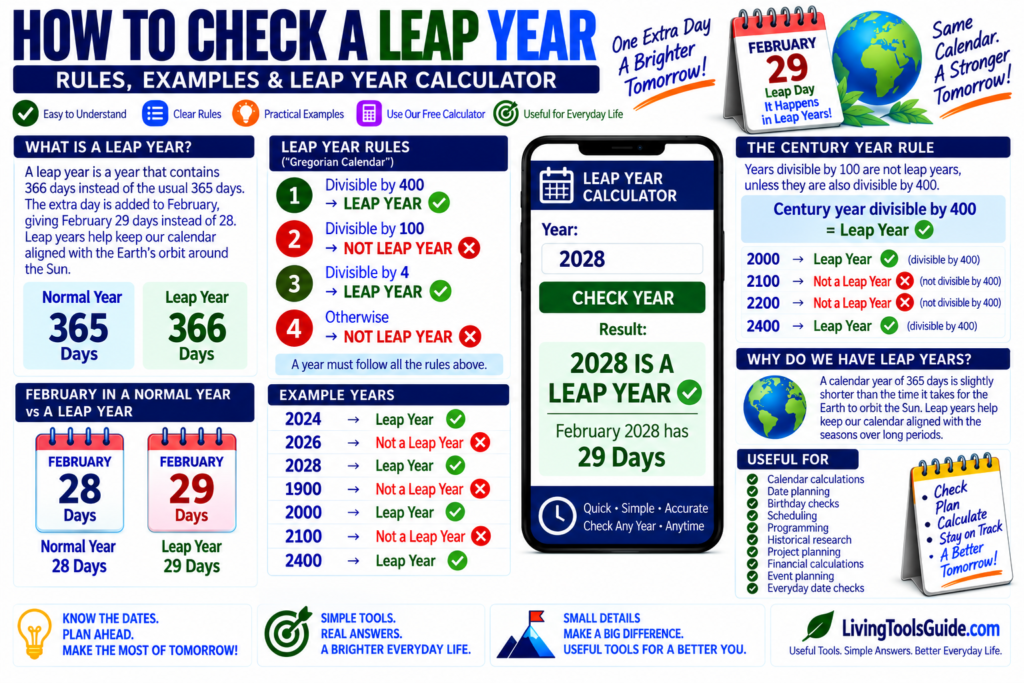
The Leap Year Calculator helps you quickly check whether any year is a leap year or a common year.
A leap year is a year that contains 366 days instead of the usual 365 days. The extra day is added to February, giving February 29 days instead of 28.
Leap years are important because the calendar year does not perfectly match the time associated with Earth’s orbit around the Sun. Adding an extra day periodically helps keep our calendar aligned with the seasons.
Checking whether a year is a leap year is usually simple, but there is an important exception for century years.
What Is a Leap Year?
A normal year contains:
365 days
A leap year contains:
366 days
During a normal year:
February = 28 days
During a leap year:
February = 29 days
The additional day is called Leap Day and occurs on February 29.
What Are the Leap Year Rules?
The Gregorian calendar uses three main rules to determine whether a year is a leap year.
Rule 1: Divisible by 4
If a year is divisible by 4, it is usually a leap year.
For example:
2024 ÷ 4 = 506
Therefore:
2024 is a leap year.
Rule 2: Divisible by 100
If the year is divisible by 100, it is normally not a leap year.
For example:
2100 ÷ 100 = 21
Although 2100 is divisible by 4, it is also divisible by 100.
Therefore:
2100 is not a leap year.
Rule 3: Divisible by 400
There is an exception to the century rule.
If a year is divisible by 400, it is a leap year.
For example:
2000 ÷ 400 = 5
Therefore:
2000 is a leap year.
For authoritative information about calendars and leap years, see the U.S. Naval Observatory’s calendar resources.
Leap Year Formula
You can summarize the rules like this:
If divisible by 400 → Leap Year
Otherwise, if divisible by 100 → Not a Leap Year
Otherwise, if divisible by 4 → Leap Year
Otherwise → Not a Leap Year
This rule correctly handles ordinary years and century years.
Leap Year Examples
Here are some useful examples:
2020 — Leap Year ✅
2024 — Leap Year ✅
2025 — Not a Leap Year ❌
2026 — Not a Leap Year ❌
2028 — Leap Year ✅
2032 — Leap Year ✅
1900 — Not a Leap Year ❌
2000 — Leap Year ✅
2100 — Not a Leap Year ❌
2400 — Leap Year ✅
Example: Is 2028 a Leap Year?
Step 1: Check Divisibility by 4
2028 ÷ 4 = 507
2028 is divisible by 4.
Step 2: Check the Century Rule
2028 is not divisible by 100.
Therefore:
2028 is a Leap Year ✅
February 2028 has:
29 days
and the entire year contains:
366 days
Example: Is 2100 a Leap Year?
2100 is divisible by 4.
However:
2100 ÷ 100 = 21
So it is a century year.
Now check whether it is divisible by 400.
It is not.
Therefore:
2100 is NOT a Leap Year ❌
It contains:
365 days
Example: Is 2000 a Leap Year?
2000 is divisible by:
4
and:
100
But it is also divisible by:
400
Therefore:
2000 is a Leap Year ✅
This example demonstrates why checking only whether a year is divisible by 4 is not always enough.
Why Do We Have Leap Years?
A year of exactly 365 calendar days is slightly shorter than the time associated with Earth’s orbit around the Sun.
Without calendar adjustments, this small difference would accumulate over time.
The Gregorian calendar therefore uses leap years to keep calendar dates more closely aligned with the seasons.
How Often Does a Leap Year Occur?
Leap years usually occur every four years.
For example:
2020 → 2024 → 2028 → 2032
However, century years create exceptions.
For example:
1900 — Not a Leap Year
2000 — Leap Year
2100 — Not a Leap Year
This is why the complete leap-year rule is more accurate than simply saying “every four years.”
Why Does February Get the Extra Day?
February normally has 28 days, making it the shortest month of the year.
During a leap year, one additional day is added:
February 29
This produces:
February = 29 days
and:
Leap Year = 366 days
Use Our Free Leap Year Calculator
You can use the free Leap Year Calculator on LivingToolsGuide to quickly check whether any year is a leap year.
Simply enter the year, and the calculator determines whether it meets the Gregorian leap-year rules.
This is especially useful when checking century years such as 1900, 2000, 2100, or 2400, where the simple “divisible by 4” rule is not enough.
Where Is a Leap Year Calculator Useful?
A leap year calculator can be useful for:
- Calendar calculations
- Date calculations
- Birthday planning
- Scheduling
- Programming
- Historical research
- Project planning
- Financial date calculations
- Event planning
- Checking February dates
Frequently Asked Questions
Is 2024 a leap year?
Yes. 2024 is divisible by 4 and is not a century year, so it is a leap year.
Is 2026 a leap year?
No. 2026 is not divisible by 4, so it is not a leap year.
Is 2028 a leap year?
Yes. 2028 is a leap year and February 2028 contains 29 days.
Was 2000 a leap year?
Yes. Although 2000 is a century year, it is divisible by 400, so it was a leap year.
Will 2100 be a leap year?
No. Although 2100 is divisible by 100 and 4, it is not divisible by 400, so it will not be a leap year.
Final Thoughts
Checking a leap year becomes easy once you remember the complete rule:
Divisible by 400 → Leap Year
Divisible by 100 → Not a Leap Year
Divisible by 4 → Leap Year
Otherwise → Not a Leap Year
For a quick answer, use the free Leap Year Calculator on LivingToolsGuide.